
A slightly unconventional series post today because a) because it’s non-fiction and b) each book has a different author but bear with me because I have things to say about them.
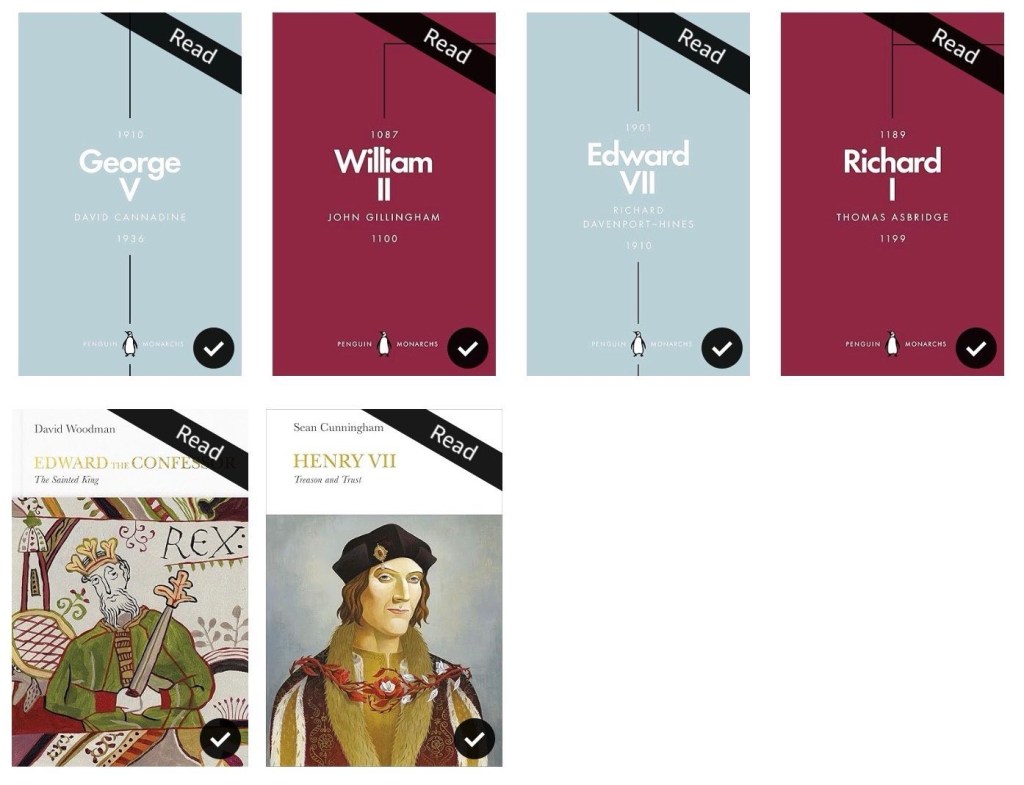
Penguin Monarchs are a series of 44 short biographies of British Monarchs intended to be digestible introductions to the lives of the ruler in question. All the ones that I have read are around 100 pages excluding bibliographies and illustrations – which takes them to around 120 pages all in. The first batch came out in hardback in 2014 – I know it was hardback because I went to an event in Westminster talking about one of them to march the release – but are now out in slim and quite stylish paperbacks that are very easy to get hold of in the shops.
Each is written by a different author, many of whom (particularly in the early days) are names you may recognise from writing popular history or biographies that you might spot in the bookshops – for example John Guy wrote Henry VIII, Philip Ziegler did George VI, Helen Castor did Elizabeth I and David Cannadine did George V. Others are written by renowned historians who hold prestigious jobs in academia who you might only have heard of if you are reading academic history books or journals.
At this point I have read eight of the series, covering both monarchs whose reign I am familiar with and those who I am less au fait on. And if you’re wondering the stuff that I’m less good on is basically everything before the early modern era. When I studied history at university my department had split history into five periods and you had to do a variety of different periods. I made strenuous efforts to stick to period 3 onwards – which meant that managed to stick to modules from the 12th century onwards and helped by the fact that I was doing French as well and had to do my dissertation on French history, to mostly be post 1700. And my historical reading these days mostly sticks to The Wars of the Roses onwards. So when I read the books on Edward the Confessor, William I and Richard I, I was substantially out of my comfort zone in terms of background knowledge.
What I do really like about all of them is that they have great bibliographies and further reading lists at the back – so if you want to go and read more on a particular aspect of the story you can or if you want to see how much of the research material that you have already read that’s also an option. It also usually comes with a commentary about what to watch out for while reading it which I appreciate too especially if they come with a side of historian snark. For example in Piers Brendon’s further reading to Edward VIII you have “Michael Bloch was [also] a clear partisan of the Windsors but his volumes contain rich deposits of original material” and “William Shawcross’s official life of Edward’s sister-in-law, Queen Elizabeth The Queen Mother (London: Macmillan, 2009) is extremely long and full of inside information. But it omits almost everything to its subject’s discredit, succumbing to the prevailing weakness of royal historical biographies – retrospective sycophancy.” Burn!
And so to my conclusions: for the monarchs that I was knowledgable about, I found them interesting summations of the lives and reigns and I enjoyed seeing which threads of the monarch’s life they thought were important enough to explore in the limited amount of space they have. For the monarchs that I wasn’t as familiar with it was a different experience because for one or two certainly I didn’t think the narrative of the events of the life was clear enough for the casual reader (if you can call me casual) but that comes with the proviso that history pre 1200 is really hard because it’s so dependent on chronicles – some of which are not contemporaneous – and interpreting what their biases might be and what is real and what’s not. All of which is to say that it can be complicated guesswork on an era and a mindset that are incredibly different to anything we are familiar with now.
Have a great weekend!


