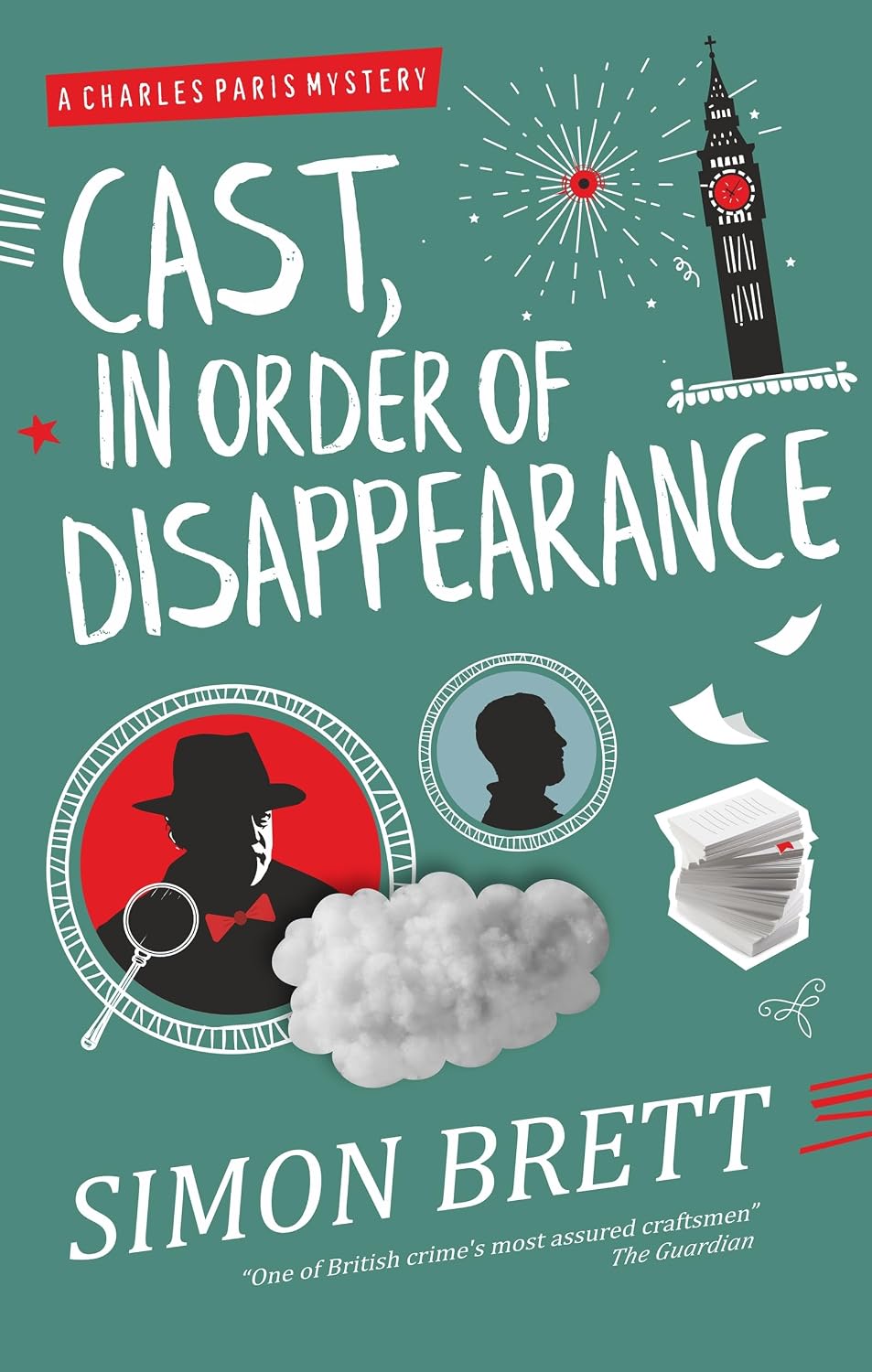
There was a new Fetherings book out yesterday (number 22 in the series) which makes today an ideal time to remind you about my favourite Simon Brett series – Charles Paris. Charles is a middle aged, probably alcoholic actor who just about manages to stay the right side of solvent by picking up odd acting jobs. You can find my original post about the series here – I first binged my way through them seven years ago and have re-read or re-listened to most of them since. There are 20 books in the series and if you do them all back to back you will notice that they started in the 1970s and that we’re still going and they’re now in the current day and Charles is still basically the same age, but don’t let that bother you. The floating now nature of the series means that Charles is always coming across new facets of the acting profession to get jobs in.
I sort of think that the series may be complete at this point because there hasn’t been a new book since 2018 – but given that there was a 15 year gap between books 17 and 18 that’s not a given. These are all in Kindle Unlimited – individually (all with fresh covers since I first read them!) and a six book omnibus edition of the start of the series – and there are also audiobooks read by the author, and radio dramas (lightly adapted to bring them all into the present-ish) day starting Bill Nighy as Charles.
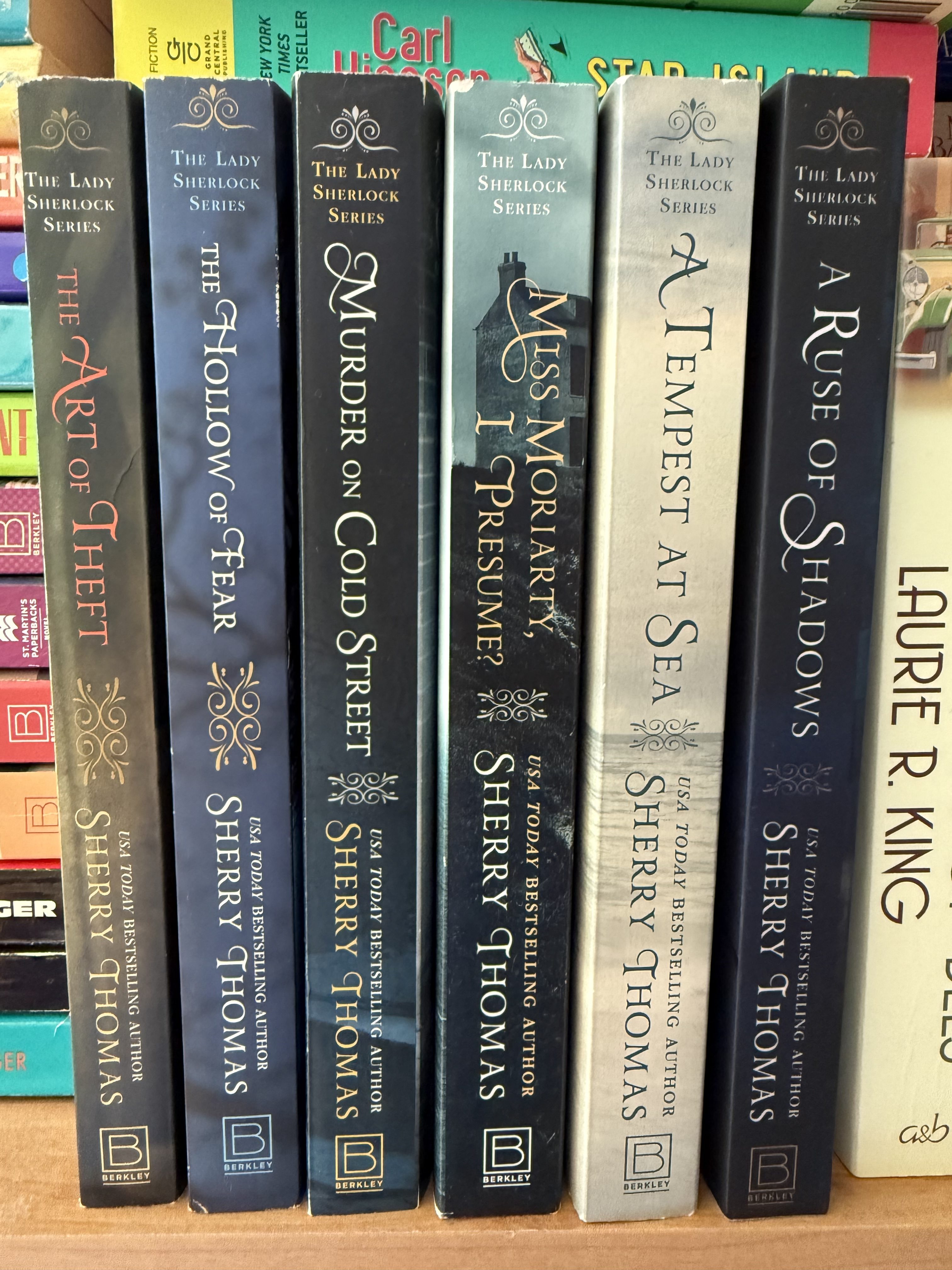
It’s been two years since the eighth Lady Sherlock book but this week book 9, The Vanished Sister has come out. In the interim Sherry Thomas has written a contemporary thriller called The Librarians (which I still haven’t read) but she’s now come back to her series about Charlotte Holmes. I’ve written a Series I Love post about this series before, but as a reminder, the set up here is that Sherlock Holmes is the alter-ego of Charlotte Holmes in order to circumvent the restrictions of being female in Victorian England. And because it’s inspired by the original books there are lots of nods back to those books.
The last couple of books have become increasingly interlinked as Charlotte investigates Moriarty’s network – and when I read book eight a few weeks back I wished I’d re-read book seven first to remind me of how everything was left in that because there was so much building on the previous book(s) – but looking at the early reviews of The Vanished Sister it looks like it might be more standalone, which would be a really good thing. The blurb says that Charlotte and co are on holiday in Devon when Mrs Watson’s estranged sister Mrs Carstairs invites her to a house party and then disappears. A body is found, but Mr Carstairs insists that the body cannot be his wife – despite the fact that it matches her physical description. So what has happened? Why did Mrs Carstairs want a reconciliation? Who is the real Mrs Carstairs and was she actually trying to get the attention of Sherlock Holmes all along?
My interest in this book has increased at the idea that it is a standalone, but (and here’s my little moan) but don’t expect me to read this any time soon because I suspect this is going to be really hard to get hold of in the UK in paperback. As you can see from the photo, I’ve been buying the paperbacks since book three and I would like to carry on doing that – not least because the kindle prices for this series are often higher than my kindle purchase limit. But when I read book eight I realised that it wasn’t a US import like the others, but a print on demand version of the US book. You can’t tell from looking at the spine – but from the top you can see the paper is different and when you’re reading it it’s heavier and generally just less comfortable to read than a normal paperback. And I find that really annoying. As of time of writing, Amazon has separate pages (ie not linked editions) for the Kindle and paperback versions of this book and wants more than £30 for the paperback which suggests there’s something weird going on. So I’m moderating my expectations for if (ever) I will be able to get hold of an actual copy of this one. But if you’re in the US that’s not going to be a problem for you. And if you haven’t tried the series before, you may be able to start with this one without being as lost as you would have been if you started with the previous one.
Given that the new Willow Creek book came out yesterday, I thought it would make sense to do an if you like that try this type series post today, so I had a think and also took to trawling the “readers also liked” section of goodreads for each book. And a couple of authors kept coming up over and over again – one of which was Olivia Dade and it got me to thinking that although I’ve written about some of her books, one thing I haven’t done is write about her There’s Something About Marysburg series of small town romances.
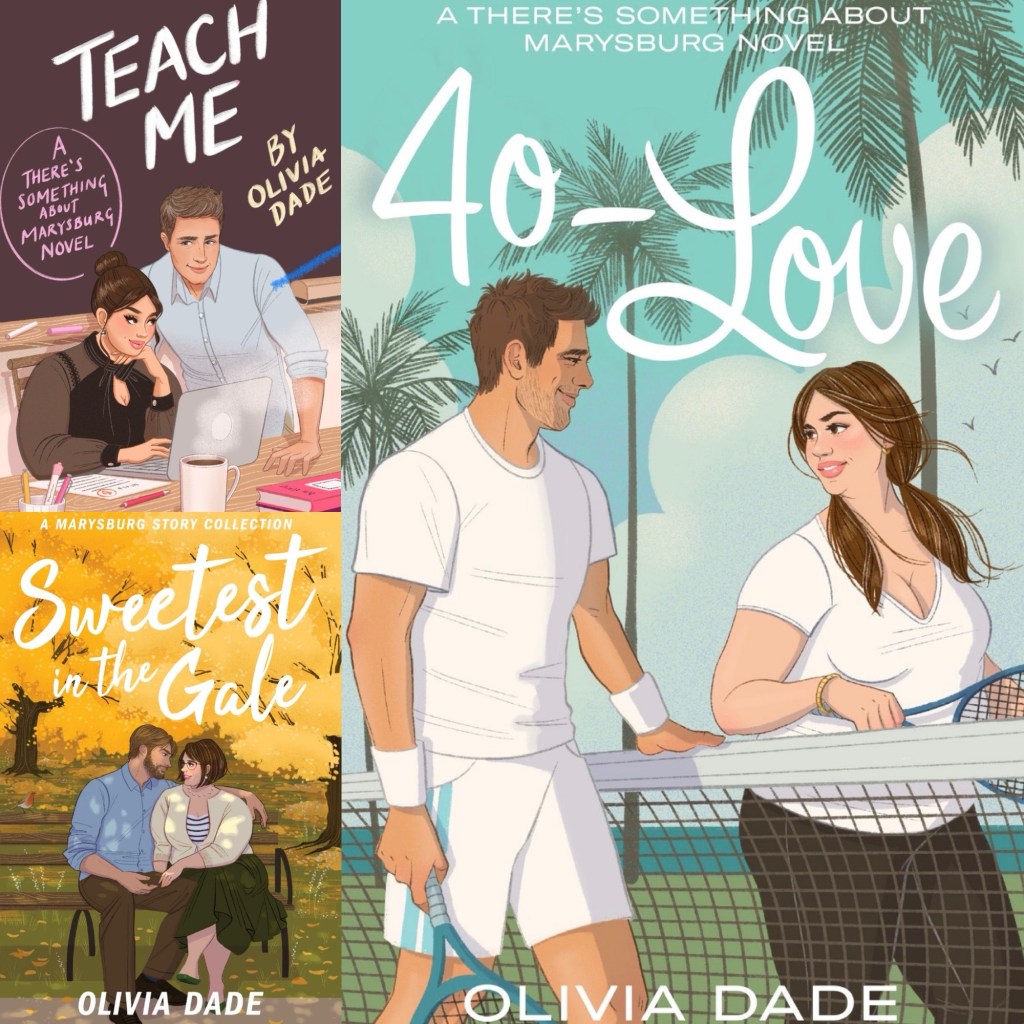
We have three books here: Teach Me, 40-Love and Sweetest in the Gale. They’re linked together by the fact that they’re linked by the town’s High School. And basically the theme of this series could be: No Stupid Drama. There’s no high stakes/high adrenaline stuff here, just a group of slightly older (as in 30-something or 40 soemthing) characters finding love.
Teach Me is a lovely romance between a newly divorced Dad and the teacher whose world history class he’s unwittingly stolen. Rose has reasons why she doesn’t trust people and why she won’t let people in. Martin has issues around his self worth. But there’s no big misunderstanding that could (should?) be resolved by a simple conversation, it’s all about two people working out if they are right for each other beyond just chemistry, and then starting to negotiate life together. And it’s very, very romantic despite – Dade is proving you don’t necessarily need high stakes drama to make a satisfying romance.
40-Love was a Book of the week back in 2020 and was the first of this series I read (yes I read them out of order as per usual) and that’s about Tess, a feisty assistant principal and Lucas a flirty Swedish tennis pro almost fifteen years younger than her. They start a romance while she’s on holiday at the resort that he works at while he’s coming to terms with the premature end of his career on the pro-tour. But can the two of them breakdown their defences to find out if it could be more than just a holiday fling? I’m not usually an age gap romance person, but Lucas’s years on the tennis tour make him more sensible and mature than your normal late-twentysomething. As I said back then the conflict here entirely about is whether they’re going to work together when they get to know each other and get beyond the (just) the chemistry. Funny, flirty and sexy.
And finally Sweetest in the Gale is three linked novella length romances set in Marysburgh – two in the school, one with an ex-teacher – and three different tropes. There’s a widowed teacher, an opposites attract and a marriage of convenience/friends to lovers. There’s something bittersweet in all of them and I really enjoyed them. So if you want something slightly lower profile than Dade’s Spoiler Alert series, with some small town vibes tht you also get from the Renn Faire books, then these might be your jam.
These are at the pricier end of the Kindle and Kobo range as I write this, but that’s probably the easiest way to find them as I don’t think i’ve ever seen them in stores. But if you do want cheaper Olivia Dade options The Spoiler Alert series and former BotW At First Spite are in Kindle Unlimited at the moment.
Happy Friday everyone, I’ve got a mystery series for you that has a fourth instalment that came out this week – and I’ve read all four this year so they’re even fresh in my mind!
The French Village mysteries are about Zoe, who moves to Provence to take over a bookshop in a hilltop village because she wants to spend her older years somewhere with books, good food and lovely scenery. The first book was a BotW back at the end of March and covers her arrival in Sainte-Catherine and a body that is found in the church. Initially the locals are hostile to Zoe but as the books have gone on she’s gathered a group of friends in the village who have become regular characters.
The second book, Murder at the Chateau is set in a dilapidated chateau where Zoe staying visiting an old friend when a death happens. In The French Market Murder we’re back in Sainte-Catherine where Zoe discovers a body in an abandoned house during a bank holiday weekend. And finally we have the new book The Vineyard Murder, where Zoe is helping her friend Marcel with his grape harvest when she discovers a body in among the vines when she is arriving in the early morning. But when she returns with the local police officer the body has disappeared. The reader knows that Zoe wasn’t wrong, but she doesn’t and carries on with the harvest and getting to know the other people who have come to work on the grape harvest who are a very mixed bunch to say the least. This has got surprisingly little murder in it until very late on, but there’s still a lot of mystery going on. I think Zoe’s inquisitiveness is at it’s most unattractive in this book – I’m not sure whether you would actually like her if you only read this book, but I did like the way it dug into the personalities and rivalries of the characters. Plus it has some Ngaio Marsh references and I’m a sucker for that because you all know how much I love Inspector Alleyn!
I really love Sainte-Catherine as a setting and the descriptions of the countryside and the lifestyle of Provence are really good. I also like that Zoe is an older protagonist. She’s not retired or as obviously old as the protagonists of the Thursday Murder Club or its imitators but she isn’t a naieve twenty-something and she has a past that influences here. As I mentioned in the BotW review of the first one there seems to be a link to an earlier Greg Mosse series which I am still trying to get around to reading. Book four suggests that there may some sort of romantic thread coming towards us if the series carries on, but I actually thing it probably needs ot have another book set somewhere away from Sainte-Catherine next because there’s a limit to how many murders one small hilltop village can have and still attract tourists! That said, Zoe is already feeling anxious about the number of bodies she’s discovering, so I’m not sure stumbling across them elsewhere is going to help her with that!
Anyway – these are a nice way of passing a few hours even if they will give you a yearning for some good French food! The first three are also in Kindle Unlimited so they’re very low risk if you’re in that scheme. They’re also available on Kobo.
Happy Friday everyone and for the third series post in a row I have a mystery series for you. After current (at the time it was written) with Imogen Quy last week and St Just before that this week (coincidentally both set in Cambridge) this week it’s a historical mystery series – not set in Cambridge!
These are called the Spector Locked Room mysteries, but I think it’s fair to say that Joseph Spector and the police detective who calls him in George Flint are equal leads in these locked room mystery stories. And every mystery may not be a literal locked room (although several are!) but they are so called ‘”impossible” crimes where it appears impossible for the deaths to have been carried out by a human or be anything other than suicides.
Now there are a fair few locked room mysteries in Agatha Christie (Murder of Roger Ackroyd, Mysterious Affair at Styles) but I would say that these are closer to John Dickson Carr’s books. Tom Mead has come up incredibly twisty solutions, that often require a fair degree of concentration to follow as they’re explained, which is not something I’ve ever found with Christie.
These are set in the 1930s – we’ve reached 1939 in this latest one – which firmly puts them in that inter-war Golden Age-esque category of historical mysteries. The other series that has a magician and a policeman working together is Elly Griffiths’ Brighton Mysteries – but those are all post world war two, and tend to be more focussed on Edgar (the policeman) not Max (the magician). The first book in this series, Death and the Conjuror was a BotW in July last year, but I think the fourth book in the series is the best/my favourite – it’s got a creepy mansion that can get cut off by the tide that attracts ghost hunters and people seeking contact with the spirit world.
The first three of these have been consistently in Kindle Unlimited since I started reading them last year, but the fourth one isn’t yet – I was wondering if it would go in when it came out in paperback but it didn’t – although I did pick it up when it was on sale. No news yet on whether there is a book five, but there are a couple of short story collections too that I haven’t had a chance to read yet.
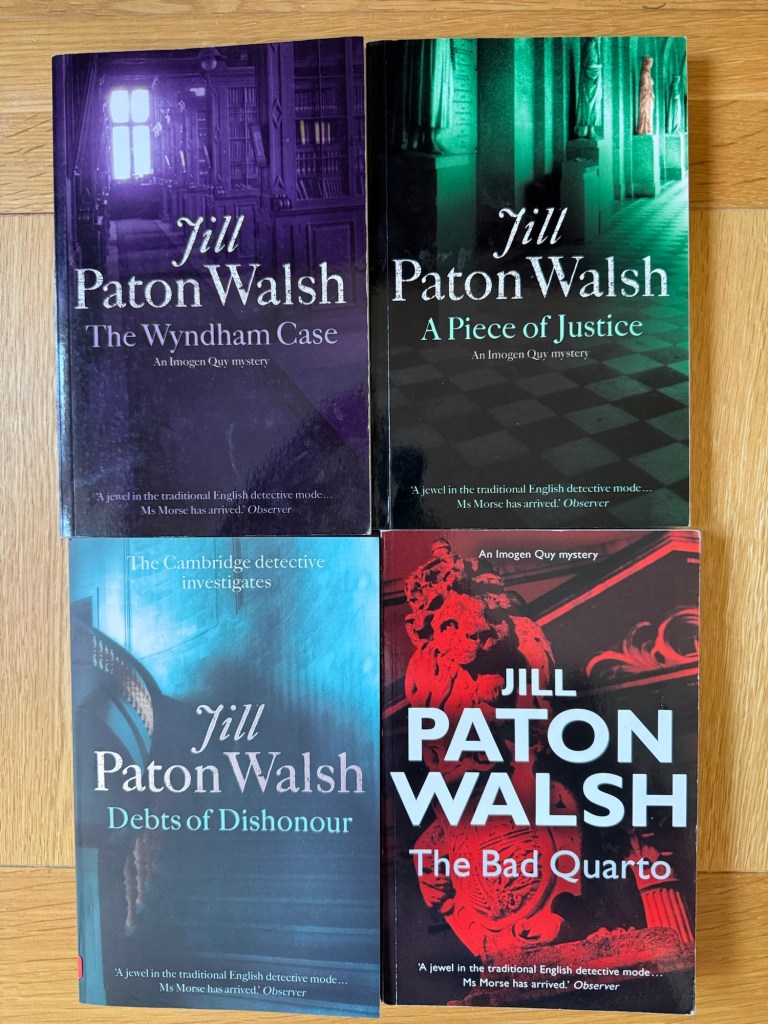
Happy Friday everyone and I’ve got a mystery series pick for you today – back in May I picked The Wyndham Case as a BotW and I enjoyed it so much that I immediately bought and binged the rest of the series and now a couple of months has elapsed and I feel it’s only fair I should tell you about the series.
Imogen Quy is the college nurse at the fictional St Agatha’s College, Cambridge. In fact she initially started training as a doctor but dropped out to move to America with her boyfriend – who was also training as a doctor and had got an opportunity over there. After he dumped her, she moved back and finished her training but this time as a nurse. Now she’s in her thirties and living in the house her parents left her in Cambridge, complete with a couple of lodgers (who change a bit from book to book) and across the four books stumbling across some mysteries.
As the college nurse, Imogen has a good reason to be called to look at a body when it’s found in college, and her role in college means that she sits outside both the students and academics of the college. She has a group of friends which includes some of her lodgers, some of the other people at the college and also a local policeman. The first mystery is connected to a historical book collection held by the college, the second is a half-written biography of a mathematician which seems to be burning through authors, the third is about the death of a prospective benefactor to the college and the final book about the mysterious death of a college scholar who fell while attempting a spot of night climbing. All of them are well constructed and pretty clever – and you can draw your own conclusions about how much I liked them based on how quickly I read them!
As I said in my review of The Wyndham Case, I had been wanting to read the Imogen Quy series since I first read one of Jill Paton Walsh’s Wimsey continuations – in the introduction to the first one she writes about how inspired she was by Gaudy Night and so I wanted to see what she did with her own Oxbridge college mystery series. And I wasn’t disappointed. I didn’t like the final book quite as much as the others, but I would happily have read more if she had written them. Paton Walsh was a prolific author and also wrote novels for younger readers and more literary fiction. She wrote the first two in the early 1990s before she worked on Thrones, Dominations and alongside other things and then are sandwiched between A Presumption of Death and the third and fourth of her Wimsey/Vane novels as the last five books she published.
I picked all of these up second hand – but they’re also available on Kindle and if I hadn’t already started buying them and wanted the set (and as matching as possible!), I might have been tempted by the Kindle editions so I could read them quicker rather than waiting for the postman.
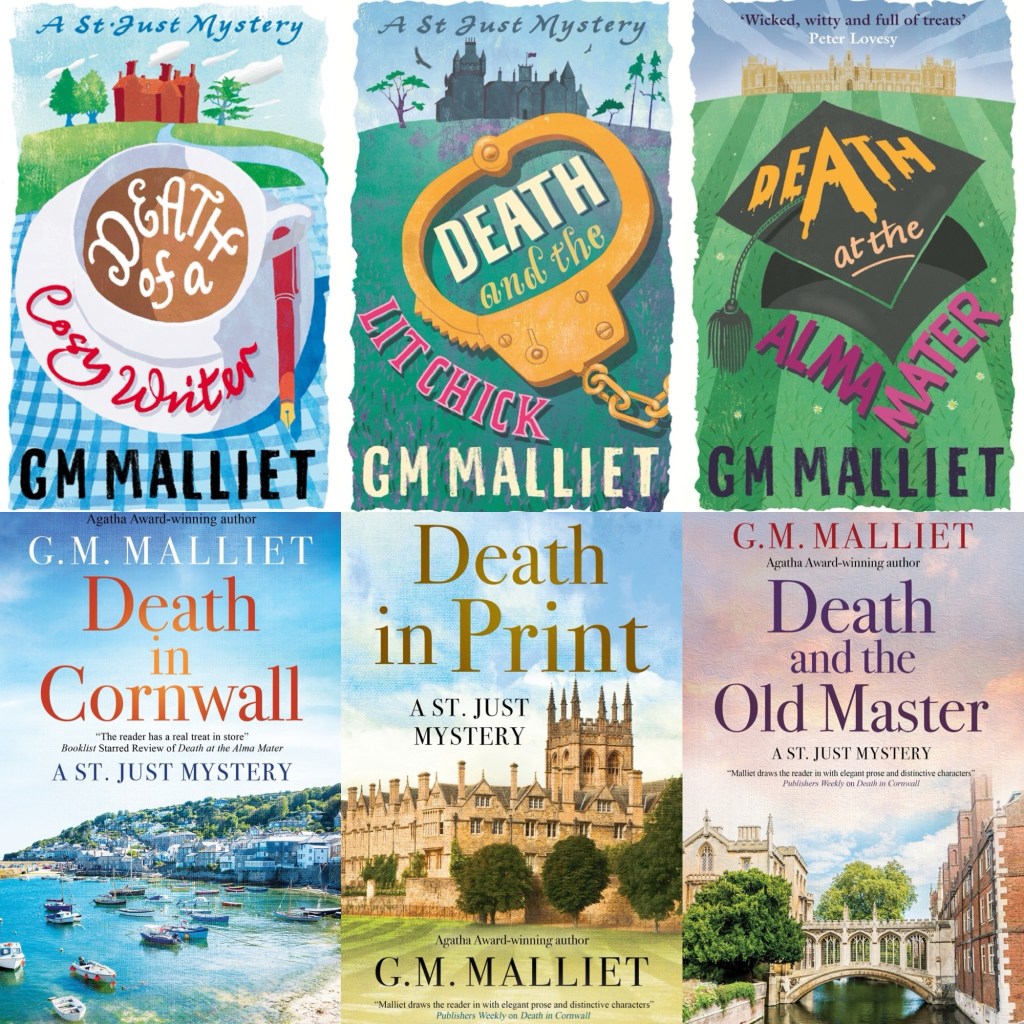
Happy Friday everyone and today for the series post I’m writing about G M Malliet’s St Just books. I’ve already written about her Max Tudor series, most recently back when I did a spy-themed week a couple of months back. But this week I finished the last book in the series I hadn’t read (reading severely out of order!) and so now I can tell you about then.
Our detective is Arthur St Just, a police Detective Chief Inspector and the crimes are Christie or Golden age-esque. Many of them are set around rich families, authors or Oxbridge colleges, or some combination of the above. St Just is from Cornwall but primarily based in Cambridge but Oxford also makes an appearance or two. St Just is a widower but does acquire a fiancée later in the series for some continuity of running characters as well as the fact that is it even a mystery series without a love interest?
It is very much a series of two halves as there was a decade or so gap (and a change of publishers) between book three and book four, and in fact I hadn’t realised that the series had restarted until I saw Death and the Final Cut on NetGalley last autumn. I read that then and now I’ve filled in the gaps with books four to six. And I’m pretty sure I’ve enjoyed these later ones more than I liked the earlier ones. My reviews of those on Goodreads from around a decade or so ago (I read them after having already started on the Max Tudors) are short but very much in the ok to fine sort of area.
Books three to six are in Kindle Unlimited at the moment and I actually think these are a pretty good place to start or at least test out series. They all have interesting characters, but the earlier books are more in the dislikeable mode than the later ones, and three to six particularly have good pacing and interesting mysteries. Seven isn’t quite as good, but it clearly wasn’t enough to put me off going back for the rest when I got a chance or to make a note to keep an eye for any more appearing.
Happy Friday everyone. If all goes to plan I should be on my way to Book Con at the moment, so in honour of a long weekend of bookish delights focused on literature for school girls in the twentieth century I’ve got a Girl’s Own boarding school series for you this week.
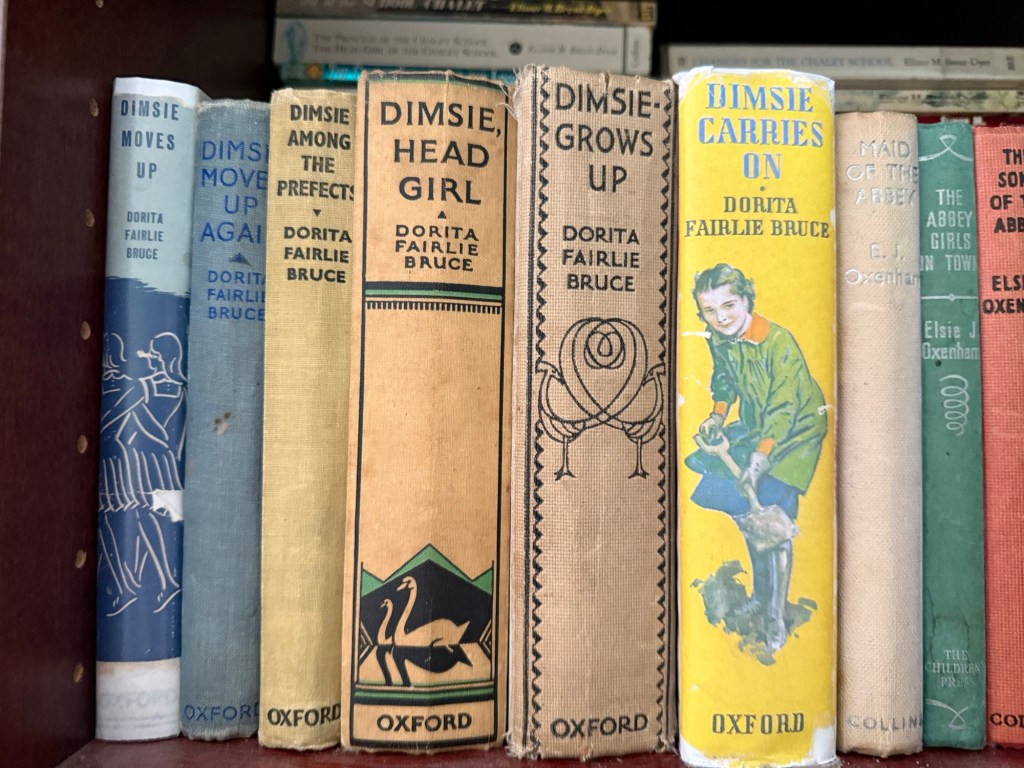
Dimsie is Daphne Isobel Maitland and she is the heroine of nine stories – seven set at her school, The Jane Willard Foundation, and two at her family home. As you can see from the photo I’ve read six of the and the missing ones are on my purchase list for conference this weekend. The name Dimsie comes from her initials D I M in case you hadn’t realised and the books follow her from her first year at the school all the way through to her final year as Head Girl. There were originally seven books in the series, but the final two were written in response to reader requests and the final one is actual set during World War Two when Dimsie is married. They were published across a 20 year period starting in 1921, and as was often the case with school series in this era there were also short stories published in various annuals.
Dorita Fairlie Bruce is one of the names when it comes to Girl’s Own boarding school books for girls along with Angela Brazil, Elinor M Brent Dyer (Chalet School), Elsie Oxenham (the Abbey books) and depending on your point of view Enid Blyton. The Chalet School will always be my favourite (and in writing this I’ve astonishingly realised that I’ve never written a proper series post about them so I must rectify that at some point) because those are the ones that were still in print when I was little and so were the ones I could get hold of from the library or buy for myself (see also Drina and Sadlers Wells) but DFB is my favourite of the ohers, all of which I first read as an adult, which is obviously a different experience to when you’re seven or eight and you first come across the idea of a boarding school.
I wrote about Dimsie, Head Girl back when I first read that and it’s fair to say that Dimsie is, like many other a boarding school heroine, a girl that somehow manages to get away with things that others wouldn’t for: Reasons. Dimsie is able to talk to prefects on their level when she’s a junior and have conversations with teachers (and the head!) that others wouldn’t be able to get away with. And yet you still like her. She’s a good friend, she’s not annoyingly smart or talented, and she cares about people. The thing you will have heard of from Dimsie (if you have heard of anything that is) is the Anti-Soppists League – which is Dimsie and her friends in league to not to go soppy over senior pupils or teachers or anyone. And the books follow the usual rules of boarding school – inter pupil drama, trouble with the juniors, trouble with a pupil who isn’t quite undertanding the rules of the school or is out for herself not the group, sports rivalries and illnesses, with the odd exceptional event thrown in – which are where they can be a bit bonkers. The Chalet School has handy mountains and lakes (and Nazis) to provide opportunities for drama, but being set in Britain, DFB has had to come up with her own ideas – which include stolen old masters and secret passages.
As ever there are some old fashioned stereotypes and language that isn’t acceptable today in here which means that I won’t be lending them to the young readers in my life, but they’re also unintentionally hilarious at times and I find them really really readable. This is another day when its not so much a suggestion to read if you’re not already interested in this sort of book, but if you are you really should try one. They’re miles better (to my mind) than Elsie Oxenham! Fingers crossed that I can lay my hands on the missing ones in the book sale.
A slightly unconventional series post today because a) because it’s non-fiction and b) each book has a different author but bear with me because I have things to say about them.
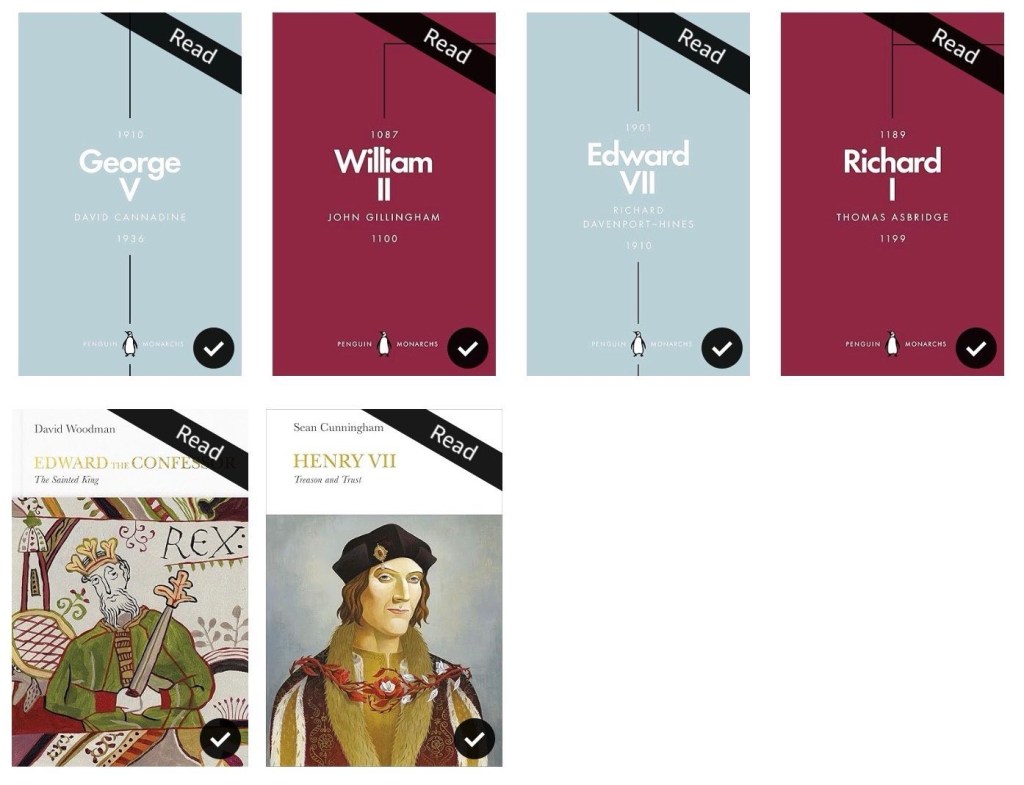
Penguin Monarchs are a series of 44 short biographies of British Monarchs intended to be digestible introductions to the lives of the ruler in question. All the ones that I have read are around 100 pages excluding bibliographies and illustrations – which takes them to around 120 pages all in. The first batch came out in hardback in 2014 – I know it was hardback because I went to an event in Westminster talking about one of them to march the release – but are now out in slim and quite stylish paperbacks that are very easy to get hold of in the shops.
Each is written by a different author, many of whom (particularly in the early days) are names you may recognise from writing popular history or biographies that you might spot in the bookshops – for example John Guy wrote Henry VIII, Philip Ziegler did George VI, Helen Castor did Elizabeth I and David Cannadine did George V. Others are written by renowned historians who hold prestigious jobs in academia who you might only have heard of if you are reading academic history books or journals.
At this point I have read eight of the series, covering both monarchs whose reign I am familiar with and those who I am less au fait on. And if you’re wondering the stuff that I’m less good on is basically everything before the early modern era. When I studied history at university my department had split history into five periods and you had to do a variety of different periods. I made strenuous efforts to stick to period 3 onwards – which meant that managed to stick to modules from the 12th century onwards and helped by the fact that I was doing French as well and had to do my dissertation on French history, to mostly be post 1700. And my historical reading these days mostly sticks to The Wars of the Roses onwards. So when I read the books on Edward the Confessor, William I and Richard I, I was substantially out of my comfort zone in terms of background knowledge.
What I do really like about all of them is that they have great bibliographies and further reading lists at the back – so if you want to go and read more on a particular aspect of the story you can or if you want to see how much of the research material that you have already read that’s also an option. It also usually comes with a commentary about what to watch out for while reading it which I appreciate too especially if they come with a side of historian snark. For example in Piers Brendon’s further reading to Edward VIII you have “Michael Bloch was [also] a clear partisan of the Windsors but his volumes contain rich deposits of original material” and “William Shawcross’s official life of Edward’s sister-in-law, Queen Elizabeth The Queen Mother (London: Macmillan, 2009) is extremely long and full of inside information. But it omits almost everything to its subject’s discredit, succumbing to the prevailing weakness of royal historical biographies – retrospective sycophancy.” Burn!
And so to my conclusions: for the monarchs that I was knowledgable about, I found them interesting summations of the lives and reigns and I enjoyed seeing which threads of the monarch’s life they thought were important enough to explore in the limited amount of space they have. For the monarchs that I wasn’t as familiar with it was a different experience because for one or two certainly I didn’t think the narrative of the events of the life was clear enough for the casual reader (if you can call me casual) but that comes with the proviso that history pre 1200 is really hard because it’s so dependent on chronicles – some of which are not contemporaneous – and interpreting what their biases might be and what is real and what’s not. All of which is to say that it can be complicated guesswork on an era and a mindset that are incredibly different to anything we are familiar with now.
It’s Friday and it’s Pride month so I’ve got a romance series that fits the brief for you. I was going to say trilogy because there are three of them, but I think trilogy suggests that they have to be read in order or together, but you don’t – they’re linked by a friendship group but you don’t need to have read the previous one to enjoy the next on. In fact I read the first one last and it bothered me not a whit on that front.
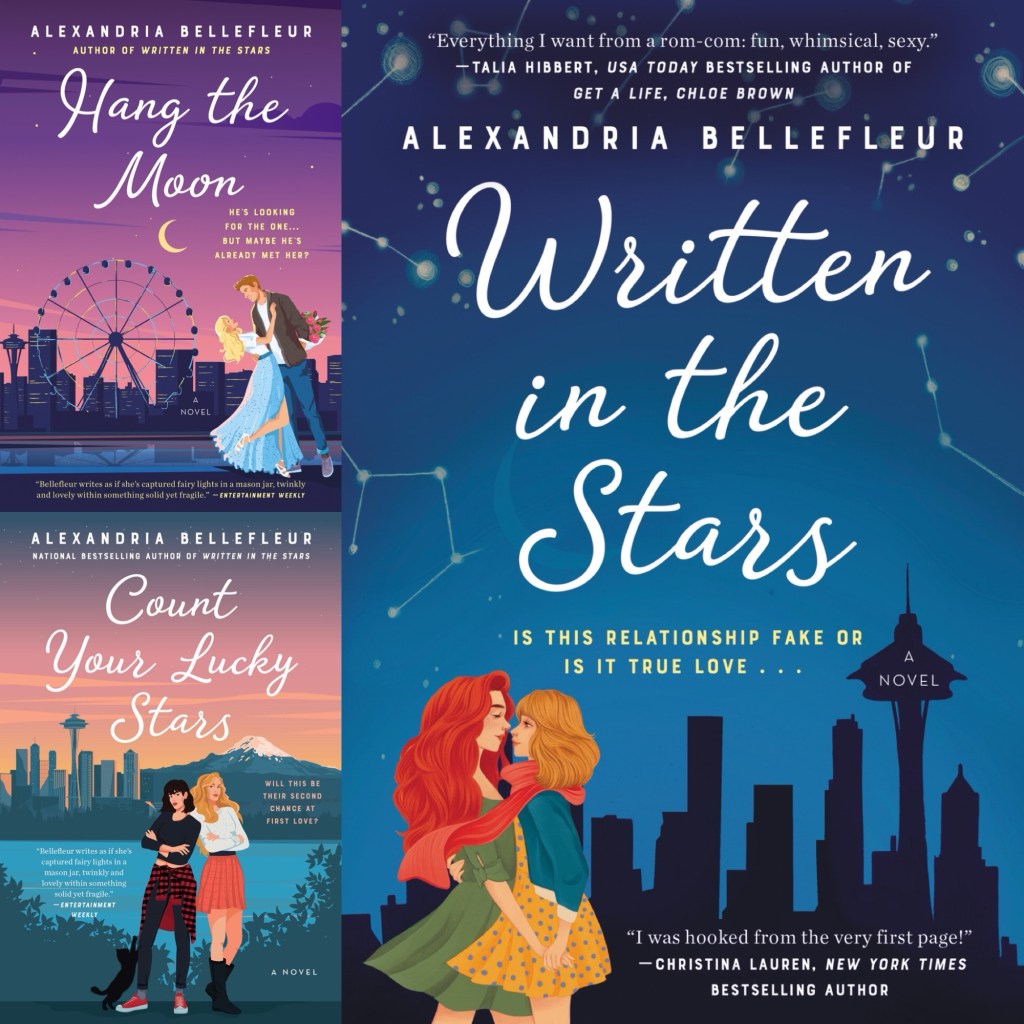
This is a series of three connected romances set in Seattle. The first one is Written in the Stars about an astrologer and an actuary who end up in a fake relationship for: reasons – Elle is looking for the one and Darcy isn’t looking for anything after a broken engagement. The second book is Hang the Moon and features Darcy’s brother Brendan who is a side character in the first book and Annie who is in town to visit friends before she moves around the world. And finally Count Your Lucky Stars is Elle’s best friend and business partner Margot and her former best friend and first love Olivia.
These are fun romances with interesting characters and witty dialogue. I like them rather than love them – mostly because a lot of the conflict could be solved by people using their words and having conversations. But that’s a common gripe for me and honestly I’d often rather have misunderstandings based on not communicating, which is pretty low stakes over some of the Big Dramatic things and definitely over Creepy Danger ones! I’ve actually got one of Alexandria Bellefleur’s standalone novels waiting on the virtual TBR which I really should get around to before I acquire any more and she has two more books coming out this year as well, including a second paranormal romance.
The good news if you want to read these sis that book one and book three are in Kindle Unlimited and Kobo Plus at the moment and although the middle one isn’t, it’s still only £1.99. I think my favourite is book three – but I wouldn’t swear to it!