Happy Friday everyone, and it’s another mystery series today, but this one aimed at middle grade readers. And I do love a good middle grade book. And sometimes a bad one if you look at some of the terrible lesser known Girl’s Own books I’ve read over the years!
So the Taylor and Rose series is the follow on to Katherine Woodfine’s Sinclair Mysteries and features the same main characters, Sophie and Lillian, who are running a detective agency but also doing work on the side for the secret service agency. It’s in the years running up to (but not reaching) the First World War and the overarching plot that runs across the series is around a shadowy organisation who are trying to disrupt the world order and even maybe start a way by sowing discord between nations. Thus means there is plenty of scope for international travel as you can see from the titles of the books.
I really enjoyed the original series and this is a great continuation, that widens the world out and feels like it’s for slightly older readers in the same way that the main characters are slightly older. These are adventure capers more than mysteries and probably do need to read these in order to get the most out of them because of the over arching storyline with the secret society. I read the first two a couple of years ago and the last two over the last month or so and it worked really well.
You should be able to get these really easily in bookshops with children’s sections – and the first one (or even the set!) would make a great Christmas book for the 10-12 year old in your life.
Happy Tuesday everyone and I hope that those of you who had a bank holiday yesterday had an excellent day. This week’s pick is a nostalgic trip down memory lane for me, because I read several of the Wombles books when I was at primary school, so when I saw this in the same edition as the school library had at a book sale a few months ago, I snapped it up.
This is the third book in the series of children’s books about the Wombles, furry animals who live in burrows and clean up the mess that humans leave behind them. In The Wombles at Work, they are living in Hyde Park after being forced to move from Wimbledon Common. The overarching framing device for the book is that the Wombles are competing to come up with the best ways to fight pollution. Within that, the different strands of the plot sees the different Wombles trying to solve the various problems that they come across. So for example Tomsk saves a swan from choking to death on a net, a music festival takes place in the park and leaves lots of rubbish behind it, Madame Cholet is struggling with restrictions on how long she can have her stove on every day because the cooking can be smelt above ground and there are mysterious notes being left for the burrow.
When I bough this I wasn’t sure if this was one of the ones that I had already read or not, but in reading it, I realised that I hadn’t and that was also a delightful treat. I went off and had a look at the book summaries and I have definitely read the previous book where the Wombles had to move form Hyde Park, and fifth book the Wombles around the World where some of the burrow are sent around the world to find out more about other countries and other Wombles. I think I’ve read the book where they move back to Wimbledon common, but I’m not 100% sure. And I have the audiobook of the first one too because it’s read by Bernard Cribbins, which I listened to years ago and now want to listen to again! It’s easy to think that the problem of pollution and people wanting to care for the environment is a new thing, but when you go back and read the Wombles books – written in about eight years from the late 1960s through the 1970s, you realise that things really haven’t changed a lot. All of which means I think it would still be a great story to read as a middle grader today, even if the references to the Old Queen are more likely to be read as references to Elizabeth II rather than Victoria!
These were out of print for years and years which may explain that – my school library was the only place I ever remember seeing these and I’ve never come across them anywhere else before, and I suspect they may still be hard to find in the shops but they are at least on Kindle now.
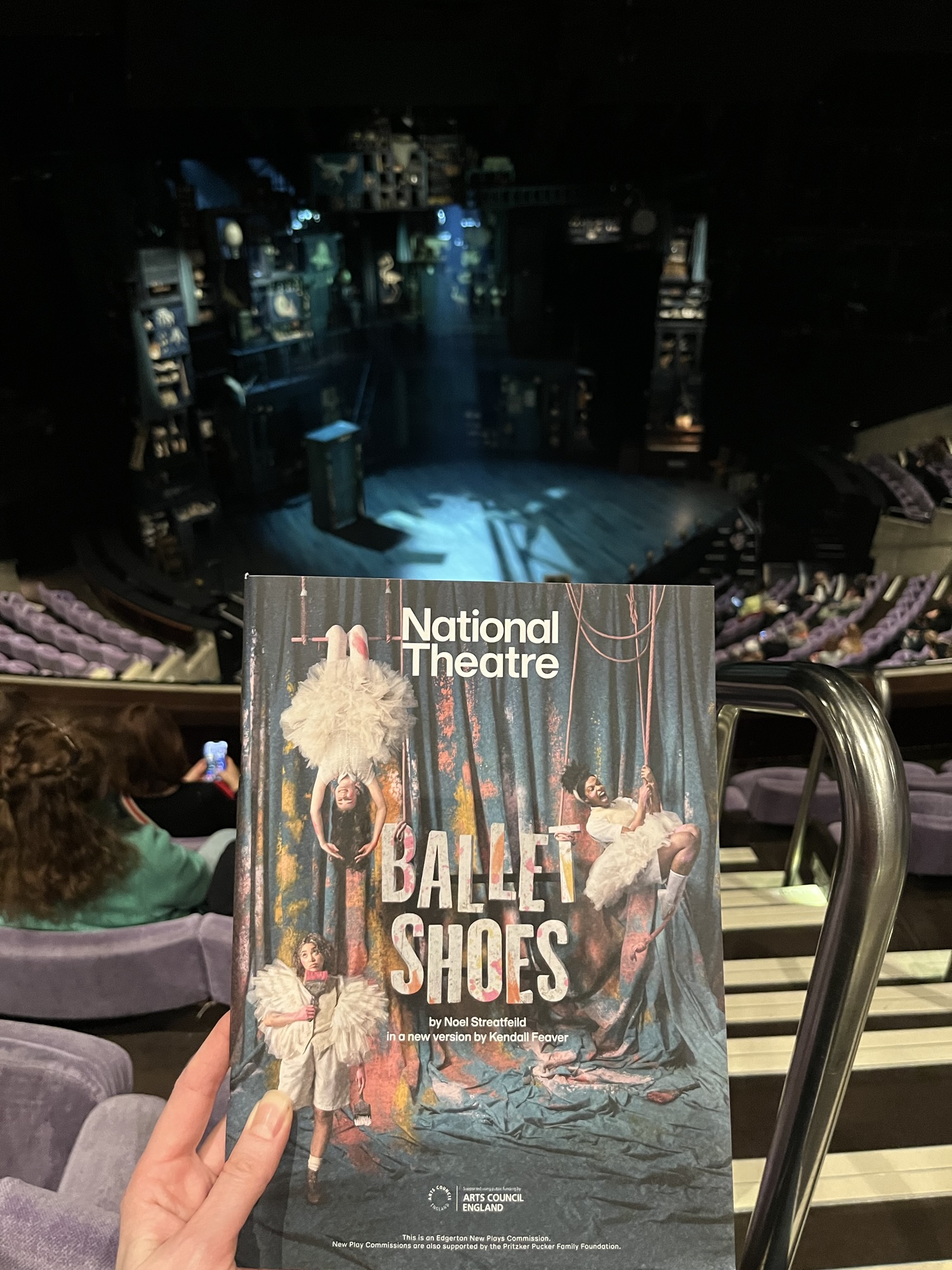
Ballet Shoes is a new adaptation of the beloved children’s novel (and one of my favourites) by Noel Streatfeild. The book tells the story of three sisters – Pauline, Petrova and Posy – who are adopted by an eccentric traveller who brings them home to his great niece Sylvia and her former Nanny, Nana. They live in Gum’s (Great Uncle Matthew) house in London while he is away, but after he fails to return from an expedition, their money starts to run out and the household starts to take in boarders to make ends meet. These include (fortuitously) a pair of tutors who take over the girls education when Sylvia can’t afford the school fees anymore, and a dance teacher who arranges for the girls to take classes at a theatre school. And thus begins the girls theatrical careers and another vitally needed income stream for the family.
This has been lightly modernised and a few bits of the plot have been simplified – for example the two tutors are down to one, it’s a single man with a car not a married couple and there are less plays that the girls are in – but it’s still very much the same story. Financial troubles and orphans are a staple of books from this era – for adults and children (see Miss Buncle and all the parentless girls at the Chalet School) but it’s also a found family with a sprinkling of showbiz glamour which is one of the reasons why the book still works today – and why it translates so well to the stage. There is comedy and tension and plenty of excuses for dancing and fun. It’s full of excellent performances, the set is beautiful and time just flew by. And the changes worked so well I found myself re-reading the original book this week to check that I wasn’t misremembering that it wasn’t always like that!
It’s only on for another two weeks – so if you’re in London and have a free evening it’s really worth trying to see it. I saw an understudy playing Sylvia – who was wonderful but I would happily use that as an excuse to go again and see Pearl Mackie play her, but I’m not sure I have an evening that works for it.
Ballet Shoes is at the Olivier at the National Theatre until February 22.
Yes, the list last week was huge, with lots of good stuff on it – but I have other plans for some of them. Yes, yes, yes, this is cheating because I finished this on Monday. No, I’m not really bothered that I’m breaking my own rules again because I’m jet lagged and I’ve caught something with a cough from the plane (no it’s not Covid, I did a test). So here we are with a rule breaking BotW pick, you’re welcome.
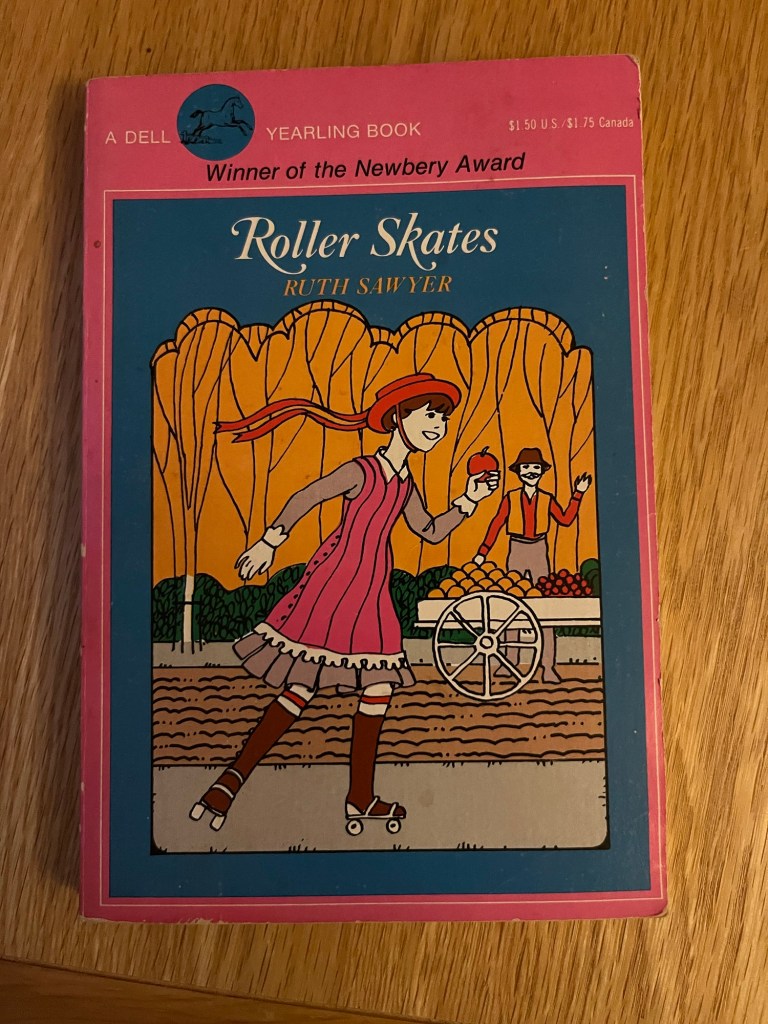
Roller Skates is a Newberry award winning children’s book, first published in 1936. Set somewhere in the 1890s, it tells the story of a year in the life of a little girl called Lucinda, who moves to New York to stay with two ladies while her parents are away in Europe. Lucinda has a greater degree of freedom while living in New York than she is used to at home, and as a result explores the city on her roller skates and makes a variety of friends along the way. Lucinda clearly comes from a fairly well-to-do background, but many of her friends do not, and she learns a lot about the way of the world from her adventures.
My love of children’s books from the first half of the twentieth century is sufficiently well known at this point – and this was one of my acquisitions from Book Con this year. And as is often the case in books of this age, there’s more death in Lucinda’s life than might be expected in a modern children’s book, but given my grandma’s stories about her childhood, nothing that wasn’t realistic. I haven’t read a lot of children’s books set in late nineteenth century urban America and that made this interesting even beyond the lovely writing. It’s hard to tell whether I would have loved it as a child the way that I did Lottie and Lisa – which was written about ten years later and which I used to borrow from the primary school library on the regular and obviously is the basis for one of my favourite Disney movies – but as an adult with an interest in the genre is an interesting one.
I’m not expecting many (any?!) of you to want to read this, but if you do, you’re going to have to pick it up second hand I’m afraid, but there are a few copies on Abebooks.
I mean who doesn’t watch Mary Poppins at Christmas right? Surely it’s not just me and my family? A roaring fire and a Sunday afternoon and Mary Poppins on the TV…
I mean this is an all time classic. The Banks children have scared away another nanny in their efforts to get their parents attention – their workaholic father is a banker, their mother a militant suffragette. In flies Mary Poppins, who will put the family back together through singing and dancing, chalk pavement pictures and chimney sweeps. Dick van Dyke’s cockney accent is legendary in all the wrong ways, but Julie Andrews is practically perfect in every way.
It’s well known how unhappy P L Travers was with the way Walt Disney changed her character from the original books, but for most people the movie version is all they know so it’s made that interpretation of Travers’ nanny immortal for better or worse. And for me it’s very much for better. I can sing all the songs (although many would ask me not to) and I could probably recite the script. I’ll be getting it out to watch again this Christmas. And if you want to find out more about P L Travers and the making of the film, there’s a movie version of that too – Saving Mr Banks.
If you want to watch Mary Poppins, it’s on Disney+, or it will be on TV at some point over Christmas for sure. And I’ve still got it on DVD…
As mentioned yesterday, very much a week on my sickbed last week with a lot of rereading going on, which left an interesting array of options for today – so I’ve setttled on a sort of re-read – I’ve read the abridged version of Chalet School Wins the Trick before, but never the original version, so here we are, another week another Girls Own pick! Apologies for the slightly gloomy/shadowy picture – it’s so overcast here you would not believe
The Chalet School Wins the Trick is number 46 in the series and in many ways could be considered Peak Chalet School Tropes. But I’ll come back to that. First, lets have the plot: Just before the start of term, Miss Dene catches a group of children trying to start a campfire in the middle of the school’s best cricket pitch. She sends them along their way – but the group swear they’ll get their revenge on the school. Thus the summer term is marked by a series of pranks pulled by the quintet affecting the pupils, the staff and ex pupils.
So if you were playing Elinor Brent Dyer Bingo, this would get you a full house. We have: Joey saves the day, Mary Lou Butts in, Joan Baker being “not the right type”, sick parents/relatives at the San where the children don’t know, very weird medical treatments (a scalded arm into a vat of flour), lots of unaccompanied Child Wandering, a fete, a death of (another) parent, women’s careers being thrown over because of housework and the all time great – a massive continuity fluff within the same book. I think the only thing its missing is Joey singing someone out of an illness/coma!
As with so many reviews of Girls Own stuff that I write, this is not a book that you can easily get hold of – and nor do I recommend you to, unless you’re already interested in the oevre. It was one of the rarer books – it is from 1961, so fairly late in the series and so it had less time to be reprinted than the earlier ones. And it is full of references to escapades in previous books, which might get tiresome if you haven’t read them. If you’ve never read a Chalet School book, you should probably start with Chalet School in Exile – which is probably EBD’s best book – grappling with how to deal with a British school in Austria as the Nazis swept through Europe and what women and girls could do about it. It’s not your normal school story. Other than that, you could always start at the beginning.
It’s been a couple of weeks of Girl’s Own type books, so I’ve no regrets about making another of them this week’s Book of the Week and carrying on the theme of theatres and dancing.
A Time to Dance is a standalone ballet career book about the first couple of terms of a newly established ballet school in the north of England. It follows a selection of the pupils as they study dance, help promote the school and try and work out if dancing is really what they want to do. It’s quite gentle and there’s no peril really at all – even less than usual in these books if anything, but I particular enjoyed the fact that it focussed on several of the girls and the different challenges they faced.
Most of the time in ballet books you have a school-age heroine who is convinced that she is destined to dance and that there is nothing she would rather do with her life. But this has a couple of older pupils who have left school are trying to balance learning to dance with jobs and the need for cash. And it’s got several girls who are studying even though ballet isn’t going to be their career. Of course it does have a desperate to dance or two too, but I appreciated the variety and the realism it added to the mix. This was written in the early 1960s and has a more modern feel to some of the other books – the potential distractions for the students include television adverts and modelling.
I haven’t read any Robina Beckles Willson before but this was charming. Goodreads only has this and a couple of picture books under her name, and I didn’t get a chance to look her up to see what else she might have written that hasn’t made it into Goodreads database!
I got my copy at one of the book sales at conference, but I suspect that most of you aren’t going to be interested enough in the genre to want to buy it! If you do, you’ll probably need a specialist bookseller or a lot of luck.
As it’s been a week of Girls Own content, lest carry it on with another classic children’s series – this time an adventure one for boys and girls.
In case you’re unfamiliar with the series, they follow a group of children going on outdoor adventures during the school holidays. There are three families – the Walkers (the Swallows), the Blacketts (the Amazons) and the Callums (the Ds) – who appear in various configurations across the series, but the opening books (which are my favourites) mostly centre on the Walkers and the Blacketts who start off as rivals but become friends. Sailing is often involved – and many of the books are set in and around the Lake District in the North West of England.
I first encountered the Swallows and the Amazons when my Year 3 teacher read the first book out loud to our class and I carried on reading most (if not all) of the rest of the series by borrowing them from my local library. What’s not to love about a group of children going off to camp on an island and sail around a lake all summer long. There’s “pirates” and actual crime and it’s just wonderful. Let’s be honest, which child didn’t wish they’d had a grown-up free holiday or two, or been allowed to roam around without supervision for days on end – I think it’s one of the reasons why Secret Island was one of my favourites of the Enid Blyton series when I was little.
I should say at this point that I am not by any means an outdoors person. We never went camping when I was a child, so when I was first reading these the idea sounded fun – I think I “camped” on the floor of my bedroom for a few weeks after reading the first book, but I was not a big walker or hiker. I also suffered from travel sickness so being on a boat of any size was always pretty awful, but I loved the books – and still continue to enjoy them whenever I get a chance for a re-read. There’s something about children with a secret code between themselves and who go on what are basically quests that just really appeals. Also you learn a lot about various countryside-y things from the mid 20th century – most of what I know about charcoal smoking and dowsing for water comes from this series – which of course means I’m hopelessly out of date, but I didn’t know that at the time.
There are a couple of books in the series that get a bit weird – and as with a lot of books of similar era, there are some bits that haven’t aged well. I probably should have had a reread before I posted this – but I remember that I found Missee Lee very weird when I read it when I was about 10. And I don’t own all of them – I have some from when I was little and I’m picking the others up as I see nice copies at sensible prices. But I do own the first two on audio book and have listened to their fairly regularly. I treated myself to Pigeon Post (my other childhood fave) the other week and it’s next on my to listen list.
The first book has been turned into a film twice – it’s been a while since I saw the original film, but I remember it as being fairly true to the actual plot. I have seen the most recent one has had a fair few alterations to the plot – and not just the fact that they renamed the unfortunate to modern ears Titty. I’ll leave you to judge for yourself from the trailers!
Anyway, delightful outdoors fun, even if pemmican – real or fake – sounds disgusting!
I am off to book conference this weekend, so in honour of all the fun I’ll be having, this week’s series I love post is a Girls Own one.
Lorna Hill’s Sadlers Wells series follows a series of young women as they embark upon careers in dancing. The first book, A Dream of Sadlers Wells was first published in 1950 and follows newly orphaned Veronica Weston as she tries to carry on learning ballet despite having moved to live with her cousins in Northumberland. The second book follows Veronica as she embarks upon her training at Sadlers Wells ballet school (now the Royal Ballet) and the other books in the series all follow girls who have a link to Veronica somehow.
Despire being clumsy and coordinated, I loved ballet books when I was a child and moved on to Sadlers wells after I had started on the Drina series – as both had reissues at about the right time for me. But the Sadlers Wells ones were harder to find – and didn’t go the whole way to the end of the series, so some of the later ones I’ve only read in the last five or so years. And the end of the series isn’t a good as the start, but the first half dozen or so are just great. Because they focus on different people you also get glimpses of your old favourites as you carry on. In fact a bit like romance series, some of them set up the next heroine in the previous book!
And where Drina is a city girl through and through, nervously learning to love the Chiltern when she’s sent to school there for a term, she is worried about getting injured and ruining her dance career (and she does indeed twist her ankle at one point) the women of the Wells books embrace the outdoors. Veronica, Caroline, Jane and Mariella romp around the countryside on their ponies, swim in lakes and clamber around the hills. They made me want to visit Northumberland – although not learn to ride a horse.
It’s only thinking about it as an adult that I realise that, like many Girls Own books of the era, they’re subtly quite subversive in their way. In the first two books, Veronica refuses to give up her ambitions of a dancing career in the face of various trials and tribulations – but also in the face of a potential love interest. Sebastian is a musical prodigy and in one quite awful speech when he’s trying to persuade Veronica not to go to London, he says that women don’t have to have careers and could (and maybe should) leave it to the men. But Veronica carries on – and gets the success and the love too. In the later books you can see her and Sebastian, married but she’s still dancing. And if they don’t do a very good of listening to their daughter Vicki, they don’t really do a worse job than any of the other parents in the book! But the message is there – girls don’t have to just grow up and get married, they can do things and have a career too.
Say hello to a slightly leas tidy bookshelf. The clue to this one is in the title. It’s a bit of a bits and bobs shelf. Along the front from left to right you can see some classic Girls Own with Angela Brazil, Elsie Oxenham and Dorita Fairlie Bruce. Then a couple of odd hardbacks – a Noel Streatfeild and a duplicate Sadlers Wells, followed by the Arthur Ransome selection. Then it’s a group of books I’ve had since I was a kid. The Lion, the Witch and the Wardrobe and the omnibus Prince Caspian and Dawn Treader are TV tie in editions that I got given for Christmas when I was about 8. The other Narnias are from the same era and so are the pile of books on top. The Beat series were one of the first crime books I read, I remember crying buckets when Paul the Chief Inspector and love interest was killed off – it was probably one of the first books with a main character death I read. Behind all these, which you can’t see are my original paperback Sadler’s Wells and all my original chalet School paper backs. I keep telling myself that I’ll have a rationalise and get rid of them, but I’m not sure I’ll be able to bring myself to. Also in the back is my set of early 90s Drina reprints which I know I’ll never be able to part with as they’re all tied into childhood holidays – as well as the fact I don’t have a hardback set of Drina *and* I’m fairly sure there isn’t a matching set of hardbacks that includes Drina, Ballerina…
Writing this and staring at the photo (and the shelf) has made me realise that I probably need to have a bit of a tidy up and organise – if book conference goes ahead this summer, perhaps a bit of weeding out will help me with some motivation?!