A short post this week, but a festive -themed one. I read a whole bunch of books last week for my 50 states (and D.C.) challenge but there wasn’t a lot I wanted to write about – except this one which is not the first in a series and is a series I’ve written about before. But hey ho, rules are made to be broken at Christmas aren’t they?
Christmas in Paradise is the fourth book in Kathi Daley’s Tj Jensen series. The series is set at a resort on a lake in a town called Serenity. As you might suspect from the title, this one is set at Christmas and Tj is planning a big celebration but also waiting for the arrival of the man who says he is the real father of one of her sisters. Tj’s mother is dead – and she’s the guardian of her two younger sisters and is worried about what this might mean for their little family unit. When the new boyfriend of one of her neighbours is found dead in the grounds of the resort, Tj can’t help but try and find out who did it – to clear her friends’s husband of suspicion.
This is another Henery Press cozy crime from the period where they were really on good form. This isn’t too gory or thrillers – it’s a good mystery that runs nicely alongside the ongoing story strands for the main characters. I’ve read these wildly out of order, but this is the seventh in the series that I’ve read and they’re a very easy way to pass a few hours. And of course this has the added bonus of being set at Christmastime – and we’re just days away now.
Christmas in Paradise and the rest of the series are in Kindle Unlimited, which means they’re off the other digital platforms at the moment – unless you want the audiobook. But if you’re a KU member, it’s an ideal time to binge!
Another week, another British Library Crime Classic pick. I’m not going to apologise though because they’ve got seem to have changed their Kindle Unlimited selection and you have to take advantage of that while you can!
Murder in the Basement opens with a newly married couple moving into their first house together and promptly discovering a corpse being in the cellar. It has been there for some time and Chief Inspector Moresby’s first task is to figure out who it is. The first section of the book deals with the routine police work necessary to try and identify a body in pre-DNA times. When Moresby discover it, the reader is still left in the dark – you know it is a woman who worked at a school – but not which one. The next section of the story is a book within a book as you read the novel that Moresby’s friend Roger Sheringham wrote while working at the school and try to figure out who the victim is. And then the final section features the attempt to prove a case against the Very Obvious Suspect.
Now if I’ve made that sound complicated, I apologise but do go with me – it makes much more sense when you read it and it really is very cleverly put together and out of the ordinary for Golden Age crime novels. This is only my second Anthony Berkeley and from what I can deduce from my review of the other one I didn’t like that anywhere near as much as this one. I can’t quite work out whether part of my delight in this is because I love a boarding school story so much that seeing the seething rivalries between the teachers in the book within a book really really works for me, but it may well have something to do with it. Moresby and Sheringham are both interesting characters and the resolution is somewhat unexpected. Definitely worth a look – especially if you’re a Kindle Unlimited member.
And if you aren’t a Kindle unlimited person, the kindle edition isn’t too much to buy or you could just get the paperback. I assume the Kobo edition will reappear when it rotates out of KU.
So as you can see from yesterday’s post, I read a lot of stuff while we were on holiday, so I had plenty of choice, and a lot of the stuff from that list will pop up somewhere else on the blog. But for today’s pick I’m going with Traitor King – which I spotted in Waterstones in hardback the other week and really wanted, but couldn’t justify buying two hardbacks – as I was also buying a signed hardback of the new Judith Mackerell. But when I spotted the airport version (that’s the giant sized paperback, but it’s still a paperback and not a hardback so easier to read) in the WH Smiths at Luton, I was delighted to pick myself up a copy as my holiday book.
Andrew Lownie’s Traitor King examines the life of the former Edward VIII did in the years following his abdication. As the title suggests (I mean it doesn’t have a question mark after Traitor King, so I think it’s fair to say that) what Lownie says he did was a lot of scheming and intrigue against the interests of his former Kingdom in the interests of himself and his wife both in terms of their position and their financial gain.
A lot has been written about the events leading up to the abdication, but not so much about what happened after – or at least not in as much detail as this. Lownie starts with the day of the abdication and moves on from there – assuming that the reader will know what has happened, which obviously I did because I’ve read a lot of stuff – fiction and non-fiction about this whole sitauation. Most of what I have read has suggested that the Duke and Duchess of Windsor (as they became) were as the blurb says “naïve dupes” of the Germans in the run up to and the early stages of the Second World War, but Lownie’s thesis is that they knew what they were doing and were active participants themselves. He draws together threads of stories that I’ve come across before – the closeness of Wallis to von Ribbentrop, the rather dubious Charlie Bedaux and the trip to visit Hitler among other things – and comes to the conclusion that this was part of a concerted effort by the couple to conspire against British interests to try and benefit themselves. Unfortunately for Edward – and fortunately for the UK – Edward was not that bright and his plans were spotted by the various arms of the British establishment that were keeping an eye on him (which range from his friends, to his secret service detail, to the embassy staff and more) and documented. This is the documentation that Lownie uses to make his case – and he’s got the footnotes to prove it! The book also touches on the more usual aspects of the Windsor’s married life – ie were they actually in love, was it worth it and did Wallis learn sex tricks in when posted with her first husband in China – and draws some conclusions about them that I won’t spoil here, but the main focus is on the macchinations.
And it’s a very enjoyable and interesting read. As regular readers of this blog will know, I am very interested in the history of the first half of the Twentieth Century and the abdication crisis is one of the key events of it for Britain, outside the two World Wars. I’ve read a lot on the subject and this added some new perspectives and interpretations of events that I have read a fair bit about before. It’s got an extensive set of references – whether it’s the author’s own research or references to other authors working in the field – and it’s also got a really good further reading list at the back, which has a fiction list featuring my beloved Gone with the Windsors, as well as the nonfiction stuff. Speaking of Laurie Graham’s novel, I don’t think you can read that and come away with it with a particularly high opinion of the couple, but it would seem from this that Graham understated the case when it came to their meanness and the way they treated their friends and their staff. Despite the couple’s efforts to establish their relationship as the romance of the century, public opinion at the time was mostly against them and reading about it in the history books it is hard to draw a lot of favourable conclusions about them – even before you come to the Nazi connection.
I’m very pleased with my decision to buy this, it’s about to be sent out on loan to my mum and when it returns, it will undoubtedly find it’s way on to the Keeper Shelf. If you’ve got an interest in the period, or in the history of the British Monarchy, or even on stories about awful people, this is probably one you’ll be interested in. You’ll probably do best with it if you have a working knowledge of the abdication crisis to start you off with, but it does give you the basics so it’s not essential. I’m off to try and get hold of some of the other books Lownie mentions at the end, as well as his previous book about the Mountbattens.
As mentioned at the top, this is a hardback if you’re not going to an airport anytime soon, but it’s in the bookshops (the Waterstones I found it in isn’t a massive one in the grand scheme of things, especially as they have their top floor shut at the moment for Covid safety reasons) and Foyles have lots of options for click and collect. And of course it’s on Kindle and Kobo as well – but because it’s a hardback, the ebook versions are fairly expensive at the moment – more than £7 as I write this.
Yes I finished this on Monday. So yes, I’m cheating for the second week in a row. I make the rules, so I can break them if I want to. Anyway, you should all just be glad that I didn’t pick another mystery!
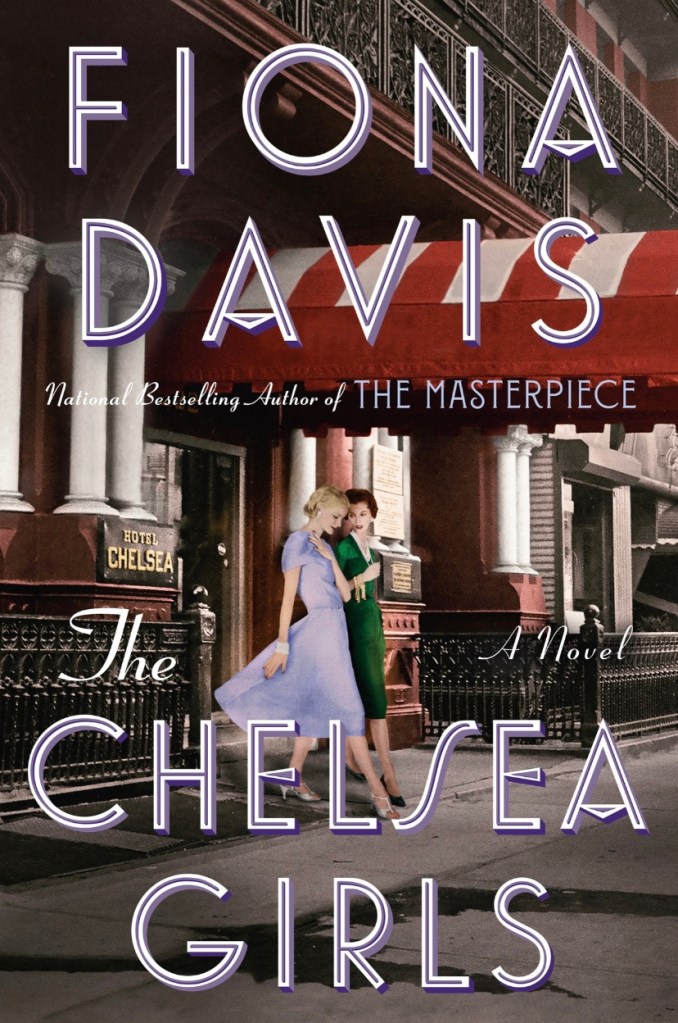
Maxine and Hazel meet on a USO tour in the last months of the Second World War. They meet again in New York in the 1950s when Maxine is an up and coming film star and Hazel is an aspiring playwright. Both living in the famous Chelsea Hotel, soon they’re working together on Hazel’s first play which is going to be staged on Broadway. But the red scare is well underway and the production and their careers are threatened by the witch hunt for communists turning its attention to the entertainment industry. As the pressure starts to build what will happen to the women and their friendship?
The Chelsea Girls follows a twenty year friendship between two women forged through a trauma in Italy, through the ups and downs of their careers. They’re both engaging and intriguing characters – Hazel’s mother is always comparing her to her brother who was killed in the war and finding her lacking, while Maxine is using the theatre to build a better life for her and her German immigrant grandmother. And as the red scare comes to Broadway, they both find themselves in the spotlight because of the actions of Hazel’s brother years before. And as well as being tense it’s also a wonderful portrait of the Chelsea Hotel – famously home to artists and bohemians, it becomes Hazel and Maxine’s refuge as they battle the outside forces trying to tear their lives apart.
I’ve been wanting to read this for ages. It came out two years ago and it’s been on my want to read list for about that long – so I’ve no idea where I even heard about it to start with. I read one of Fiona Davis’s other books a year or two back and liked the idea but didn’t love the execution, but this one really worked for me. It took me a day or two to properly get into it, but then I read 200 pages at a sitting because I wanted to see where it was going. I am fascinated with Old Hollywood, in fiction and non-fiction and this lives adjacent to that. I’ve written about some other books in this area before (like Trumbo and Karina Longworth’s Seduction) and this fitted right in to my wheelhouse. Well worth a look.
My copy came from the library, but it’s available now on Kindle and Kobo (and at time of writing is slightly cheaper on Kobo) as well as in paperback, although I’m not sure how easy that will be to get hold of in store – Foyles have stock to order, but not to click and collect.
I nearly broke away from the mystery theme of the last few weeks for today, and then I changed my mind. So much of my recent reading has been murder mysteries, that maybe I’ll end up doing mystery month. Although to be fair, a lot of them have been Inspector Littlejohn novels and that would get a little boring for you all!
When an antique dealer is murdered on a train, the police soon make an arrest. But Reverend Lucian Shaw was also on the train and soon becomes convinced that the police may have got the wrong man. When he starts to investigate he discovers that there may have been even more under currents in his parish than he knew about – although his wife could have filled him in on some of them!
A Third Class Murder really wants you to think that it’s a British Library Crime Classic, but it’s not. But don’t hold it against it,because it’s actually a nice, easy fun cozy crime novel that happens to be set in the 1930s. It’s not earth shattering or ground breaking, and yes I figured out who did it before the reveal but that’s fine – I wanted a murder mystery that I could enjoy and not have to think too hard about. Perfect lazy afternoon reading.
My copy came via my Kindle Unlimited Subscription, which means it’s only available on Kindle (at the moment at least).
Another week, another classic crime Book of the Week pick. And this time it’s a Margery Allingham that’s *not* an Albert Campion. On to that in a second, but first a reminder that there will be Mini Reviews tomorrow, and that if you missed the July Stats you can find them here.
Black Plumes starts with the slashing of a painting at a prestigious art gallery. Then the owner’s son-in-law is murdered. At the centre of the mystery is 90-year-old Gabrielle Ivory, formerly a society beauty, now side-lined by the younger generation who think she’s past it. But as the mystery develops it becomes clear that she may know more than they think she does – and she’s not going to let them ignore the threat to the gallery and chalk it up as a practical joker – even if there is a risk that the person behind them may be rather close to home.
This is a clever and atmospheric murder mystery. There are a lot of unlikeable characters in this, but also a lot of suspects – not all of whom are the unlikeable ones! You see this story mostly by following Frances, youngest of the Ivorys. At the start of the book her brother-in-law is pressuring her to marry the unpleasant co-owner of the gallery and artist and family friend, David Field, proposed a fake engagement to her as a way of getting out of it. Frances is convinced that something is wrong at the gallery but her concerns are dismissed by other members of the family – even after the murder has happened. David – whose painting is the one that is slashed at the start of the novel – is one of the only people who listens to her, but he is a bit of a rogue and some of the clues seem to point at him. I really enjoyed it – and if you haven’t read any Allingham before, this wouldn’t be a bad place to start – especially as the Campion series takes a while to settle in, which can make it tricky for people who like to start series at the beginning.
My copy came from Kindle Unlimited but it’s also available to buy on Kindle where they also have a modern paperback edition, which Foyles also has available to order but not in store pickup. This was originally published in 1940 so there are likely to be second hand copies around – but I can see from some reviews mention of racially offensive language, which as I didn’t notice it in my Kindle edition has presumably been edited out in the newer versions but which will be in old editions
So after a week of old favourite authors and only a few new things, I find myself back in the realms of classic mysteries for this week’s BotW pick.
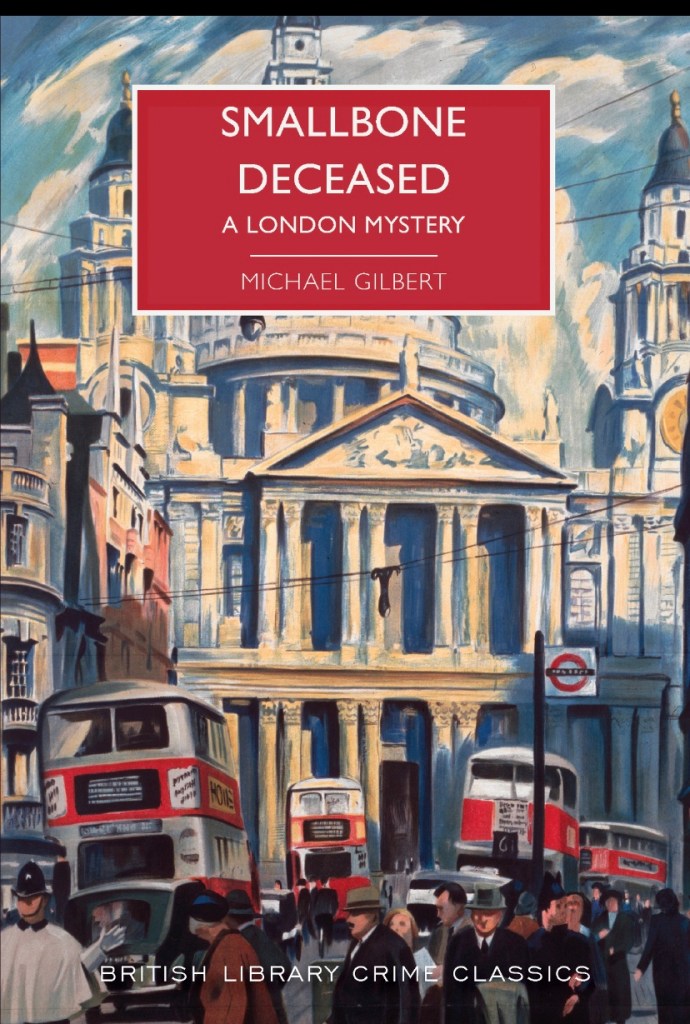
So Smallbone Deceased is a murder mystery set in the offices of a firm of London solicitors. Horniman, Birley and Crane is a well established and prestigious firm – who have just lost their senior partner, Mr Horniman. Some weeks after his death, when his son has taken over his share in the firm, a body is discovered in a deed box and the firm is thrown into turmoil. Inspector Hazlerigg is sent to investigate what strongly seems to be an inside job, and receives some assistance from Henry Bohun, the newest solicitor of the firm – newly qualified and arrived after the body must have been placed in situe.
Michael Gilbert was a solicitor by training, and this is a wonderfully drawn picture of the characters of the law firm and the way the wheels of the legal profession turned in the late 1940s. I think I’ve mentioned before how much I like all the details about the advertising company in Dorothy L Sayers’s Murder Must Advertise, and this does the same sort of thing for a solicitors office. The mystery itself is very clever, although a little slow to get started, the pace picks up nicely and by the end its tense and fast paced as Hazlerigg and Bohun race around (not together!) trying to catch the killer.
I’ve read a lot of British Library Crime Classics now and written about a fair few of them here (like Murder by Matchlight, The Sussex Downs Murder and The Division Bell Murder). I find them such a reliable series for discovering new-to-me Golden Age murder mysteries. They may not all be to my precise taste, but they’re always well constructed – even in the ones when the writing style doesn’t appeal to me. And they also have a habit of rotating their titles through Kindle Unlimited so if you’re smart you can work your way through them quite nicely.
My copy came via the wonders of the aforementioned Kindle Unlimited, but it’s also available to buy in the Crime Classics edition on Kindle for £2.99. Kobo has a slightly different looking version, for a slightly higher price. The Crime Classics version is also available in paperback – and if you get a big enough bookshop you should be able to get hold of it fairly easily. You could also buy it from the British Library shop direct – where they’re doing 3 for 2 on their own books so you could also grab
The reading list yesterday was a little shorter than usual, and with some relistens and old favourites on it but the pick for today was actually easy because as I mentioned the new Helen Ellis essay collection arrived last week – and of course I read it!
Bring Your Baggage and Don’t Pack Light is a series of essays examining friendship between adult women and what it’s like to be a woman pushing 50. There’s stories of Middle Aged sex, a trip to a psychic and what happens when one of your friends has a bad mammogram. And there are so many characters: bridge ladies, cat lady plastic surgeons and platinum frequent fliers. It’s the first book in a while I’ve found myself reading bits of out loud to Him Indoors – and the first time in even longer that he didn’t tell me to shut up! Sample response: “is this real? Do her friends know she’s writing this?” (Answer: yes, and yes). It’s witty and wise and I want Helen Ellis to be my friend too.
I first discovered Helen Ellis through a proof copy on the Magic Bookshelf at work. The Magic Bookshelf is now a thing of the past, but when it existed it was a library trolley full of books that lived near the entertainment and arts teams. It had a label on it telling you that you could take them – as opposed to all the other bookshelves up there which has labels telling you absolutely not to take the books. It’s where I was introduced to Curtis Sittenfeld (via Eligible), Brit Bennet(The Mothers) and Lissa Evans (Crooked Heart) – all of whom are now on my preorder list because of the books I read from the shelf. I miss the shelf – because I wonder what I’m missing out on because I don’t stumble across new (to me) books there any more. But still, I already have more books waiting to be read than some people own to start with so I really can’t complain. Anyway, every now and again I recommend an essay collection. Yes, it’s often one from Helen Ellis, but if you like Nora Ephron, or fiction like Katherine Heiny, this is the essay equivalent. You’re welcome.
Here is a confession: I preordered this from Amazon, in hardback and it’s the American edition. That’s how much I love Helen Ellis. I regret nothing because it is wonderful. But that does mean it’s a little expensive and might be harder to get hold of over here for now at least. It’s available in Kindle and Kobo – at the pricier end of the e-book scale, and Foyles say they can get hold of it in a week, but I wouldn’t expect to find it in a store – not yet anyway.
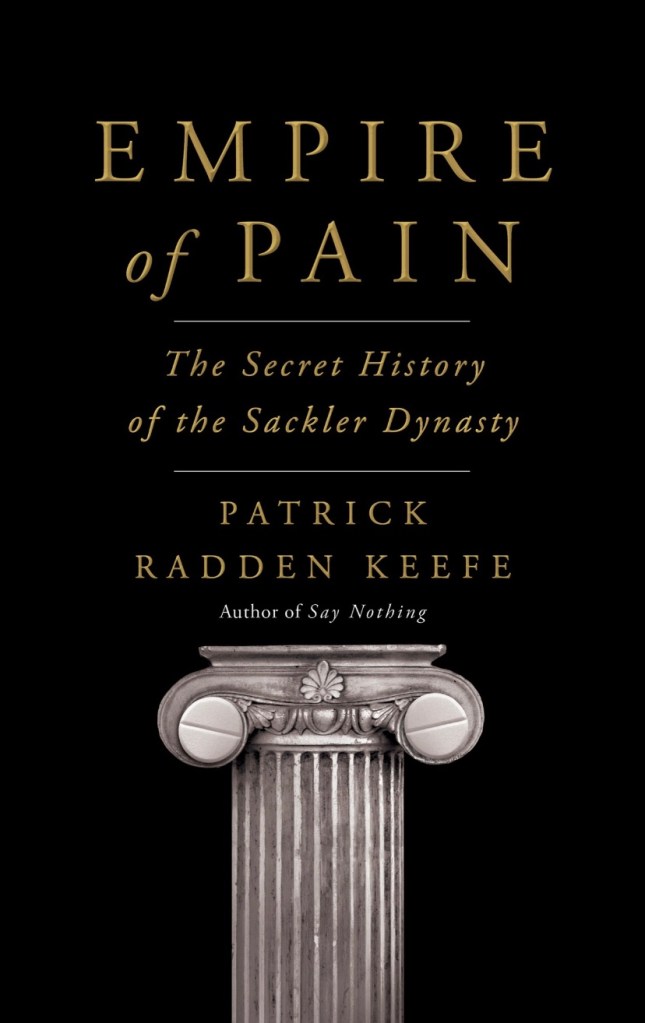
As I suspected yesterday, I finished Empire of Pain last night and it seems the obvious pick to write about even with that slightly cheaty caveat and joins the list of really very good narrative non-fiction books I’ve written about here – but rather than dealing with a tech startup squandering millions of dollars on something that doesn’t work (Bad Blood) or a business model they can’t get a profit from (Billion Dollar Loser), or the investigation into Harvey Weinstein (Catch and Kill) this is the story of the Sackler dynasty – the family behind Perdue Pharma.
If you’ve heard of Purdue Pharma, it’s probably as part of coverage into the opioid epidemic in the United States, as the company is behind the painkiller OxyContin. But until the last few years, you probably didn’t know that the Sacklers were the owners of the company. If you’d heard of them at all it was probably because of the galleries or museums or university departments named after them all around the world. But then a series of court cases accused Perdue and the family behind it of being the root cause of the opioid epidemic in the US. Patrick Radden Keefe started writing about the family in an article for the New Yorker, which has expanded into this look at the three generations of the family, how they made their money originally and their role in the modern world of pharmaceutical advertising that you see in the US today.
I first heard the Sackler name in connection with the opioid crisis when I was in Washington in the autumn of 2018 when the court cases and bankruptcy hearings are getting underway, and there have been plenty of articles and books since then about the crisis itself and its effect on communities across the country. But what Radden Keefe is doing here is looking at the family themselves and setting out the longer term picture – the way the Sackler family built their fortune and helped set up the conditions for the sale and marketing of OxyContin whilst keeping their name separate from the business but well known for philanthropy.
None of the family spoke to Radden Keefe for the book – and in his end notes he sets out the efforts that he took to try and secure an interview and the conditions they wished to impose on him in order for one to be granted. But he does set out how the book was fact checked and who he did speak to – over two hundred people on and off the record – with the on the record sources meticulously chronicles in end notes that take up nearly 20 percent of the kindle edition. He’s also made use of the mass of court papers, archival collections and Arthur Sackler’s own columns in the Medical Tribune. But he goes on to say that although there were almost too many documents for him to handle, there are still even more out there as the bankruptcy hearing could result in a repository of documents about Purdue running into tens of millions of papers. And the story isn’t over yet.
This is a long book (500+ pages on Kindle including those end notes) but if you’ve been following the opioid epidemic and the effect that it has had on the US – or even if you haven’t and have maybe only heard of OxyContin as a prescription pain pill that various celebrities have had issues with, this is worth the hours of your time.
My copy of Empire of Pain came from the library, but it’s out now in Kindle, Kobo and hardback. It should be fairly easy to find – Foyles have it on Click and Collect at six stores which is usually a good indicator. And if you’re wondering why Patrick Radden-Keefe’s name seems familiar – he’s written various books before as well as being a New Yorker writer, but he was also the host of the Winds of Change podcast that I wrote about in my Pandemic Podcast recommendation post.
I like writing about swoony romantic books, so although I really liked the new Duncan MacMaster – I mean a murder mystery set at a Fyre-esque festival is lot of fun and I’m sure I’ll write about it properly at some point, but I just loved Kate Clayborn’s Love at First, so my inner romantic won out. Again.
Nora loves her flat, and the building it’s in. She’s loved it since she was a kid and visited her Nona every summer. Now her Nona is gone but the community of her friends is still there and Nora has taken over looking after them. She moved across the country to Chicago to live in it, she’s got her remote working situation sorted and now she just needs to make sure the building’s new occupant doesn’t change the atmosphere. For Will, the flat is an unexpected inheritance from an uncle he didn’t know and didn’t want to. He can’t imagine living in it – so he just wants to deal with it and move on. Soon Will and Nora are low key feuding as she tries to gently sabotage his plans. But it’s more like frenemies than enemies because there’s just something between the two of them…
So this has a lovely prologue setting it up, and then a delightful romance with enemies to lovers and friends with benefits stuff going on. Will and Nora both have reasons why relationships are tricky territory for them and watching them find their way towards each other is lovely. I also adored the other residents of the building with their quirks and their fun and sparky relationships with each other. I really liked Clayborn’s previous book, Love Lettering – I mean it was a Book of the Week and one of my favourites of last year – but I think maybe I like this one even more!
I borrowed this from the library, but I suspect I’m going to be ordering myself the paperback so that I can lend it around – after all I own Love Lettering in paperback and on Kindle… At the moment it’s only available as an import paperback in the UK but when I asked Kate Clayborn on Twitter what was going on, she said she thinks it’s just transitioning to a new imprint. I hope that’s what’s happening – because I have two books of a three book series of hers and I really need the third at some point, so I’ll keep my eyes open and try to remember to update you all when it’s on Kindle and Kobo again.


 When an antique dealer is murdered on a train, the police soon make an arrest. But Reverend Lucian Shaw was also on the train and soon becomes convinced that the police may have got the wrong man. When he starts to investigate he discovers that there may have been even more under currents in his parish than he knew about – although his wife could have filled him in on some of them!