Another mystery book this week, this time a new to me author writing mysteries set in the 1930s.
In Death and the Conjurer, a celebrity psychiatrist is found murdered in his study – but the door was locked and there seems to have been no way for anyone to have committed the crime. The Scotland Yard detective calls in magician turned sleuth Joseph Spector to help solve a seemingly impossible murder.
And this really does seem to be an impossible one. The solution when it comes is clever and well worked out and as the book says the clues are there, even if I didn’t believe it when the book said that! Inspector Flint and Spector are a good duo – they both have their strengths so it feels like a pretty equal relationship rather than a stupid cop and a brilliant amateur. It’s also the first of three so there are two more for me to read now too.
This one is in Kindle unlimited at the moment and so if you’ve got a membership it’s worth a look.
I finished the last book in this eight book series a week or two back, which makes this the perfect time to talk about them!
This is a series of eight murder mystery books set on different ocean liners starting in 1907. Our detectives are George Porter Dillman and Genevieve Mansfield who are employed by the shipping line as detectives on the ships but travel incognito and mingle with the first class passengers looking to try to prevent trouble before it even starts. Except that bodies keep turning up. In the first book it’s only George who is the detective but Genevieve soon joins him on the payroll. Most of the books are set on transatlantic crossings but there are a few on other routes too.
This is all Edwardian and pre-war set, which makes a change in historical mysteries in general and for me to – because there are a lot of interwar series and a lot of Victorian series but not so much set in between. I also really like the cruise ship settings – it’s got some glamour but it’s also a closed group for the murder so you feel like you have a chance at figuring out who did it before the reveal. They’re also pretty easy reading – not scary, not too many bodies or on page violence but enough twists to keep you turning the pages.
These are pretty easy to get hold of – they’re often in the mystery sections of the bookshops still, and they had a spell where they were in The Works all the time so they turn up relatively regularly in the second hand shops. And of course they’re on Kindle and occasionally go into Kindle Unlimited too.
This was the other book that came out the week before last – and so they’ve both now been BotW picks. So that’s two new books in a row, two romances in a row – although this one is set in the past – and two books I’ve been looking forward to that haven’t let me down!
It’s 1960 and baseball player Eddie O’Leary is having the worst time of his life: after being trading to the New York Robin, his swing has vanished and he doesn’t know how to get it back. On top of that all his teammates hate him after comments he made on TV after finding out he was being trading live on air. Mark Bailey is an arts writer, except that recently he hasn’t been writing much at all. So when he’s assigned to ghost write a weekly column for the city’s most notorious baseballer, he is distinctly unenthusiastic. But when he meets Eddie he finds someone who might be as lonely as he is and there’s a definite pull between them. But it’s 1960 and Eddie is a professional sportsman, and Mark doesn’t want to be anyone’s secret (again) so nothing can happen right?
This is in the same world as Sebastian’s earlier book We Could Be So Goodwhich was also a BotW pick here. That was set at the same newspaper that Mark works at – and you’ll see some familiar faces here if you’ve read that book too. This is a grumpy-sunshine type story and is very, very slow burn for some very valid reasons for the characters, but it’s very satisfying watching these two figure out their stuff and get their acts together. I read it across two evenings – and would have read it faster if I didn’t have to do actual work.
My copy was on Kindle, but it’s also on Kobo and in paperback.
Back to historical romance this week – and this one isn’t actually out until next week, but I’ve already finished it, so I’m going with it today – sorry and all but you can at least preorder it if you like the sound of it.
Silver Lady is the first in a new series from Mary Jo Putney and is set in a lightly magical version of Regency Britain where some people are “gifted” – which means they have special skills that border on magic. Bran Tremayne is one of this – his powers of perception have made him an excellent investigator for the Home Office. But he finds himself drawn to Cornwall, where he was born before he was abandoned by his birth parents. When he is there he meets a mysterious woman who has had her memories suppressed. As she recovers her memories in his care, Bran discovers that Merryn is at the centre of a dangerous plot – can they survive the danger to get to a happy ending?
I mean it’s a romance novel, so I think you know the answer to that, but this is a fun read – it’s got some peril and adventure and the world building is pretty good – the “dangerous gifts” of the title are explained very well and naturally as part of the plot of the book . I’m not usually a lover of amnesia storylines, but this one makes sense within the framework that you’re given for the world and Merryn is less of a damsel in distress than I was expecting her to be. I’ve had a bit of a mixed record with Putney before, but I enjoyed this and will look out for the sequels when they come along.
Silver Lady is out next week – you can preorder it on Kindle and Kobo and if you’re in the US you should be able to get a paperback too.
Mary Balogh has a new book out this week – Remember Me is the second book in her Ravenswood series, so today I’m taking the opportunity to talk about one of her other series – the Survivors Club books.
The six novels and one novella in the series follow six men and one woman who are injured in the Napoleonic Wars and end up convalescing at the same place – the home of the Duke of Stanbrook. In the way of such series, each book follows one of the group as they find love, with glimpses of previous couples as you go through as well and building to the final romance as you get to know the whole group.
I’ve read five of the novels and the novella as well and like reading Mary Balogh when I want something a bit less dramatic than some of the other equivalent historical romances. The heroes and heroines are a little older – old enough to have been soldiers for the men, and som of the women are widows, others have remained unmarried for Reasons. They all have real problems to overcome, but the angst is low and there don’t tend to be many stupid misunderstandings that could be solved with a conversation along the way. Basically you’re getting non-cookie cutter heroes and heroines and characters who grow and fall in love and mature without much melodrama. Although at the end of the series there is a touch of that. But by that point if you’ve read most of the others, then you’ll let it off because you’re getting the romance you’ve been waiting for for a couple of books!
These should be fairly easy to get hold of, I’ve seen all of them in the shops in paperback – although they came out a few years ago (the series was completed in 2016) so it may be slightly trickier now. But they’re also all on Kindle and Kobo.
Happy Friday everyone, I hope you’re all having a good week and have a delightful weekend planned. Allow me to usher you towards it with a post about a 1960s-set cozy crime series!
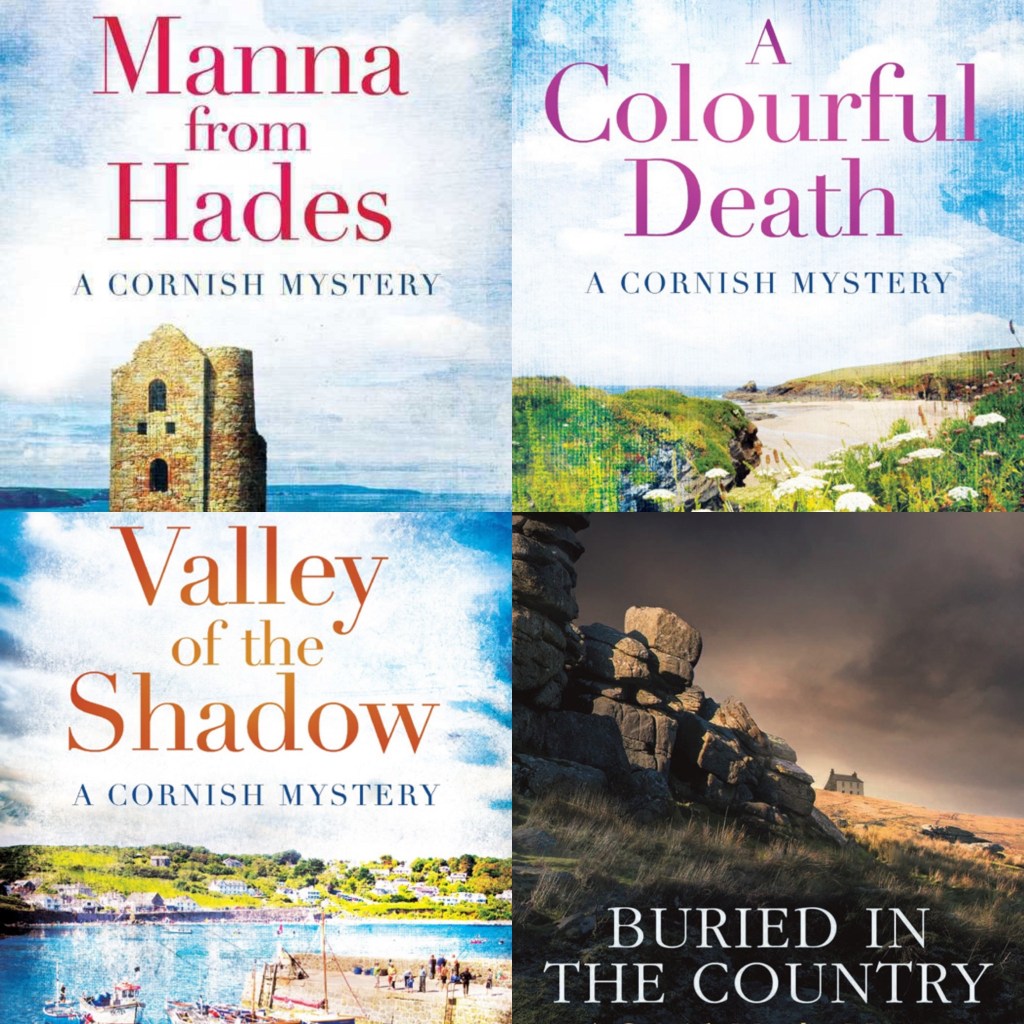
It’s the 1960s and Eleanor Trewynn is a retired widow who is living over the charity shop she’s running in a Cornish village. Her niece Megan is a police detective who has recently transferred to the local force and now finds herself with a commanding officer who doesn’t really think female officers are a good idea. There’s an artist living next door and a cast of side characters who work in the charity shop. Eleanor and her husband lived all over the world working for a charity and this life experience means that she can handle almost anything and is used to trying to solve problems. And thus you have all the ingredients for a satisfying mystery.
As I’ve mentioned before, I really like Carola Dunn’s other mystery series – the 1920s-set Daisy Dalymple series. I don’t love these quite as much, but they have good puzzles to solve and an interesting premise and it’s nice to read a series set in the 1960s – there are lots of interwar historicals, and some immediately post war and 1950s ones, but not as many sixties ones. Yes Inspector Alleyn gets into the 1960s, but none of them are my favourites, his age is getting a bit fuzzy and Ngaio herself was in her 60s when she was writing them. There are only four of these which is a shame but I’ll take what I can get in these cases.
My copies all came from various bookshops – I read most of them when they first came out a decade ago, but the last one came out a year or two later (as you can tell by the non matching cover…) and I hadn’t seen it in the flesh (or at least I don’t remember seeing it) until I spotted it in Gower Street Waterstones the other week when I was on that little buying spree. What a fortunate circumstance. They’re also on Kindle and Kobo.
I’ve done a couple of Sherlock Holmes related posts over the last few years, so as the new Lady Sherlock mystery came out this week, it’s time for me to talk about another one of my auto-buy series
So Sherry Thomas’s take on Sherlock Holmes is that Sherlock is the creation of Charlotte Holmes, a brilliantly clever woman who is restricted by the conventions of late Victorian society. In the first book, she becomes a social pariah and sets up her own household and begins to investigate crimes after her family is implicated in a series of deaths. Over the course of the series so far, Thomas has introduced many of the elements of the original Sherlock books – including a Watson and a Moriarty and other things that are too spoilery to mention.
The latest book is the seventh and really does follow on from the sixth book in the series – and I cannot stress enough how much you want to read these in order – the latest book sees Charlotte taking a sea voyage, but even reading the blurb gives you spoilers for the previous book. I made A Study in Scarlet Women my Book of the Week when I read it – so I can point you back at that as well.
These are historical mysteries but they have a fair amount of suspense to them – is historical mystery suspense a genre? At any rate, they’re not thrillers and as Sherry Thomas was a romance writer before she turned to mysteries, there is a (very) slow burn romantic thread running through these too. Basically they are quite hard to confine to one genre, which is probably why I like them so much. In terms of comparisons, I would say that if you like any of Deanna Raybourn’s historical mystery series – Veronica Speedwell or Lady Julia Grey – or Phryne Fisher (even though this is Victorian not inter-war) then you should think about trying these.
Oh, I'm wondering if it's because my pub date was moved from December to March. There was a printing shortage in the US and they needed longer lead time.
They are all available on Kindle in the UK – I even picked up the first one on a deal back in the day – but at time of writing they’re fairly pricy, but you never know, we might get some special offers for the new book. I own most of the rest in paperback (and I think we all know I’ll probably fill the collection in at some point) but my pre-order for the latest one was cancelled a few months back. As you can see, I tweeted Sherry Thomas about it and she thought it could be because of the release date getting bumped back – so hopefully/maybe it will appear in the UK soon so that I can get my hands on an actual copy. Fingers crossed
As I said yesterday, it’s the Platinum Jubilee holidays here this (long) weekend, so today I thought I’d do a recap of the various royal related books I’ve talked about here over the years. I’m going to try and work my way back in time rather than split this into fiction and non-fiction. We’ll see how that goes…
I took this on Wednesday in my favourite Italian deli when I was buying lunch. It just tickled me!
To start with, I did a post about books featuring the Queen back on the actual anniversary of her accession. Then from the pre Elizabeth II half of the twentieth century we have in non-fiction: Andrew Lownie’s Traitor King about Edward VIII after his abdication, Mary S Lovell’s The Riviera Set which also features the Duke and Duchess of Windsor in the background. In fiction there is TP Fielden’s Stealing the Crown mystery set in Buckingham Palace during World War II, the Royal Spyness series of mystery books and Deanna Raybourn’s Veronica Speedwell books have more than one royal connection across the series so far. Oh and don’t forget my beloved Gone With The Windsors by Laurie Graham – what would Maybell say if I didn’t mention her experiences with Wallis Simpson and Edward VIII?
Back into the nineteenth century now and I have a whole post about books related to Queen Victoria’s Dynasty and there’s more on Hannah Pakula’s An Uncommon Woman about Princess Victoria, Queen Victoria’s eldest daughter and wife of Kaiser here as well. There’s also Greedy Queen about the food that Queen Victoria ate. Daisy Goodwin’s The Fortune Hunter features Empress Sisi of Austria and a cameo from Queen Victoria and John Brown. Pre Queen Victoria there’s a royal connection in Georgette Heyer’s Regency Buck. Honorable mention to the Pink Carnation series, which features Royalist plots, the Napoleonic Empire and Sultans at various points so could rightly be considered Royal Related. In fantasy novels, both Zen Cho’s Sorcerer to the Crown and V E Schwab’s Shades of Magic trilogy are set in alternate universe Regency Londons as is a lot of Gail Carriger’s Parasolverse.
Pre-nineteenth century I’ve written about a lot less royals – here at least, although there are reviews of more over on my Goodreads profile if you can find them. But there’s still Simon Sebag Montefiore’s The Romanovs (I’m still not past the Napoleonic era), David Starkey’s Elizabeth about Elizabeth I, yesterday’s post about Philippa Gregory’s Tudor novels and some of Shakespeare’s various Kings get a mention in my post about Sir Antony Sher. I really should try and write some more here about of it. After all I was a history student at university and I’ve read a lot on the French Revolution, the French monarchy, and the Stuarts – even if not all of it is royal related. I must pull my socks up and do better in future. I think I’ve got at least half a dozen bits on the to read shelves virtual and physical at the moment that could fit in this post- including more than one about Charles II and about the Bourbon Kings.
I also did a whole post of Royal Romances – which covers a whole bunch of different time periods so I’m putting it on the end, but there’s also Talia Hibbert’s The Princess Trap which is a contemporary romance. I also wanted to mention Tomi Adeyemi’s Children of Blood and Boneset in a West Africa inspired magical world which has a heroine fighting the monarchy to return magic to the people.
And if this doesn’t break WordPress’s little brain with all the links back to my own blog, I don’t know what will. Have a great weekend everyone!
I offer you a non fiction book this week – and after a few weeks where I’ve been recommending new (or newish) releases, here’s one that’s not quite as new a release because it came out in October…
Anyway, Greg Jenner’s latest book does exactly what it says on the tin – it answers fifty questions from history that are the sort of thing that most people actually want to know – as opposed to the sort of history people thing they ought to know. So you can find out how women dealt with their periods in the past – but also how historical periods got their names, where history starts and pre-history ends and why people are so obsessed with the Tudors (see also the question about how many nipples Anne Boleyn had) and then more horrible histories type stuff like how much horse manure was created each day in London or what the Flintstones got right. And because it’s fifty questions it makes for great bite sized reading – I read a couple of questions a night before bed.
As I’ve mentioned before, Greg and I overlapped at the same university and we did student radio at the same time although in different departments (I was news and he was speech) so we didn’t really hang out together although we were in the Langwith bar at the same time a few times after the weekly meeting. I really like the niche he’s carved himself as a public historian – he is incredibly knowledgable but wears it very lightly and his writing style is fun and accessible. And he’s the sort of history writer who wants to appear like he knows it all right off the top of his head – he’s not afraid to show his working and tell you which historians or other experts he spoke to in the main text and not hidden in the footnotes. And if there’s something you’re particularly interested in, there’s always a further reading list at the back – complete with notes about which are the more academic books as opposed to the more lay person friendly ones. As well as working for the grownups, I think this is also the sort of book that would appeal to a kid who read horrible histories and is now looking for something else fun and historical. It’s got a few swear words in it, but I think that teens and tweens will love that (and parents: they’ve heard all the words already at school, that ship has sailed)
My copy (complete with signed book plate) came from Big Green Books, but it should be fairly easy to get hold of from any reasonably sized book shop as well as on Kindle and Kobo. And if you read it and like it, then try Greg’s other books Dead Famous (definitely more for the adults) and A Millions Years in a Day. And as a bonus Greg reads his own audiobooks, which is always delightful – if you listen to his podcast You’re Dead to Me you know what he sounds like and it would be weird for it not to be him narrating!
There were lots of options for this post today. I like a week like that. I’ve gone for a historical romance because it’s been a few weeks and this was a lot of fun and I needed something fun and frothy and if I hadn’t written it already, another entry for the marries the person you’re trying to save someone from post.
Kitty Talbot’s parents have died, leaving their daughters with debts and an uncertain future. Determined to secure her sisters’ future, she decides the solution is to marry well and heads to London with the last money they have to try to secure a rich husband. She’s never moved in this sort of society before, but with the help of her mother’s best friend she’s sure she can succeed. And indeed she soon attracts a suitor and is intent on reeling him in, until his older brother, Lord Radcliffe comes to town to put a stop to it. He knows she’s a fortune hunter and is determined to keep her out of his family, but somehow he finds himself helping her ingratiate herself with the ton…
As you might be able to tell from that summary – which doesn’t even cover half the book – this has got a lot of plot and a lot of twists. It rattles along so fast that you don’t have time to think about it, but when I was trying write that plot summary I realised how much had gone on beside the whole fortune hunter main idea. It pulled it off, but I do wonder whether there are any ideas left for Sophie Irwin’s next book! But I enjoyed this a lot so I’ll definitely be looking for it when it comes to see. It’s “not quite in the common way” of the historical romances I have read recently, not least because the steam level is basically smouldering glances for most of the book and never gets higher than kissing – so not so much enemies to Lovers as enemies to soon to be marrieds!
My copy came from NetGalley, but it’s coming out on Thursday in ebook and hardback and if you pre-order it today it’ll drop onto your Kindle or Kobo or your doormat on release day.




 Verity Reads Books (lots of them)