historical, reviews

Review: The Storms of War

Finishing off a busy week over here on the blog with a review of Kate Williams’ The Storms of War – which I started during #Sunathon and has taken me longer to read than you’d expect considering how much I enjoyed it – because of the fact that it’s a hardback and I can’t lug it around with me on the train.

Firstly, I love a good saga – I worked my way through Barbara Taylor Bradford’s Woman of Substance trilogy when I was 16 (back when it was still a trilogy!) and then moved on to Elizabeth Jane Howard’s Cazalet books, which I adored – so this looked just up my street, especially when you consider that I studied First World War Literature for my A-Level English Literature.

Storms of War
It’s a big hardback – but it’s got such a pretty cover

So, the plot:  The de Witts are an Anglo-German family, who, at the start of the Great War, are preparing for the marriage of their eldest daughter to a member of the English Nobility.  Rudolph, the father, is from Germany and has made his money through meat factories.  Verena, the mother, is the daughter of a lord and they have four children Michael, Emmeline, Celia and Arthur (who is away from home at the start of the war).  The book follows them through the war, as Rudolph suddenly becomes an outcast in the country he considers his home and the children face not only the consequences of that – but the effects of the war in general.

I really enjoyed this – as I’ve already said on Twitter – I would describe it as Cazalets do World War One, but with added tensions caused by the family’s German links.  The characters were interesting and engaging and having read a lot of books about World War One over the years, both novels and non-fiction, their experiences seemed realistic and rang true with what I have read – which to be honest is only what you’d expect as Kate Williams is a “proper” historian.  The fresh angle here is that Anglo-German twist that I’ve already mentioned – and I thought that was handled really well.  Book two is promised for next year – and I look forward to seeing how the family fares in the post-Great War world.  I foresee interesting possibilities – particularly as there are ends left untied here and a development at the very end of the book creates potential for fresh conflict within the family.

I’ve read some of Kate Williams’ historical biographies in the past – but it was a few years ago and I found the writing style a little harder to get on with than some others in that genre.  This, however is an absolute joy to read – and very difficult to put down (despite its size!) – and it has inspired me to bump one of her other books that’s still sitting on the to-read pile up to the top of the list.  The front cover has a quote from Alison Weir recommending it to fans of Downton Abbey and although I think that’s a bit of a simplistic view of the market for this book, I think that it is a great way of getting people to pick up what is a large and intimidating looking hardback.

There’s a wealth of books about World War One out there (and lots of new ones appearing at the moment because of the anniversary) so there are lots of other books to read if you like this – I’ve already mentioned the Cazalets which is a slightly later period, but is a similar sort of family saga – but there are also books like Pat Barker’s Regeneration and a wealth of accounts written by people who lived through the Great War – like Erich Maria Remarque’s All Quiet on the Western Front and Robert Graves’ Goodbye to All That.

Kate Williams’ The Storms of War should be in all good bookshops – as the phrase goes – and here are my traditional links to Foyles for the hardback and Amazon for the more portable Kindle edition. This is the sort of book I always want an actual copy of though – as I know I’ll want to lend it to my mum and sister if it’s any good.

Authors I love, books, fiction, historical, romance

Authors I Love: Georgette Heyer

Between the 1920s and 1970s, Georgette Heyer wrote nearly three dozen novels set Regency or Georgian times, along with a string of thrillers.  I love me some Golden Age detective action, but this article is about her historical romances which, in my opinion, are sublime and nearly perfect examples of their type.

My shelf of Georgette Heyers
Hardback, paperback, different styles – my shelf has editions from the 1940s through til the 2000s

My mum had a shelf of Heyers on the landing the whole way through my childhood, but it was only when I was about 16 that I first picked one up (either False Colours or Cotillion, I can’t remember which) and that one led to another, which led to all of the ones she had and then to buying the ones that she didn’t.  When my parents moved house a couple of years ago, mum passed them on to me as she “didn’t have space for them” any more, on the understanding that she could borrow them back if she wanted and that I wouldn’t get rid of them.  Since then though, rather than borrowing them from me, she’s started re-buying them!

I have a lot of favourites, but if I was forced and could only have one, it would be The Grand Sophy. Sophy is feisty, independent, well-travelled and used to running her own life – and everyone else’s.  She arrives back in England to live with her aunt and her cousins after her diplomat father is posted to South America. She finds them in the midst of a family crisis – with one daughter in love with an unsuitable poet and the eldest son engaged to a disagreeable bluestocking.  Sophy proceeds to try to organise the household along more harmonious lines and arrange matches for her cousins and, in the end, herself.

The Grand Sophy
My copy of The Grand Sophy – in what I think is a late 1980s edition

What I love about Heyer’s female characters are that they’re not weak and wishy-washy pushovers, but they also don’t feel like modern women who have been supplanted to the eighteenth or nineteenth century.  Her women aren’t simpering misses sitting around waiting for life to happen to them or for a man to make their life complete, but they’re not doing anything that feels jarringly out of period either.   I have a weakness for American-written British-set historical romances (you know, the ones with the buxom heroines bursting out of their corsets on the covers) which lead a shamefaced existence* on the uppermost shelf of my tallest spare bedroom bookcase – and that’s a problem I find with some (but by no means all) of their heroines.

One of the feistiest and most independent of Heyer’s heroines is Léonie in These Old Shades – who we first meet as Léon the page when he is bought “body and soul” by Justin, Duke of Avon – known as Satanas because of his lack of morals.  Heyer books always have a lot plot and not a lot of yearning looks or heaving bosoms and Shades is a great example of this.  At the start of the book Justin is a thoroughly disreputable character who buys Léon not to free him from a life of abuse and mistreatment, but because he sees a method of being revenged on one of his enemies.  Léonie is in love with Avon almost from the start, but you’re not sure until the very end, after the plot has taken you from France to England and back to France again, whether Avon’s motives have changed at all. Most of Heyer’s books are standalones, but Shades is unusual in that some of the characters have appeared before, albeit with different names and in a less developed form, in The Black Moth – and Justin, Léonie and Rupert all appear again in Devil’s Cub (which I also love) where Justin and Léonie’s son Dominic – who has all of his father’s faults and his mother’s temper but does at least have a conscience – runs off with a virtuous young lady who is trying to protect her sister’s honour.

The Black Moth, These Old Shades and Devil's Cub
My copies of Moth, Shades and Devil’s Cub show some of the range of different editions in my collection!

In Regency Buck (another with a sort-of sequel – An Infamous Army of which more later) another strong minded heroine comes up against a domineering alpha-male and, dear reader, you may start to see a pattern in the sort of heroes that I like.  Preferably tall, dark and handsome, he needs to be bossy, clever and with a bit of a dark side or at the least a temper – like Buck‘s Julian St John Audley, the titular Sylvester or best of all Damerel in Venetia.  But they also need to be up against a smart woman who is prepared to stand up for herself and what she wants.  I don’t want to see any woman being forced into a marriage by a man who holds all the power.  The Heyers that come off my shelf the least are ones like Cotillion (Freddy’s too thick), Friday’s Child (Hero the heroine is too wet), Cousin Kate (Kate’s too stupid to see the trouble coming) and A Civil Contract (Adam needs a good slap).

Inscription in the front of Devil's Cub
My copy of Devil’s Cub has a note from in the front written by my mum

Those are the exceptions though and just looking along the shelf is like seeing group of old friends – they live in the sitting room so I have them to hand if I need them!  If you’ve never read any Georgette Heyer, may I heartily recommend you have a look now – particularly if you are a fan of authors like Eloisa James or Julia Quinn.  They don’t have the sex that modern historicals do – in fact there’s barely any kissing, but they’re still breathtakingly romantic in places and have tight well-structured plots – and a wealth of meticulously researched historical detail (An Infamous Army was required reading for trainee army officers because its descriptions of the Battle of Waterloo are so accurate – it also features Julian and Judith from Regency Buck and a cameo from a much older Dominic and Mary from Devil’s Cub) that I can only imagine the current crop of authors have drawn on.  It also says a lot that more than ninety years since her first book was published and forty years (this year in fact) since Georgette Heyer died, her Regency/Georgian romances are still in print.

Artistically arranged Heyer novels
A selection of my favourites in a charming garden setting!

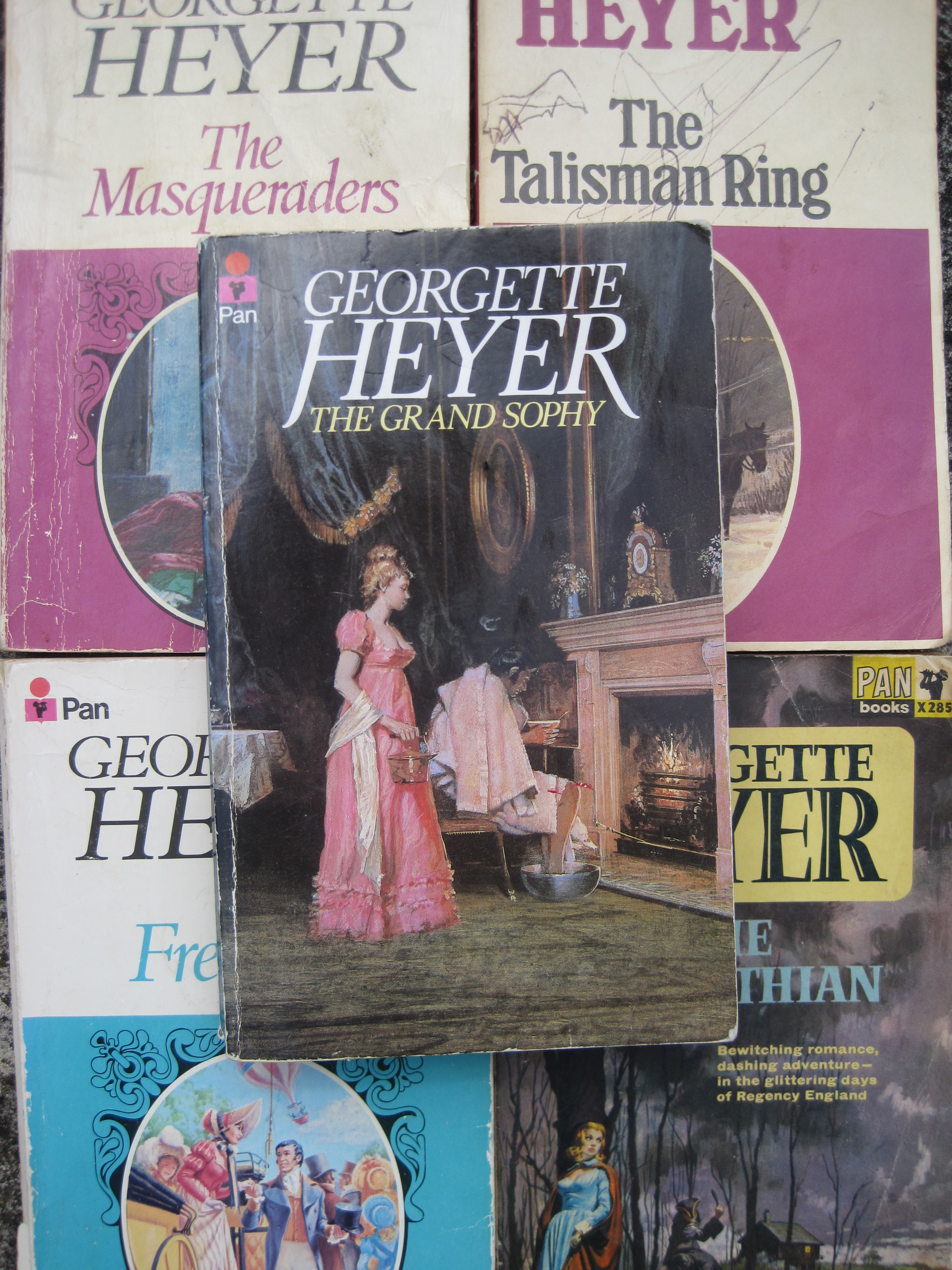
I like them so much I even have a couple of them on my kindle and as audiobooks in case I need a fix when I’m away from home.  And, while I was taking the photos for this article I discovered I’ve got a couple of duplicates of my own – I think I bought the pretty Pan paperbacks of The Talisman Ring and The Masqueraders when I was living in Essex – in the days when mum had most of the Heyers…

I suggest you start with The Grand Sophy.  Or These Old Shades.  Or Venetia.  Or Regency Buck.  Or Sylvester.  Or April Lady. Or Sprig Muslin. Oh go on, just pick one and dive in.

* Thank you Peter Wimsey for that turn of phrase (From Busman’s Honeymoon, about his collection of press cuttings about Harriet)