Inspired by yesterday’s post about Small Miracles, I thought I’d write today’s recommendsday is a batch of books that are similarly gentle but uplifting, but it was harder than I expected.
So Small Miracles is blurbed by A J Pearce as in the Emmy Lake series – which have more sadness to them than these (or at least more on page sadness) but the first one Dear Mrs Bird is in Kindle Unlimited at the moment, so that’s fairly risk free if you’re a KU member.
It’s actually really hard to come up with something that feels really similar – but I think maybe The Diary of a Provincial Lady would work – it’s funnier and also nearly 100 now, but it has a similar gentle, low stakes feel to it. Which also made me think of Miss Buncle – another woman trying to get some money, although in this case because her dividends have failed and Ladies don’t have jobs.
There were a few things in the people also read/bought columns that looked promising Julietta Henderson’s The Funny Thing About Norman Foreman – still haven’t read but kept coming up as a suggestion when I was writing this – so maybe I should get around it to! Also popping up is Claire Pooley’s The People on Platform Five – which I don’t have, but is 99p at the moment, so it’s entirely within the realms of possibility that I’ll end up buying it after writing this post! Again, I haven’t read them, but I know my sister and my mum really like Rachel Joyce’s novels and I think they’re doing something similar too.
Oh, and I’ve pre-ordered the Small Miracle’s sequel…
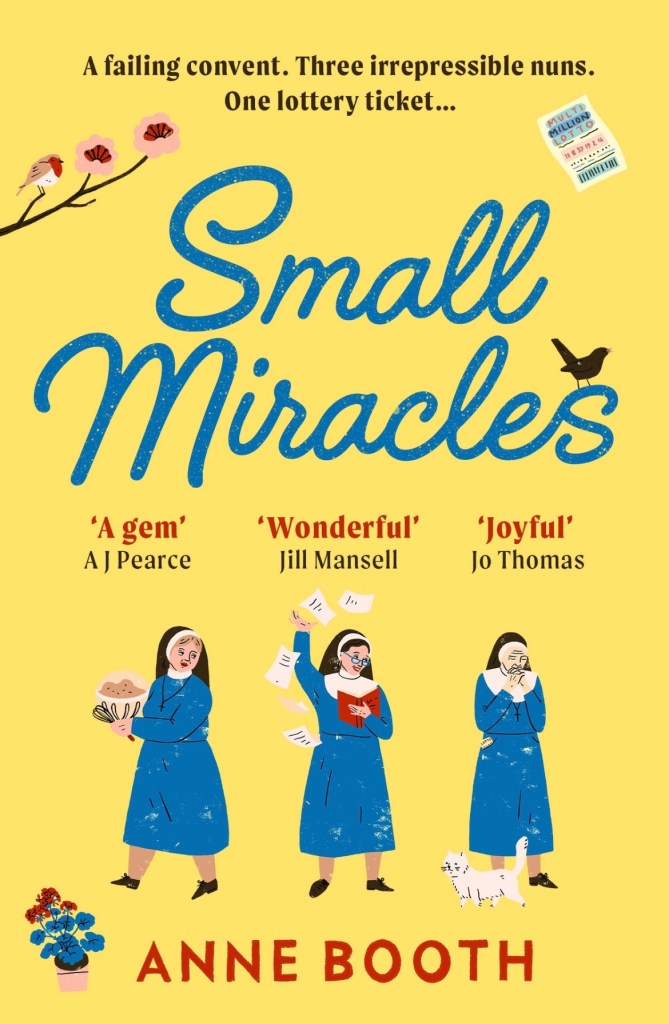
I could write about Codename Charming again today, but you’ve already heard enough about Lucy Parker from me in the last week or so, so instead I’m going with Anne Booth’s Small Miracles which I finally got around to reading after I spotted it when I was putting together the Kindle offers post this month.
It’s the mid 1990s and Sister Margaret, Sister Bridget and Sister Cecilia are the last three members of their order and struggling to figure out how their convent can survive in the face of the loss of some of their number and a house in need of more repairs than they can pay for. But after 90-year-old Sister Cecilia decides to play the new National Lottery things start to change for them and their community.
This is a warm and uplifting novel which moves around between the nuns and some of the people whose lives they touch. It is about a religious community but it doesn’t feel preachy or overly religious – despite the fact that poor Sister Margaret has a lot to pray about at various points. One small miracle has a ripple effect – sometimes in ways that the people involved can see, others in ways that are only known to you as the reader. Basically it is just a lovely tale of how little things can start bigger things moving and can cause good things to happen.
So if you need a nice gentle read to make you feel warm inside, this would be a great pick. And as I mentioned in that offer post, there is a sequel coming – and it’s Christmas themed!
My copy of Small Miracles was an advance proof that I’m not quite sure how I got, and which I lent to mum before I remembered I needed a photograph. But it is 99p on Kindle and Kobo at the moment so run don’t walk if this sounds like your cup of tea.
So this is a post I’ve been thinking about writing for ages – but thought I probably ought to read some Anthony Trollope before I did so that I can sound knowledgeable about the origin of the setting. But I’m finally admitting that that’s probably not going to happen any time soon – because, you know, huge to-read pile, pandemic and my general (and ever more pronounced) reluctance to read anything “classic”. And the other issue is that I’ve only read fifteen of them. But if I wait for Virago to publish all of them I could be waiting a long time. So, I’m going for it now. Sorry, not sorry.
This is a series of loosely connected books all set in the same (fictional) county and featuring some of the same characters. The first book was published in 1933, and as in book 15 I’ve just reached the end of the Second World War the section of the series that I’ve read fits nicely into the interwar period that I read about so much. Not a lot happens in them – or at least nothing dramatic – they are just amusing and witty portraits of life in a certain part of British society. In High Rising – the first in the series – we met Laura Moreland, a widow who started writing books to help pay the school fees for her irrepressible son Tony. The books are wildly successful, but not highbrow, so Laura is somewhat embarrassed by them. There are squabbles in the community, misunderstandings, misbehaving children, there are issues of class and there are gentle romances. The pattern for the series is set.
They do turn darker through the Second World War, and there are bits that haven’t aged as well as others. I see from notes on the later books in the series that they turn more romantic and less social comedy, but as far as the ones I have read go, they are comedies of manners and society with some romantic interludes. Think the Golden Age murder mysteries in style and tone but with more humour and no dead bodies. If you read school stories as a child (or still do as an adult like me) then Summer Half is a behind the scenes look at what might have been going on in the staff rooms of some of the schools that you read about (albeit at a boys school). There are books set at Big Houses or at weekend parties. There are fetes and village events. And there is a lot of gentle fun to be had.
And as we all know that’s the sort of mood I’m in (almost permanently) at the moment. Gentle fun, low peril, it will all turn out alright in the end type books. In fact the only thing that hasn’t turned out right in the end here is that Virago changed the editions so that the cover illustration doesn’t wrap around the spine on the later books that they’re republished so my shelf doesn’t match as nicely as I want it to. Truly a first world problem.
You should be able to get hold of these fairly easily – I’ve bought mine in various bookshops as well as on Amazon (there are a couple that were kindle only at first). In fact I think I originally started reading them because I spotted one on a table in Old Foyles. I saw the cover and read the back and off we went. And it’s been delighful.
We’re midway through March and it’s been a while since I picked something from my list of slightly quirky out of the way authors. So here we are, with Mrs Tim of the Regiment, which firmly fits into the gentle English life subset of my reading.
As the title suggests, Mrs Tim – Hester Christie – is the wife of an army officer, in the 1930s. Told in the form of a diary, we see her navigate regimental life, including moving across the country when Tim gets promoted, and trying to make friends and raise a family. The first half of the book is more about the day to day, the second follows a holiday that Hester takes to Scotland with her young daughter to visit a friend and the complications ensue.
I’ve written a lot about the fact that I’ve been sticking to genres where I know that things will turn out ok in the end, and at first glance this might seem like a bit of a turn away from that, but this is actually very low stakes and relaxing to read. Hester is a wonderful narrator – she’s witty and observant of others, but also a little bit dense when it comes to herself. She is utterly oblivious to the fact that Major Morley is mad about her – and that he and her friend’s son are fighting over her when she’s on holiday in Scotland. This is a tricky tightrope for the author to tread, because Tim isn’t always around much and by its nature, domestic life of a married couple is less glamorous and exciting than holiday-ing in Scotland and dashing around the countryside. But I thought that Hester’s obliviousness – and her devotion to Tim (earlier in the book she worries about what to do if he is sent to India and whether they could afford to send their daughter to boarding school so she can go too because she doesn’t want to be apart from him again) means that this section is amusing and charming rather than feeling like you’re working up to Hester leaving Tim or being left at home unhappy.
I’ve read D E Stevenson before – she’s the author of the wonderful Miss Buncle’s Book and Anna and her Daughters which I have written about before – and this has a lot of the things I liked about both of those, but also seemed to me to fit in along with books like Diary of a Provincial Lady and Angela Thirkell’s Barsetshire books. It’s essentially a slice of life story from the interwar period, in the voice of a smart woman who is running a household (because that’s what you did when you got married in those days). There are three more books in the series, and I suspect I’ll be reading them at some point in the near future.
My copy of Mrs Tim of the Regiment was a birthday present (thanks mum and dad!) and you should be able to get hold of the charming paperback edition I have from any sensible bookshop (like Foyles), but it’s also available on Kindle and Kobo.




 Verity Reads Books (lots of them)