American imports, Book of the Week, cozy crime

Book of the Week: The Semester of Our Discontent

Last week was almost entirely taken up with cozy crimes, many of them the first in series as I’m on the hunt for another one to add to my lists.  It’s proving a harder quest than I had imagined.  Quite a few of the books that I read last week had a problem (or two).  But in the end I settled on the first book in Cynthia Kuhn’s Lila McLean series – mostly on the basis that I went out and requested the second book from NetGalley after I finished it – which is out later this month – and then read that too.
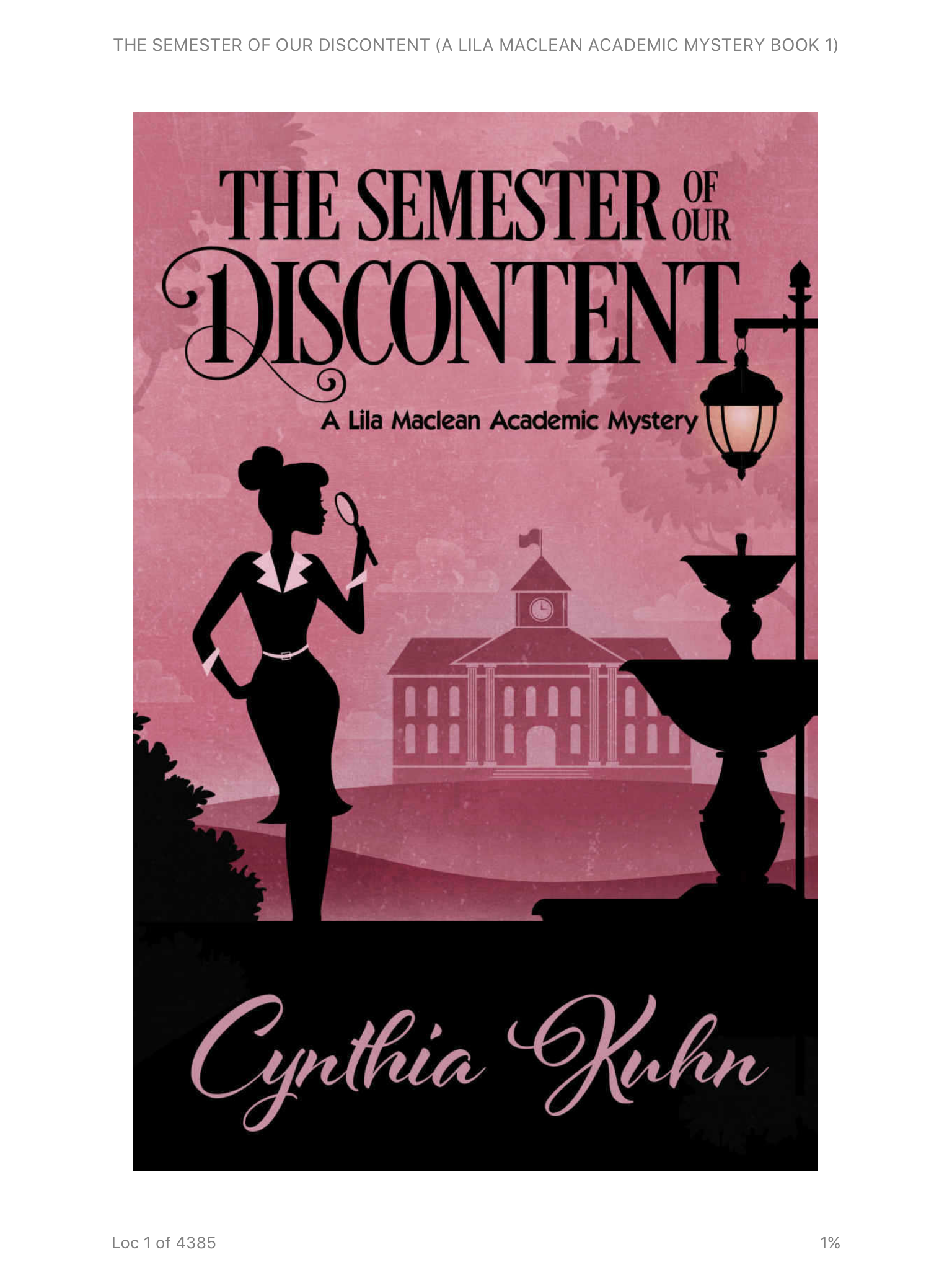
Cover of The Semester of Our Discontent
I like the simplicity of the cover – it looks classy to me.

So, in the Semester of Our Discontent we met Lila, newly appointed English professor at a small but prestigious university.  But no sooner has she arrived at Stonedale than she has more to worry about than whether she’s going to get enough published to get tenure when she finds one of her colleagues dead.  Her cousin (also on the staff and up for tenure) is one of the prince suspects, so Lila starts gathering evidence alongside teaching and settling in to her new job.

Now as a Brit, I had to google tenure the first time I can across it in a book a few years back, because it wasn’t something I had come across in the UK system, but this actually explains it really quite well and it made sense to me (or at least as much sense as it can make!) without slowing down the plot or doing an info dump.  There’s a large cast of characters in this, who don’t always get a chance to become more than just names* but the people you do get to know are engaging and three dimensional.  There’s definitely set up here for running threads for the series, but it’s done much less obviously than some of the other books I read last week.

There are a couple of moments that are a bit over the top (and I can’t tell you what) but Lila’s investigations are sensible enough and she never strays over the Too Stupid to Live or the Why the Monkeys Hasn’t She Been Arrested lines – which again was a problem in some of the other books that I read this week.

The Semester of Our Discontent isn’t perfect, but it’s engaging and readable and the depiction of campus life feels like it has plenty of potential for plots that don’t neccesarily revolve around loads of bodies**.  And at time of writing its available for the bargain price of 99p on Kindle.  It’s also available, but more expensive (£2.04) on Kobo.  The second book, The Art of Vanishing, is available on the 28th – Kindle and Kobo are taking pre-orders now, and again at time of writing Kindle is the cheaper.  They’re both published by Henery Press, who were the source of a fair few of my cozies last week, and they have more links to outlets where you can buy on their websites as well as sign up to their newsletter, which sometimes has freebies.  Wink wink.

Happy reading!

*Although this is sorted out in book 2

**As demonstrated in book 2

Book of the Week, fiction, mystery

Book of the Week: Miss Treadway & the Field of Stars

I had such a tough job picking a book for BotW this week, because I really didn’t read anything that I whole-heartedly loved.  I started reading a lot of books and then gave up on them, and I finished a few – including a real stinker.  But in the end I plumped for Miss Treadway & the Field of Stars by Miranda Emmerson.

Cover of Miss Treadway and the Field of Stars.
As I mention below, Im not quite sure the cover for this is quite right.

Anna Treadway is a dresser, working in a London theatre and living above a Turkish cafe in Soho in 1965.  When the actress who she works with disappears, she sets out to try and find her as the trail grows cold and the newspapers lose interest.   As she hunts for the mysterious Iolanthe Green she finds herself in new world of jazz clubs, police cells and backstreet doctors.

Whilst this wasn’t perfect, it was an interesting idea and a great cast of diverse characters. It’s got an interesting mystery that’s well thought through and several different plot strands which tie together quite nicely.  Underneath the mystery of where Iolanthe has gone there are issues of prejudice and race and people struggling to be heard and believed. From the look of the (UK) cover and some of the write ups I was expecting it to be ultimately more uplifting, but perhaps given the issues that it’s dealing with, I was being unrealistic.

This is Miranda Emmerson’s first novel and it does a great job of creating the atmosphere of 1960s London and the grimier side of life.  In fact that was what I liked best about it – the mix of people thrown together, some times living side by side without ever intersecting.  I think I would have liked more of Anna’s backstory and I wanted a bit more of what happened next at the end, but I pretty much always want more of what happened next at the end!

My copy came via NetGalley, but you can get Miss Treadway & the Field of Stars from Amazon, Foyles and Waterstones or on Kindle and Kobo.  It only came out a couple of weeks back so it’s hardcover and the ebooks are priced accordingly too I’m afraid.  The paperback is out in July, so it may drop a little then, if you want to add it to your wishlist and wait it out.

Happy Reading.

Book of the Week, non-fiction

Book of the Week: Blitzed

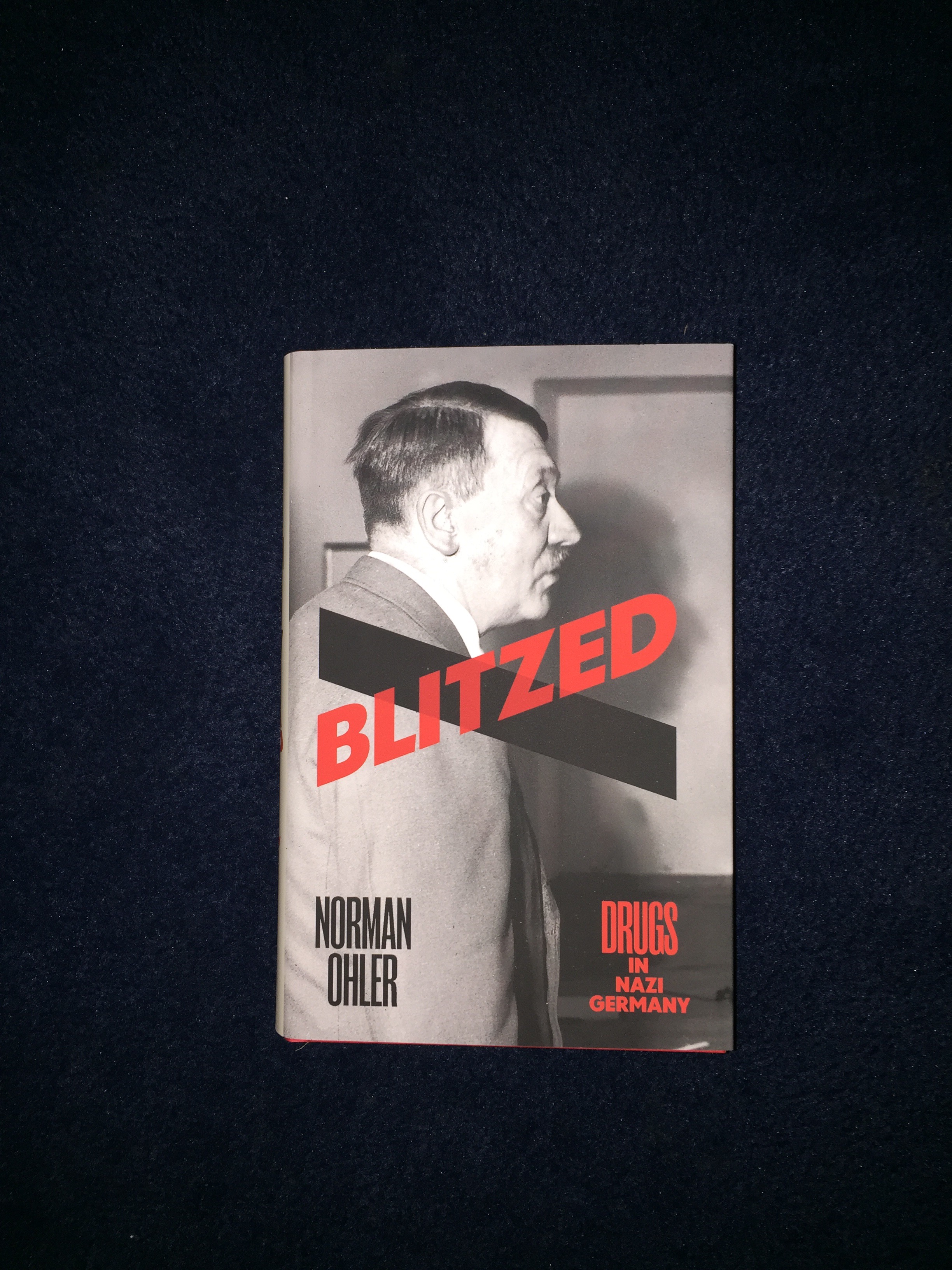
So, you may have noticed from yesterday’s WiB that I didn’t finish that many books last week. But that was not a problem when it came to picking a BotW, because one of the books that I did finish was Norman Ohler’s Blitzed.

It’s only in hardback at the moment I’m afraid, but I’m just happy it’s been translated at all.

Ohler’s thesis is that large amounts of drugs were consumed by Nazi troops as they steamrollered through Europe, that drugs were equally consumed by people on the homair front and that during the latter stages of the war (from around 1941 onwards) Hitler himself was dependent on hard drugs. Ohler backs up his assertions with primary source research using documents held in archives in Germany and in America and makes a persuasive case.

Now before I go any further, I need to say that although I have a history degree, I have, in the main, avoided study of Nazi Germany because I find it too unbearably terrible. Luckily my school stopped studying WW2 Germany at A-Level the year before I started sixth form* and at university I managed to avoid Twentieth Century history for all but one term** so I am no expert.

I found Ohler’s book incredibly readable and very well researched. It’s an appealing idea. The Nazis were off their heads on drugs. That’s why they did it. It’s comforting and reassuring – it was the drugs which made them do it – and means that you don’t have to worry about what you would have done in their place. I don’t think this is what Ohler is trying to say. In the case of Hitler he’s very specific that it doesn’t explain all of Hitler’s actions – just enabled him to maintain and continue his rule. As for the man on the street, or the soldier in a panzer regiment, the drugs enabled them to keep going for longer than otherwise. So I suppose what I’m saying is that this book shouldn’t be seen in isolation or viewed as the whole story. That would be far too simplistic. But it has new ideas and research I haven’t heard about before and is worth reading, if only so that you know what the historians are arguing about.  Because they are going to argue about this.

Get your copy of Blitzed from Amazon, Waterstones or Foyles or on Kindle or Kobo.  The paperback is out in May – pre-order on Amazon. Or if you don’t want to read the whole thing, Dan Snow interviewed Norman Ohler on his History Hit Podcast and it was reviewed in the December issue of Literary Review (subscription needed).

Happy Reading!

*We did Tudor England, the French Revolution, France 1814-1914 and the Italian Risorgimento which was much more to my taste.

** the second term of my first year, where my seminar tutor was a German Post Grad whose thesis was on “images of death in 20th Century Germany”.

Book of the Week, fiction

Book of the Week: Crooked Heart

Quite a tough decision on what to pick for BotW this week – there were several contenders. But in the end I’ve plumped for Lissa Evans’ Crooked Heart, which I devoured over the weekend while we were away for an extended jolly for my birthday.   This was another book which had ended up at the bottom of my to-read pile and resurfaced because of the Big Box Up and I’m so glad that it did.

Copy of Crooked Heart by Lissa Evans.
Mine had an extra cover on it – the actual cover is prettier.


Crooked Heart tells the story of Noel, who is evacuated to Hertfordshire in 1940.   Noel is an unusual 10 year old.  He’s been brought up by an old lady and is precocious and smart beyond his years.  He ends up with Vera – a 36 year old single mum struggling with debt, a recalcitrant and secretive son and her demanding mother.  Vera is sure there is some money to be made out of the war, but the trouble is that she’s not very good at making a plan and sticking to it.  But Noel is a different proposition.  He’s smart, he’s calm and he might be the answer to Vera’s problems.  But of course they’re not the only people making money from the war, and there are dangers other than air-raids in Noel’s new life.

I really enjoyed this.  Noel and Vera are engaging characters who make a good team.  Vera is almost a proto-Del Boy – but with Noel to help she has the chance of her deals actually going right.  In some ways Noel reminded me of  William in Goodnight Mr Tom (that’s a good thing) – Noel has had more advantages in his education and home life that William did, but he’s still a little boy who has had to grow up too fast and deal with things that children aren’t meant to deal with.  And one of the themes of Goodnight Mr Tom is finding your own family and your own place in life and there’s a lot of that here although Vee is very different to Tom.

It’s a heartwarming romp through the grey, greyer and uglier areas of life on the home front.  I could easily have read another 100 pages of Vee and Noel, but actually the ending is a brilliant touch.  I haven’t read any of Lissa Evans’ books before, but my little sister still has a copy Evans’ first novel, Spencer’s List, on her shelf which I bought for her back in the day 15 years ago, so I’m going to have to borrow that off her and read it.  Coincidentally someone posted a trailer on Facebook for the upcoming film Their Finest on the same day as I read this – and that’s based on Evans’ previous book Their Finest Hour and a Half, which I totally need to read now as well.

You can get a copy of Crooked Heart from Amazon, Waterstones and Foyles or on Kindle or Kobo.  And it looks like there might be a (slightly retitled) tie-in edition of Their Finest Hour and Half coming out too.

Happy Reading!

fiction, Forgotten books, literary fiction, women's fiction

Book of the Week: The Making of a Marchioness

This week’s pick comes from the bottom of the to-read pile – which is now the top because of the unfortunate fireplace situation.  I acquired a little stack of Persephone Print books from a friend a year (and the rest) ago and some how they ended up getting relegated to one of the piles behind the sofa arm.  What a mistake to make.  Frances Hodgson Burnett’s The Making of a Marchioness, although not perfect, turned out to be a little gem.

The Making of a Marchioness is a story of two parts.  Both are about Emily Fox-Seaton, a well-born lady in her early 30s (so on the shelf for the era – this was published in 1901) who has very little money and who supports herself by running errands for people better off than herself.  In part one, she gets invited to visit a country house to help out and during the course of her stay her fortunes change.  The second part chronicles how she adapts to her change in fortunes.

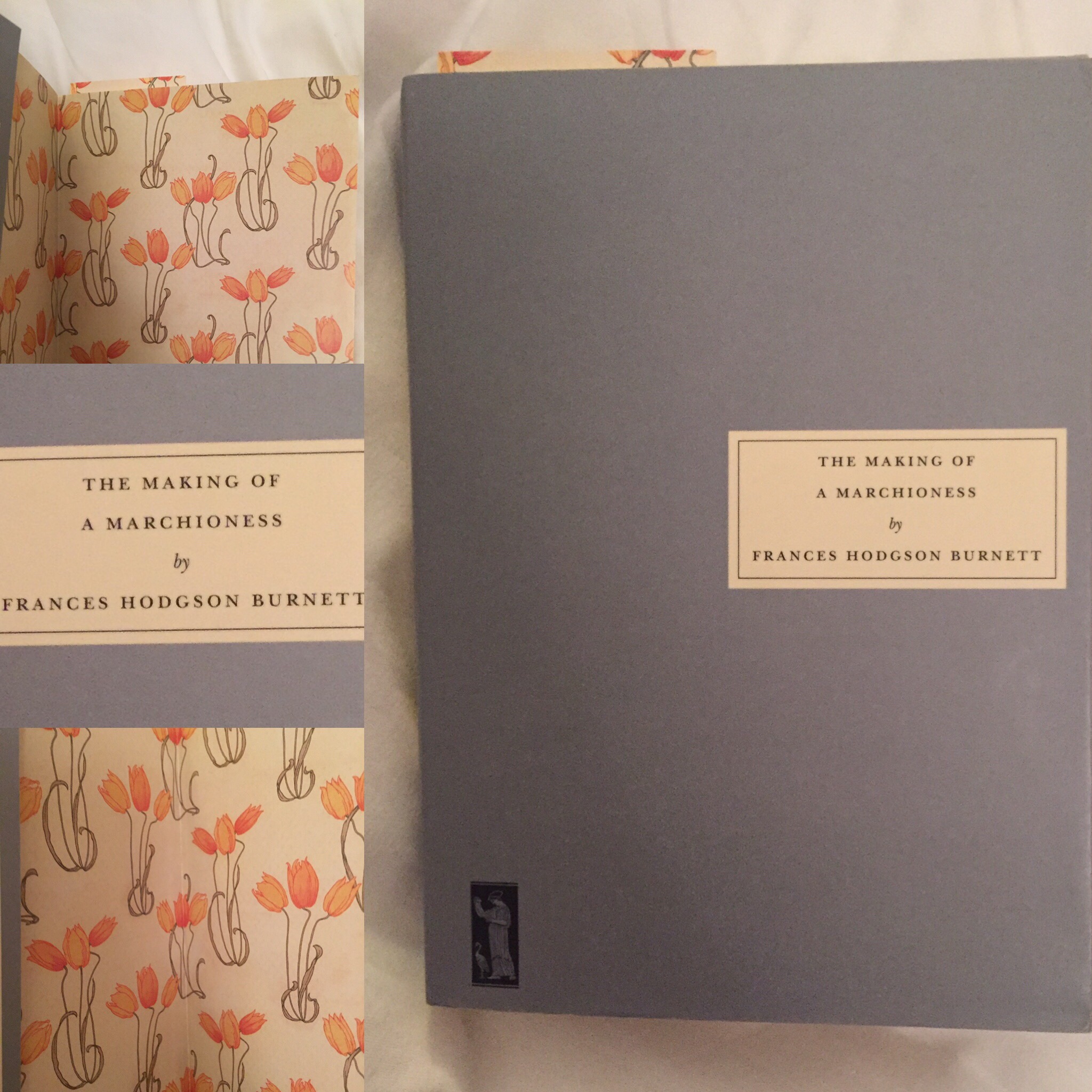
Now, in order to explain my feelings about this book, I’m going to have to give some spoilers. Sorry. So, if you don’t want to be spoilt (so to speak) then don’t read below the photograph that’s coming up.  But if you like a Cinderella story, but one that’s populated by really quite unromantic people who aren’t all beautiful or clever, than this might well be the book for you.  The latest Persephone edition, although not quite as pretty as mine is £9.00 on Amazon and Foyles as I write this or in the edition that I own for £14 from Waterstones, but the total bargain is the ebook because both Kindle and Kobo have a free versions.

Photo montage of The Making of a Marchioness
I do love these Persophones – plain unassuming grey cover and then a beautiful design inside.

And now the spoilers.  I did warn you.

I really, really, liked the first part of the book – with Emily winning the Marquess by being herself and realising what she was doing.  Emily is an immensely likeable character who is cheerful and uncomplaining and just generally indispensible.  Part two, where we see her adapting to life as a Marchioness is really very Gothic and melodramatic and I didn’t like it as much – perhaps because it was so different from the first part of the book.  Emily’s obliviousness to the machinations of the unsuitable heir and his wife (and her maid) started to annoy me a little after a while and I just wanted her to buck up and write that letter to her husband (away in India on government business) or confide in Lady Maria who would have sorted it all out.  The two parts were originally published as separate books, and I can’t work out if I would have liked the second part more or less if I’d read the first part in isolation and then come across its sequel.

What is true of both parts is that they are very well written and without the overblown romantic transports of many similar novels.  And the way it portrays marriage is also very different from other novels of the time.  Emily is not on the prowl for a husband in part one, she’s content to try and live her life without a man (even if she is worried about old age and poor health) but when she does get married, her husband is not a romantic hero – in fact he’s really not sure why he settled on Emily at some points – and their relationship is very stiff and Victorian (and Edwardian).  There are some slightly dated attitudes in here – but I’ve read much (much) worse and it’s on the nicer end of the attitudes and problems of its time.

Anyway, I really enjoyed reading an adult novel by an author that I only knew for her famous children’s stories like The Secret Garden – and I’m really looking forward to reading more of the Persephones on my to-read pile.

Happy Reading.

Book of the Week, non-fiction

Book of the Week: Grunt

Welcome to the first BotW post of the New Year, which is also the last Book of the Week from 2016.  You know what I mean – I read it last week before the end of the old year, but the post gets to you in the New Year.  Talking about last week and the old year, I hope you enjoyed my festive frenzy of posts. December stats is coming tomorrow (I thought better one post 3 days late, than three posts one day late each) now you’ve all had time to appreciate my New Years Reading Resolutions, and see my early failures in yesterday’s Week in Reading where I confess to a bit of a free book spree.  Any how, back to the point.

Copy of Grunt by Mary Roach
I don’t think I have a lot of books with green covers, not sure why!

This weeks BotW is Mary Roach’s Grunt: The Curious Science of Humans at War, which is not about guns and weapons, but about the scientific and technological developments which have come about because of war and conflict.  Topics include clothing regulations and design, shark repellent, submarine escapes and genital reconstruction.  It’s absolutely fascinating.  This is non-fiction writing at its best – informative and well researched, it wears it lightly and is incredibly readable.  You learn a lot without realising it as Mary wends her way through military installations and research centres asking the questions that you wouldn’t dare to.

I’m not a science reader – if you’ve been here a while now, you’ll know that my non-fiction reading tends to be history, biography or a bit feministy.  But I’ve been hearing about Mary Roach’s books for a while now – as they’ve been recommended on Book Riot’s Get Booked podcast as well as this getting a review on their All the Books podcast too – and I thought it might be a good way to widen my reading horizons slightly.  Popular opinion seems to have Stiff as her best book – but I’m not big on death and so was wary of a book about dead bodies – so Grunt seemed like a better place for me to start.  And if this is not Mary Roach’s best book, I can hardly imagine how good the others must be.  I might even have to get over my squeamishness about cadavers and read Stiff.

Him Indoors got really fed up of me pausing the TV to read bits out loud to him and I’ve already got a queue forming for my copy.  I bought my copy on my post-Christmas jolly to Foyles, but it’s also available on Kindle or from Amazon and Waterstones.  You’re probably going to need a bookshop with a relatively large non-fiction selection (ie probably not a train station bookshop or a small WH Smiths) but it seems to be fairly orderable.  It’s not terribly cheap anywhere I’m afraid, but it’s worth it.

Happy Reading.

Book of the Week, romance

Book of the Week: Christmas Ever After

What else could I pick for a Christmas book this week except for a book set at Christmas-time? Exactly. It has to be a Christmas book in Christmas week. And I’ve read a lot of Christmas books this year – don’t believe me? Check out my Christmas books post.

Cover of Christmas Ever After
I think this might be the last Christmas book cover of the year. Maybe.

So my Christmas book of choice this week is the third in Sarah Morgan’s Puffin Island series, Christmas Ever after, which has Christmas twice – once in the UK and once on the island – and an enemies to lovers sort of plot where artistic Skylar’s politician boyfriend hijacks her big exhibition and then runs out on her, leaving unwilling acquaintance Alec to come to her rescue.  She ends up meeting his family – who think she’s his first girlfriend since his disastrous marriage, and well, it goes from there. There’s lots of sparky dialogue, sexy times, snow, sexy times, discussions about how relationships would bring out the best in you and not stifle you and romantic times.

This was so much fun. I like fractious relationships with romantic undertones – or ‘I hate you, I hate you, I can’t stop touching your hair’ as Sarah Wendell at Smart Bitches puts it –  so this is right up my street and it was the perfect book for me to read on Christmas Eve. It was warm and festive and if my new fireplace had actually been installed (don’t ask) I would have read it tucked up in front of a roaring fire and it would have been perfect. I’ve read the Puffin Island series slightly out of order, but I don’t think it’s been a problem at all – because for me the fun of a romance isn’t who people are going to end up with, but how they get there so I don’t mind knowing in advance who is going to end up with whom because I haven’t read the books in order.

So, in short, lovely Christmas romance, perfect for reading in front of the fire on your Christmas days off (like today if you have a bank holiday too) or on New Year’s Eve if you’re not all Christmassed out by then (or by now!) – or just put it on your list for next December.

Get your copy from Amazon, Waterstones, Foyles or on Kindle (a bargain £1.99 at time of writing) or Kobo.

Happy reading!

Book of the Week, literary fiction, women's fiction

Book of the Week: Angel

You may be relieved to hear that this weeks BotW is neither Fahrenheit Press book or a Christmas book – even though the title might suggest that it could be the latter.  It is however the perfect book for curling up with on a sofa on a wintry afternoon.

hardback copy of Angel by Elizabeth Taylor
My second hand copy- the stain on the front was there when I got it, the dent in the top… I’m not sure.

The titular Angel is the spoilt darling of a grocery shop proprietress, who spins fantasies to her school mates about a glamorous house where her aunt is a maid.  When she is found out she takes to her bed, refuses to return to school and starts to write novels.  These turn out to be bestsellers – at least at first – even if they’re wildly inaccurate, far-fetched and slated by the critics.  But Angel doesn’t care – she believes she is one of the world’s greatest writers and nothing and nobody is going to stand in her way.

Elizabeth Taylor (not that one) has created a monster.  Angel is dreadful in every way – delusional, deceitful, ungrateful, selfish, vain and more.  But you can’t stop reading about her in a sort of fascinated horror.  She is oblivious to her faults and to the way that others view her and is able to sail through life in the comfortable delusion that she is clever, witty, brilliant and under-appreciated.  You would never want to spend any time with any one like her in real life, but I could happily have spend hours more reading about her antics.

There are a fair few women in books who become writers as a response to straightened circumstances – often with a trusty maid in attendance.  But they are almost always portrayed as gentlewomen brought low by financial troubles not of their own making.  Angel is not one of these – she starts writing as a way of getting her own way – initially she’s more interested in showing her neighbours that she’s better than them.  Then the money enables her to exert power over her mother, who in her attempts to allow her daughter to go further in life by scrimping and saving for a better education for her has created a stubborn tyrant who will brook no opposition.  As we follow Angel through 40 plus years we see the changes in British society as it moves from the Victorian era, through two World Wars – and we see Angel rewrite her past and invent new fictions for herself – which she believes even if those around her know other wise.

Although Angel is the centre of this book we also get to see the people she uses up and spits out – her mother, her aunt, a wannabe poetess, her husband, her servants – and the people who manage to survive her onslaught – only really her publisher and his wife.  It’s a portrait of a tyrant and it’s very, very good.

My copy of Angel is a lovely Virago Designer Hardback which I got second hand and seem to be quite hard to come by, but it’s also available in paperback from Amazon, Foyles and Waterstones and on Kindle and Kobo.  And as it was first published in 1957, you have a fighting chance of being able to find yourself a second hand copy in a charity or second hand bookshop.

Happy reading.

Book of the Week, crime, new releases, Thriller

Book of the Week: Sparkle Shot

I feel like I’m getting repetitive here, because this BotW is another Fahrenheit Press pick.  Seriously, my Fahrenheit subscription has been one of my best book-based purchases this year.  It was a total bargain (and I got in early so it really was a bargain!) and I’ve discovered older series I was too young for (or not in the right crowd for) first time around and new authors doing interesting things and who I’m hoping I can say that I was there at the beginning for.

And Sparkle Shot falls in the latter camp.  It’s Lina Chern’s first book and it’s short but it packs a lot in.  The subtitle is “A wannabe cowboy, a handsome cop and the search for a perfect breakfast cocktail” but that doesn’t really do it justice.  It is a perfect fit for the Fahrenheit family – Mara fits in somewhere between Sam Jones from Black Rubber Dress and Eva Destruction from Barista’s Guide to Espionage, in that she’s sassy, smart and runs with an interesting crowd which sees her getting tangled up with things she’d rather not be.  In this case, her roommate, a stripper who dances under the name of Karma misses a breakfast date with her and then phones in a panic – she’s witnessed a murder and needs Mara to help stop her being the next victim.

Sparkle Shot races along at 100 miles an hour, with boys with guns, girls with guns, wannabe mafia dons, cops and peril.  It’s probably technically novella length at 95 pages, but doesn’t suffer from any of my common complaints about novellas.  There’s not a hint of underdeveloped story or things feeling too rushed.  There’s plenty of plot, there’s backstory, character development and proper tension and proper danger – not just the sort of thing that is a misunderstanding or could be fixed with a simple conversation.  It does feel like it could stand a sequel or two – hopefully longer than this because it was over too fast – but even if it’s not more from Mara and her friends, I’m still looking forward to seeing what Lina Chern writes next.

You can buy Sparkle Shot on Kindle or in paperback from Amazon, or you could treat yourself to some Bad Santa Bucks from Fahrenheit themselves and buy a few of their books – the discount gets bigger the more bucks you buy – and given that I’ve already mentioned two Fahrenheit books that have been BotWs and I’ve also recommended Death of a Nobody and Murder Quadrille (this is why I think I’m getting repetitive with my love of Fahrenheit, but honestly, so many good books) that’s five there – even if you only buy the first Sam Jones book and not the series…  And if you’re still not sure, both Sparkle Shot and Barista’s Guide to Espionage would be good books to read if you’ve read Stephanie Plum or any of the other Janet Evanovich thriller series and are looking for where to go next.  And on that encouragement to buy books I’ll go away before I buy more myself.

Happy Reading!

Award nominated, historical, literary fiction, Prize winners, reviews

Book of the Week: The Underground Railroad

I am not a reader of Award-Winning Books.  See my posts here and here for proof of this — and I don’t think the situation has improved much in the last two years.  But some times you hear so much buzz and chatter about a book that you have to check it out.  Particularly when you luck into a copy of said book.  And Colson Whitehead’s the Underground Railroad was one of those books.  I’d heard everybody on the Bookriot podcasts that I listen to talking about how excited they were for something new from Whitehead – and then about how brilliant it was.  It kept popping up in lists of hotly anticipated books.  It was an Oprah Bookclub pick.  It was on President Obama’s summer reading list.

The Underground Railroad by Colson Whitehead
I apologise for my lousy photography, but I really like the cover – with the train tracks snaking around.

The Underground Railroad tells the story of Cora, a slave on a brutal cotton plantation in Georgia.  Life is more terrible than you can imagine, especially for Cora who is an outcast among her fellow Africans.  When Caesar, a recent arrival at the plantation suggests that they escape together, they take a terrifying risk to try and get to the Underground Railroad.  But it doesn’t go according to plan, and Cora’s journey is fraught with dangers as there are hunters after them, dogging their every move.  In Whitehead’s world the railroad is real – actual trains in tunnels under the southern states with a network of drivers and conductors ferrying runaways to safety.

This is such a powerful book.  It’s beautifully written, but oh so difficult to read – I’ve had to take it in bite-sized chunks so that I can digest it properly – but it’s worth it.  It makes you confront harsh and terrible truths about what people have done to each other and are capable of doing to each other.  But it’s also compelling and personal and page turning and clever.  Whatever I say here, I won’t be able to do it justice.  I still haven’t finished digesting it and I’m going to be thinking about it for some time to come.  It’s going to win all the awards – and it deserves to. It’s already won the National Book Award in the US and is Amazon.com editor’s Number 1 Book of the Year.  In years to come it’s going to be on English Literature syllabuses.  Well, well, well worth your time.

I would expect this to be somewhere prominent on a table or on a front facing shelf in bookshops.  It’s in hardback at the moment – and you can get it from Amazon (out of stock at time of writing, which says a lot), Waterstones and Foyles and on Kindle and Kobo.  It might make it into the supermarkets, but I’d be surprised.  The paperback is out in June.  I’m off to read some more of Whitehead’s work.

Happy reading.