After a break last week for a book that wasn’t strictly a mystery, this week I’m firmly back in the mystery world – not just with today’s pick but with basically everything in tomorrow’s Quick Reviews too. Because basically almost everything I haven’t already told you about from last month is murder mystery because that’s the sort of month it was, and June continues the same way (I finished this on Sunday!)
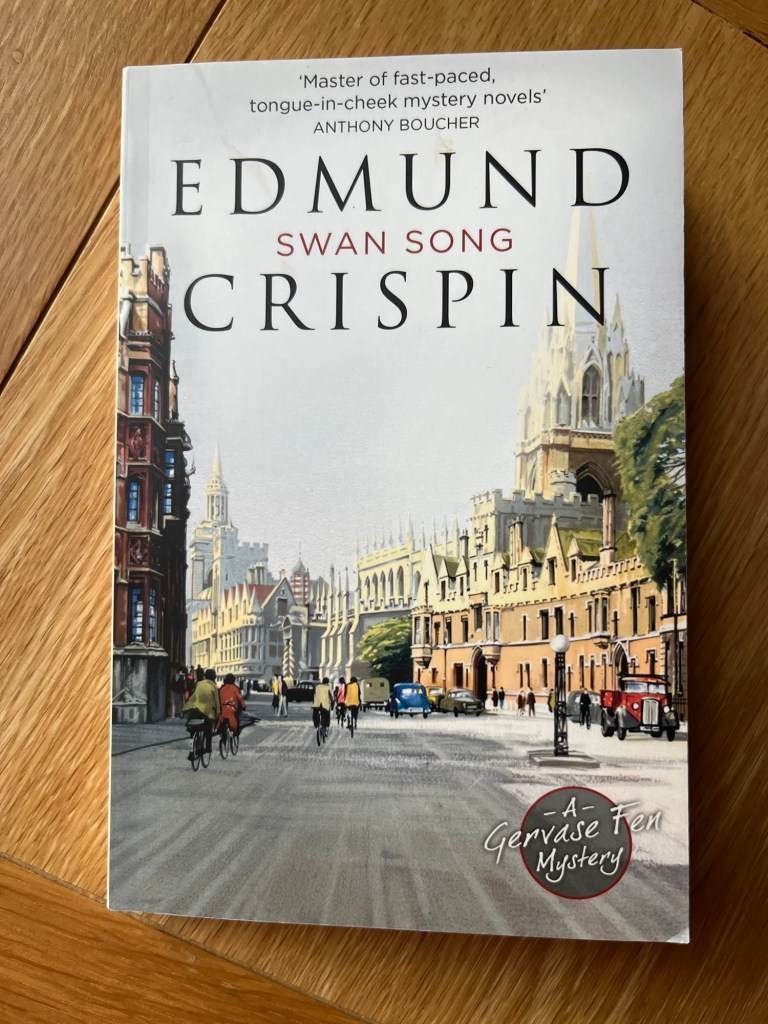
The Second World War is over, and on Oxford preparations are underway for the first postwar production of Wagner’s Die Meistersinger. It is not a happy company because one of the singers, Edwin Shorthouse, was already unpopular before he started throwing his weight around and behaving badly at rehearsals. So when he is found dead, few of the company are upset, until it starts to look like it may be murder and not a suicide and one of their number may be responsible. Gervase Fen has a challenge on his hands.
I am slowly (and out of order) working my way through Edmund Crispin’s series about the eccentric Oxford Don, and this is a really good one. I love a theatre-set mystery and this is a perplexing locked room puzzle, and those are always good too. This has a dash of the absurd about it as well as the eccentricities of Fen and it’s very easy to read and the solution fits with that.
This is available in all the usual ways including Kindle and Kobo and there have been enough recent editions that you maybe able to pick it up second hand too.
Happy Friday everyone, and to tie in with the theme this week, I’ve got a mystery series set not in Brighton but in the fictional town of Seatoun, somewhere on the south coast within easy reach of London, so you can see why it might fit my seaside-y vibes this week!
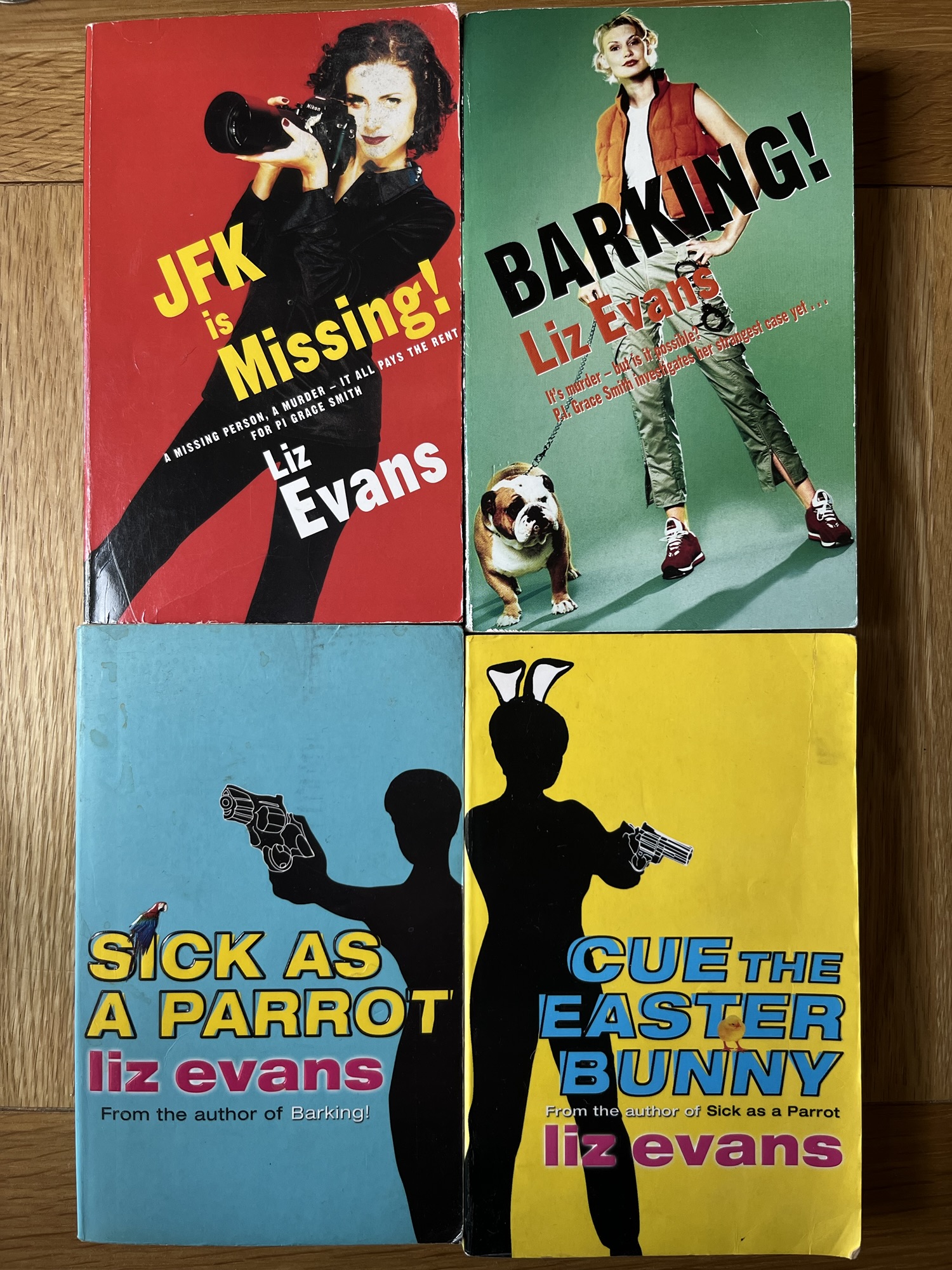
Grace is a former police officer, who left the force under something of a cloud, and who now works as a private detective in the town where she used to be a cop – trying to avoid her former colleagues as far as possible. Her career as a PI isn’t really going anywhere – and the cases she gets tend towards the mundane and the ridiculous. Less dead humans, more dead animals or missing people.
At this point it should be noted that I’ve read all but one of the five books in the series in their original late 1990s paperback form. And yes I know there’s only four in the photo (and in two different covers styles) but I couldn’t find a copy of Who Killed Marilyn Monroe on my shelves and there’s a chance I found it on the shelves at one of the hostels that I stay at. But anyway, these days they have been retitled and reissued on Kindle and that’s how I read book three. Now I read these all fairly well spaced out, so I can’t say for certain, but I didn’t notice any major re-working or rewriting between the two versions – just the radical change in title and design.
The new covers look much darker and more thriller-y than the previous ones. But don’t be deceived. Like Ruth Galloway, these are not as scary as the covers would have you expect. Obviously these are books written 20 years ago – so mobile phones are much less common and research is all done in person in archives and not on the internet – but that really works for a mystery series. And as I can remember this era from growing up – and cassette tapes machines, smoking in bars, a time before smart phones – there’s a nostalgia factor here for me too.
Only five are on Kindle at the moment, but they are all in Kindle Unlimited. One of them – with yet another different cover and the original title is available on Kobo. But I have managed to pick up most of these in second handbook shops or book exchanges so the paperbacks are not as hard to find as you might think.
As you could see from the list yesterday, last week was mostly spent reading Mitchell and Markby books, but when I wasn’t reading those, I was reading another murder mystery from the early 1990s and that’s what I’m writing about today. And just to whet your appetite, I’ve got another series of a 1990s vintage coming to you on Friday. It’s like I’ve got a coherant theme happening… oh wait, I have. Two of them. Just you wait until tomorrow…
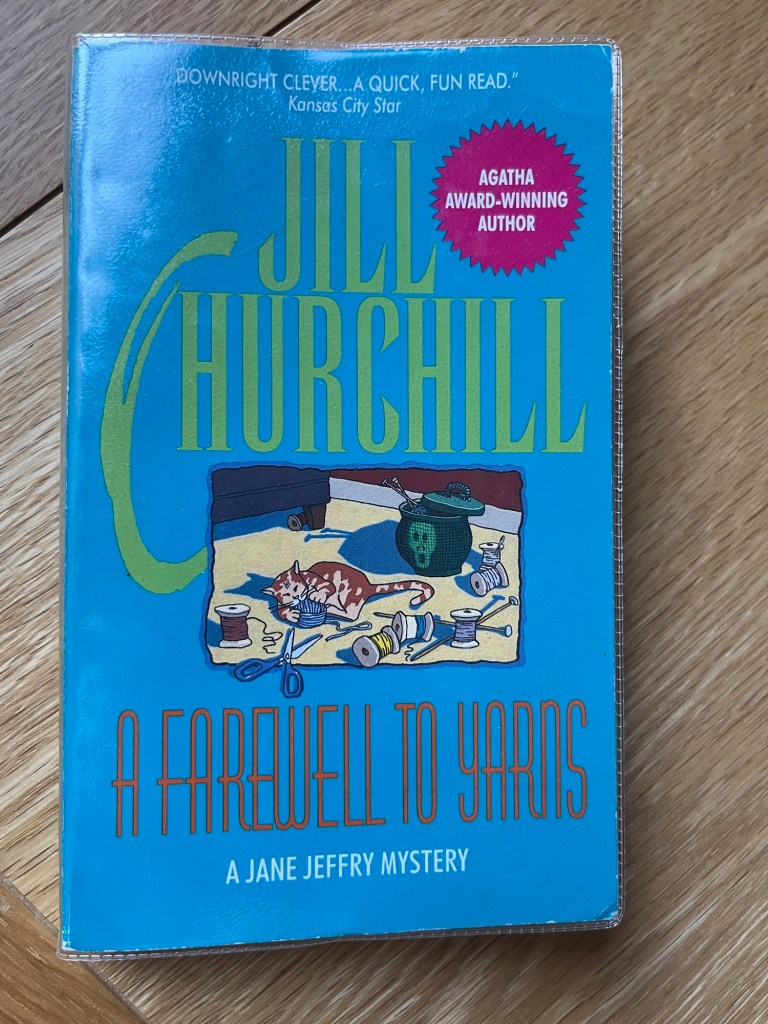
Anyway, Farewell to Yarns is the second book in a series featuring widowed single mum Jane Jeffry. It’s the run up to Christmas and as well as helping organise a church bazaar she’s got an old friend coming to visit her. Jane hasn’t seen Phyllis in years and surprised by the fact that she suddenly wants to visit her – and then is even more surprised when Phyllis turns up with a bratty son that no one knew she had. And then there’s a body and Jane can’t help but get involved in trying to figure out what happened.
Maybe it’s just the mood I’m in at the moment, but this is another really easy to read and fun (if you know what I mean) cozy murder mystery. It’s not long, but the plot is clever if slightly outlandish in places, but that doesn’t matter because if you were going to rule out slightly bonkers things in books you’d never read any cozy crime at all! Think of all those small towns with insanely high murder rates and small businesses continuing to thrive even though their owners keep stumbling across bodies on the premises. I haven’t read the first book in the series, but it didn’t matter at all because any background you need is explained in this – and it’s only the second book in the series so there aren’t too many running plots that you need to get your head around anyway.
This one is going to be harder to get hold of – I bought my copy (and another in the series) in the second hand bookshop at Baddesley Clinton and it’s not available on Kindle. But Amazon and Abebooks have copies and sensible prices, and I’m hoping that I might be able to pick up a few more in the series if I keep my eyes peeled!
For this week’s pick I’m reporting back in with some good news: the new Vinyl Detective is pretty good.
The set up is this: the granddaughter of an Italian film music composer is trying to reissue his music. But because he was suspected of carrying out a murder, some of his masters were destroyed and records themselves are somewhat hard to find. So she enlists the Vinyl Detective to try and track down the rarest of them all for her – the one for the movie where the murder happened. Oh and if he can clear her grandfathers name that would be great. But trying to stop her are the grandchildren of the murder victim…
You may remember that I was a little trepidatious about this one, because I didn’t love the last book in the series. But this was a really good read. It’s got a good mystery, a real sense of the musical genre it’s tackling and lots of food. Plus the extended gang is very much in evidence if you have read the other books in the series. Plus as a bonus for me, there’s lots of action in and around Barnes and Richmond, which are both places that I have stayed in a fair bit in my efforts to avoid the long commute back and forth to London at various points.
I’m going to say this will work best if you’ve read at least some of the others in the series, but it’s also an excuse to post the shot of them all here and to comment on the fact that this book’s cover animal is a dog. You’re welcome. I’ve already seen this in the shops so in should be relatively easy to get hold of in paperback as well as in all the usual digital formats.
Happy Tuesday everyone. I’m deeply confused about what day of the week it is and messing with my brain as I keep panicking that I’m forgetting to do things/should be somewhere that I’m not. Why is my brain like this? Anyway – to this week’s pick which sees me back with a British Library Crime Classic.
In Tea on Sunday, Alberta Mansbridge has invited an assortment of guests over for tea – among them her nephew, a friend she had fallen out with, her accountant, her doctor, an ex-prisoner she has been trying to rehabilitate and an Italian architect she has been sponsoring. But when they arrive they find that she has been murdered. The house is locked, and so her murderer must have been someone who she would have let into the flat. Our detective charged with working out who is responsible is Inspector Corby who discovers that there are plenty of options for who might have wanted the wealthy, elderly lady out of the way.
This written in 1973 but feels like it’s from an earlier period – except for the fact that some of the guests are of decidedly more modern occupations than you would have found in some of those books, or at least more explicit about what it is they do than you would have found in many of those mysteries. There have been a few patchy novels among my recent BLCC reading – but this is definitely a good one. Lettice Cooper was a prolific author, but not normally of mystery novels but I really liked her writing style so I shall look out for more from her. One of her other novels has been published by Persephone so that may be the easiest one for me to lay my hands on, should I ever get the current state of the pile under control.
Anyway, this is in Kindle Unlimited at the moment and I’ve seen it in paperback in the shops too as it’s a recent release.
So I said yesterday that I had plans for some of the other books that I read last week – and one of them inspired this post. So here I am delivering on my promise that you’d hear more about some of last week’s reading and not just the BotW! This post is about mystery books that feature real people as the detectives.
So lets start with the book that inspired this: The Mystery at Rake Hall by Maureen Paton. This new mystery novel came out earlier this month (I got my copy via NetGalley) and is set in post-war Oxford and features C S Lewis – known as Jack – getting drawn into a mystery after one of his brightest pupils stops coming to her tutorials. Susan it turns out is at Rake Hall, a seemingly respectable hostel for unmarried mothers. But there’s more to it than meets the eye and along with Lucy, one of Susan’s friends and the daughter of a college servant, Jack starts to investigate. I don’t know a lot about the real C S Lewis, but this is a good mystery in a great setting. I love Gaudy Night, and that world of scouts and bulldogs is very much still in evidence here a decade or more after Sayers’ novel – and Sayers herself makes an appearance here too.
From one golden age author to another – and Nicola Upson’s Josephine Tey series. I’ve written about these before, but they’re probably the most well known of the fictionalised real person solves crimes books. Because of the circles that Tey moved in, this also features people like Alfred Hitchcock and Daphne Du Maurier in the stories as Upson weaves the mysteries around the real events of Tey’s life. There are eleven books in the series, and I don’t remember feeling like it was all wrapped up when I finished Shot With Crimson – but that came out in 2023 and there hasn’t been another yet. And although Upson has a new book listed on Amazon, it seems to be a standalone Christmas mystery set in 1943 (which I will definitely be looking out for) rather than another Tey novel but details are sketchy so we will see. Margery Allingham makes an appearance in one of the Upson novels – and I’m pretty sure there’s a mystery series featuring Agatha Christie doing the detecting as well, so only Ngaio Marsh to go to complete the set of Queens of Crime!
It’s been a few years since I read them, but there is also Gyles Brandreth’s series of Oscar Wilde murder mysteries which also feature Arthur Conan Doyle and Wordsworth’s great grandson Robert Sherard. There are seven in this series, and I’ve read the first three and book five (I used to get them from the library, but my local library closed down for: reasons and I’ve not been a library regular since) but they’re clever mysteries with a dash of wit – although obviously you are heading towards Wilde’s eventual imprisonment (which is part of book six) and some of the foreshadowing of that can be a bit… clunky. But if you see them around, they’re worth a look.
And finally a slightly tangential one – and one where I’ve only read two of them. Jessica Fellowes’s Mitford Murder mysteries. I say they’re tangential because they’re set in the Mitford household, but its one of the staff who is doing the actual mystery solving. Louisa is nursery maid to the younger children and chaperone to the older ones (at least to start with), and this means that she has a ringside seat to the events of the Mitford sisters’ eventful lives. I will say that I thought the first one didn’t quite live up to the promise that it had in the blurb, and the second one had more of the stuff that I didn’t like about them and so I haven’t read any more of them – but the fact that they got to six in the series and I see various of them in paperback in the crime sections of the big bookshops fairly regularly suggests that other people liked them more than me!
That’s your lot for this week – hopefully there’s something here for you – but also, don’t forget I’ve got a whole post about Novelised Real People (in books that aren’t mysteries) from back in 2021.
I’m breaking a couple of rules this week because somewhere along the line I had managed to miss that Catriona McPherson had started a new series – and that we were on to the second book in it. But as The Edinburgh Murders came out last week I am at least timely!
It’s 1948 and Helen Crowther is a welfare almoner for the newly formed NHS in Edinburgh. It’s not an easy or a popular job, and her home life isn’t simple either but she keeps on going. While she’s at the bath house with one of her clients, the body of a man is found boiled to death in one of the cubicles. And then another couple of bodies turn up and Helen finds herself investigating because she’s noticed a few things that are worryingly close to home.
This has a great setting and a cleverly put together mystery to solve. I found Helen a really interesting character, and her job gives her an excellent excuse to be sticking her nose into other people’s lives. There aren’t as many historical mystery series set in the immediate post war period as there are set in the 1930s so that make a really nice change as well as the Edinburgh setting. I’m pretty sure this will work best for you if you’ve already read the first book, but I haven’t and I still enjoyed it! Like with McPherson’s Dandy Gilver series, the mystery is darker than you often find in historical mysteries, but it’s not too graphic although there are a couple of gruesome moments its more implied than right there on the page.
My copy came via NetGalley, but it’s out now in the UK on Kindle and Kobo as well as in paperback. I couldn’t find the first one of these in the shops last week when I was looking, so I don’t know how easy the hardcover version of this is going to be to find though.
I finished the last book in this eight book series a week or two back, which makes this the perfect time to talk about them!
This is a series of eight murder mystery books set on different ocean liners starting in 1907. Our detectives are George Porter Dillman and Genevieve Mansfield who are employed by the shipping line as detectives on the ships but travel incognito and mingle with the first class passengers looking to try to prevent trouble before it even starts. Except that bodies keep turning up. In the first book it’s only George who is the detective but Genevieve soon joins him on the payroll. Most of the books are set on transatlantic crossings but there are a few on other routes too.
This is all Edwardian and pre-war set, which makes a change in historical mysteries in general and for me to – because there are a lot of interwar series and a lot of Victorian series but not so much set in between. I also really like the cruise ship settings – it’s got some glamour but it’s also a closed group for the murder so you feel like you have a chance at figuring out who did it before the reveal. They’re also pretty easy reading – not scary, not too many bodies or on page violence but enough twists to keep you turning the pages.
These are pretty easy to get hold of – they’re often in the mystery sections of the bookshops still, and they had a spell where they were in The Works all the time so they turn up relatively regularly in the second hand shops. And of course they’re on Kindle and occasionally go into Kindle Unlimited too.
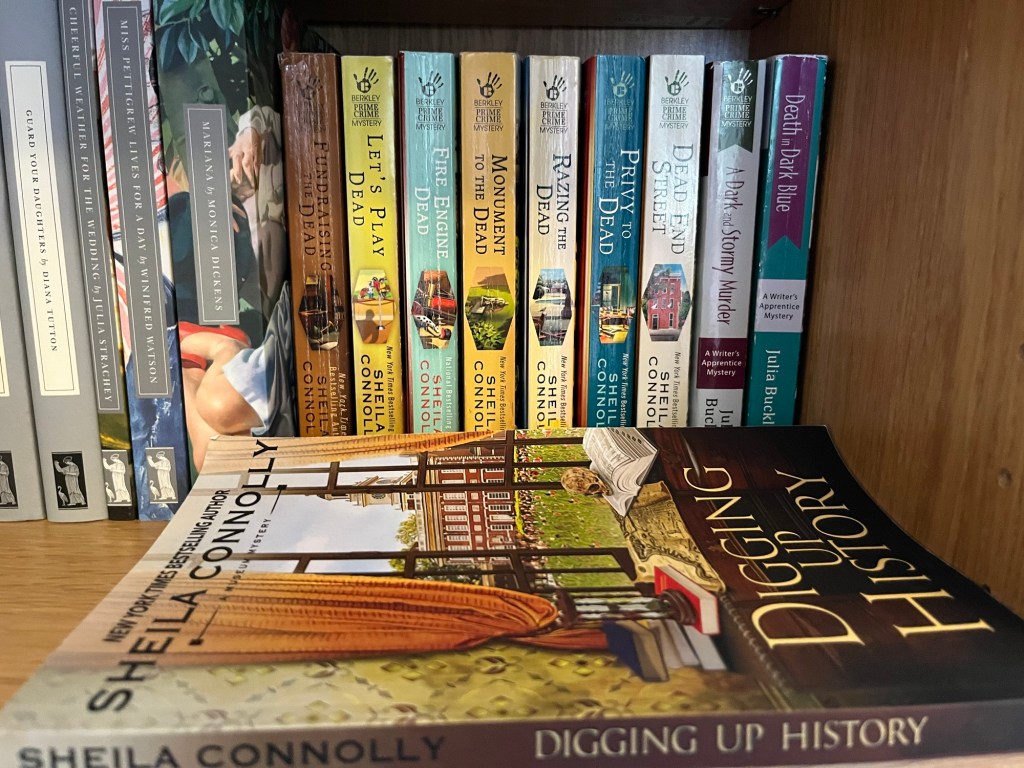
Happy Friday everyone, I’m back with a cozy crime series that I blitzed my way through over a couple of months, and although I’m still annoyed that the final book is a different size to all the others, I enjoyed them enough that I’m trying to work past the issues it gives me for shelving them and writing about them anyway!
At the start of the series Nell Pratt is the chief fundraiser at the Society for the Preservation of Pennsylvania Antiques, when an archivist is found dead on the same day that it’s discovered that a collection of letters from George Washington is missing. Of course she starts to investigate – this is a cozy crime series after all – and thus a series of museum/antique related mysteries is underway. Like most similar series, Nell develops a group of friends and colleagues who help out with the investigation and there’s a running romantic subplot through the series too.
I bought the second in the series at Bristol this summer – and once I’d read it, I went off and started buying up the others and then read them in order. I really liked the set up of the museum and philanthropic community around Philadelphia – it felt like something a bit different after a lot of small business related cozies. I don’t know a lot about the way the museum sector works behind the scenes in the UK, let alone in the US so I have no criticisms to make on that front – I just enjoyed the mysteries and the characters and let it all unroll!
I haven’t read any other Sheila Connolly – and I was sad to see when I was digging around into her writing to find that she died in 2020. But she has other series that I will happily work my way through should the opportunity present itself.
This is another of those times where most of a cozy crime series isn’t available on Kindle – only the last one is in ebook format, and I didn’t realise when I ordered the paperback it that it was going to be a non-matching size – if I had I might have gone with the ebook.
It’s been a while, but here I am, back with another post of some of the really good British Library Crime Classics I’ve read recently. And recently is a fairly elastic thing, because I started putting this together ages ago, and then some of the books that I was expecting to use in this ended up being Books of the Week instead!
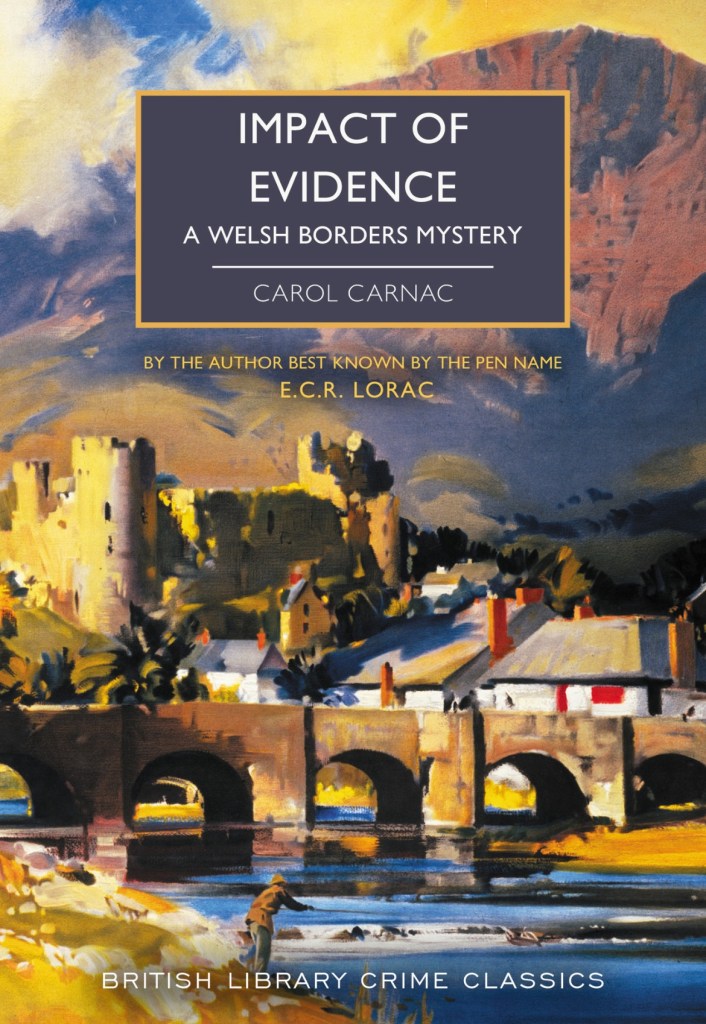
Impact of Evidence by Carol Carnac
This is set in the Welsh borders where an elderly doctor known for his erratic driving has gone off the road and into the river – but when the police pull out the vehicle a second body is discovered in the back. Who is the mystery corpse, how did he get there and was the doctor responsible? This is another mystery centering on a tight knit community where everyone knows everyone else’s business and so clues can be picked up that way. Really good and atmospheric.
Excellent Intentions by Richard Hull
This is a murder mystery about the murder of a deeply unpopular man, who drops dead on a train to London. There are four suspects, and the story is told by intercutting the investigation by Inspector Fenby and judge sitting watching the prosecution at the trial – which he intends to be his last case before retirement – without telling you who the accused is until very late on. I really enjoyed reading it – I wasn’t sure who I thought the accused was going to turn out to be, and then I very much enjoyed how it all revealed itself and what the solution turned out to be.
The Measure of Malice Edited by Martin Edwards
A collection of murder mystery short stories all with some sort of scientific twist to them. There are some authors here I haven’t come across before along with some familiar names if you’ve read other BLCC titles and then two really big names in Conan Doyle and Dorothy L Sayers. Not being a Sherlock Holmes expert I can’t tell you if the story here is one of the better known ones, but I can say that the Sayers is a Wimsey that I have read before in one of the Wimsey short story collections, which probably isn’t a surprise, although it is a good one (even if I think bits of it clash with part of the first Paton Walsh continuation, but that’s a really nerdy point). All in all a good and varied selection.
And that’s it – and I can’t see that I’ll have read enough of these for another round of of BLCC before the end of the year, although who knows whether one will end up as a Book of the Week before then in the six weeks we have to go…





 Verity Reads Books (lots of them)