Happy Friday everyone, and it’s another mystery series today, but this one aimed at middle grade readers. And I do love a good middle grade book. And sometimes a bad one if you look at some of the terrible lesser known Girl’s Own books I’ve read over the years!
So the Taylor and Rose series is the follow on to Katherine Woodfine’s Sinclair Mysteries and features the same main characters, Sophie and Lillian, who are running a detective agency but also doing work on the side for the secret service agency. It’s in the years running up to (but not reaching) the First World War and the overarching plot that runs across the series is around a shadowy organisation who are trying to disrupt the world order and even maybe start a way by sowing discord between nations. Thus means there is plenty of scope for international travel as you can see from the titles of the books.
I really enjoyed the original series and this is a great continuation, that widens the world out and feels like it’s for slightly older readers in the same way that the main characters are slightly older. These are adventure capers more than mysteries and probably do need to read these in order to get the most out of them because of the over arching storyline with the secret society. I read the first two a couple of years ago and the last two over the last month or so and it worked really well.
You should be able to get these really easily in bookshops with children’s sections – and the first one (or even the set!) would make a great Christmas book for the 10-12 year old in your life.
It’s Tuesday again and that means it’s review day. And today I’m back in Girl’s Own territory with a boarding school story that I picked up after one of my friends gave a talk about the author at Book Con before last. Yes it’s taken me more than two years to get to it, but that year was a particularly large haul. I braced myself and checked the photos from that one and the last one – I’ve got one left to read from the each. I should work on that…
Anyway: Juliet Overseas. The Overseas of the title is England – for Juliet is from New Zealand. She’s been sent over to go to her mother’s former school, which was actually founded by her grandfather and three of his friends, but when she arrives she discovers that things in her house have gone downhill – they’ve got a reputation for being the slack house and a severe shortage of seniors to try and pull things back together. And so of course Juliet throws herself into restoring the house to former glory with the help of hockey, cakes and some no nonsense behaviour.
This is such a good example of a boarding school story. I tend towards series because I like to see characters progress though the school (and I guess because all the early one so read were from series) but this does such a good job of setting up the school and the rules but without info dumping on you. The talk about Clare Mallory at Bristol was called “Salvation through Hockey” and although I wasn’t a hockey lover at school (more of a cricket and tennis girl) the match sequences in this are really good and show the power of a sport to bring people together.
I appreciate that this is a bit of a niche recommendation, but sometimes I do that and I’m not even sorry about it! Anyway this is going to be on the harder end of things to get hold of – specialist vendors only really or a book conference…
Another week, another BotW pick that is a little bit niche. But on the bright side, it’s another of my acquisitions from Book Con, so at least I’m bringing the tbr-pile down a little. And hoo boy, the plot to this one is crazy.
This is the second in the Vicki Barr, Flight Stewardess series, and it should be noted I haven’t read the first. Vicki is newly graduated from the stewardess school and is now being sent out on her first flights with Federal airlines. She’s living in a flat with five other stewardesses and has a bit of romance going on with a handsome co-pilot. SHe’s working on a short hop line and on one of her flights she encounters a young woman called Joan who is clearly in some sort of trouble and ends up helping save a timber business. Yes, you read that right a timber business. I now have a rudimentary understanding of how the timber business worked in late 1940s America, as well as the methods of fire-watching and fire fighting that were in place for forested areas. You weren’t expecting that were you? Me neither.
I feel fairly safe in telling you this, because I don’t think any of you are going to be buying this one. So I also don’t mind spoiling the plot a bit further and telling you that Vicki also rescues her younger sister from drowning in an icy pond, takes a crew of hunters up on a flight to a shooting trip – and one of them shoots a window out on the plane on the way – and that the denouement of the timber plot involves landing the plan on a track in the middle of the fire and then a life or death fight. All this in under 200 pages. You’re welcome.
The good news is that unlike her British equivalent, Shirley Flight, Vicki’s plane doesn’t crash. Shirley is in a worrying number of crashes over the course of her series, but in this one at least Vicki makes it safely down to earth at the end of all of her flights. It’s slightly random that a teenage air hostess is the one to work out how Joan’s father’s business partner is trying to put him out of business, and also that the guy who is organising the hunting trip is also a timber baron, but coincidences like that are the stuff of Girl’s Own adventure stories. And I love them for it.
There are fifteen other books in the Vicki Barr series and I’d happily read more if I can lay my hands on them at a sensible price because this is my sort of crazy. And unlike some of the other books of the ear, I didn’t spot any racism. Which is a low bar to be cleared, but there it is and the same can’t be said about some of the Shirley Flight Books. Helen Wells is also responsible for the majority of the books in the somewhat better know Cherry Ames series about a peripatetic nurse, some of which I’ve read as well and which are generally easier to get hold of.
My copy came from one of the sales at Book Con (the dealer one I think) and as it’s an American series, they’re not the easiest to lay your hands on if you want them. I can see a couple on the sales sites, but although the actual books are cheap there’s often a hefty whack of postage attached to them because they need to be shipped from somewhere else. But as I don’t think you’re going to be buying them anyway, it doesn’t matter – I just hope you’ve found this as entertaining as I did when I was reading the book!
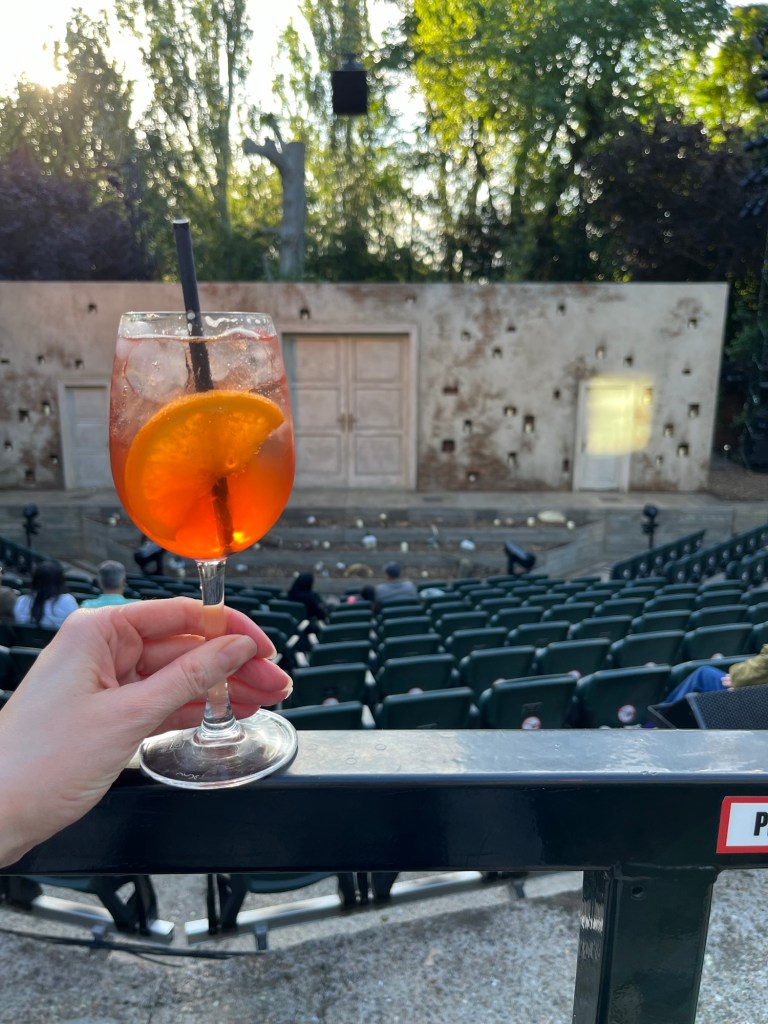
This is a fresh version of the Frances Hodgson Burnett classic children’s story that is on at the Open Air Theatre in Regent’s Park for the start of the summer. The core story – about newly orphaned Mary Lennox being sent to live at Misselthwaite Manor after the deaths of her parents and uncovering the many secrets that the house is hiding remains the same – but there has been some sensitive updating done which makes it work a bit better for today’s audiences as well as providing a beautiful inspiration for the stage design and music concepts.
I really, really enjoyed myself watching this – with the trees all around you and birds flying overhead as the sun went down, the setting is absolutely perfect for a play about the healing power and magic of nature. I saw the fourth preview – so there were still a few technical gremlins to sort out (mostly mic cues) but the show itself and the performances were wonderful. In fact my only real grip was that my feet got cold, but that was my own fault for wearing canvas shoes with no socks!
This would make a great show for the kids this summer – but sadly it’s only on until July 20th, which is just as the schools are breaking up in most places, then Fiddler on the Roof takes over in the theatre for the rest of the summer. You can find more details here.
As mentioned yesterday, very much a week on my sickbed last week with a lot of rereading going on, which left an interesting array of options for today – so I’ve setttled on a sort of re-read – I’ve read the abridged version of Chalet School Wins the Trick before, but never the original version, so here we are, another week another Girls Own pick! Apologies for the slightly gloomy/shadowy picture – it’s so overcast here you would not believe
The Chalet School Wins the Trick is number 46 in the series and in many ways could be considered Peak Chalet School Tropes. But I’ll come back to that. First, lets have the plot: Just before the start of term, Miss Dene catches a group of children trying to start a campfire in the middle of the school’s best cricket pitch. She sends them along their way – but the group swear they’ll get their revenge on the school. Thus the summer term is marked by a series of pranks pulled by the quintet affecting the pupils, the staff and ex pupils.
So if you were playing Elinor Brent Dyer Bingo, this would get you a full house. We have: Joey saves the day, Mary Lou Butts in, Joan Baker being “not the right type”, sick parents/relatives at the San where the children don’t know, very weird medical treatments (a scalded arm into a vat of flour), lots of unaccompanied Child Wandering, a fete, a death of (another) parent, women’s careers being thrown over because of housework and the all time great – a massive continuity fluff within the same book. I think the only thing its missing is Joey singing someone out of an illness/coma!
As with so many reviews of Girls Own stuff that I write, this is not a book that you can easily get hold of – and nor do I recommend you to, unless you’re already interested in the oevre. It was one of the rarer books – it is from 1961, so fairly late in the series and so it had less time to be reprinted than the earlier ones. And it is full of references to escapades in previous books, which might get tiresome if you haven’t read them. If you’ve never read a Chalet School book, you should probably start with Chalet School in Exile – which is probably EBD’s best book – grappling with how to deal with a British school in Austria as the Nazis swept through Europe and what women and girls could do about it. It’s not your normal school story. Other than that, you could always start at the beginning.
As it’s been a week of Girls Own content, lest carry it on with another classic children’s series – this time an adventure one for boys and girls.
In case you’re unfamiliar with the series, they follow a group of children going on outdoor adventures during the school holidays. There are three families – the Walkers (the Swallows), the Blacketts (the Amazons) and the Callums (the Ds) – who appear in various configurations across the series, but the opening books (which are my favourites) mostly centre on the Walkers and the Blacketts who start off as rivals but become friends. Sailing is often involved – and many of the books are set in and around the Lake District in the North West of England.
I first encountered the Swallows and the Amazons when my Year 3 teacher read the first book out loud to our class and I carried on reading most (if not all) of the rest of the series by borrowing them from my local library. What’s not to love about a group of children going off to camp on an island and sail around a lake all summer long. There’s “pirates” and actual crime and it’s just wonderful. Let’s be honest, which child didn’t wish they’d had a grown-up free holiday or two, or been allowed to roam around without supervision for days on end – I think it’s one of the reasons why Secret Island was one of my favourites of the Enid Blyton series when I was little.
I should say at this point that I am not by any means an outdoors person. We never went camping when I was a child, so when I was first reading these the idea sounded fun – I think I “camped” on the floor of my bedroom for a few weeks after reading the first book, but I was not a big walker or hiker. I also suffered from travel sickness so being on a boat of any size was always pretty awful, but I loved the books – and still continue to enjoy them whenever I get a chance for a re-read. There’s something about children with a secret code between themselves and who go on what are basically quests that just really appeals. Also you learn a lot about various countryside-y things from the mid 20th century – most of what I know about charcoal smoking and dowsing for water comes from this series – which of course means I’m hopelessly out of date, but I didn’t know that at the time.
There are a couple of books in the series that get a bit weird – and as with a lot of books of similar era, there are some bits that haven’t aged well. I probably should have had a reread before I posted this – but I remember that I found Missee Lee very weird when I read it when I was about 10. And I don’t own all of them – I have some from when I was little and I’m picking the others up as I see nice copies at sensible prices. But I do own the first two on audio book and have listened to their fairly regularly. I treated myself to Pigeon Post (my other childhood fave) the other week and it’s next on my to listen list.
The first book has been turned into a film twice – it’s been a while since I saw the original film, but I remember it as being fairly true to the actual plot. I have seen the most recent one has had a fair few alterations to the plot – and not just the fact that they renamed the unfortunate to modern ears Titty. I’ll leave you to judge for yourself from the trailers!
Anyway, delightful outdoors fun, even if pemmican – real or fake – sounds disgusting!
Last week it was a graphic novel, this week it’s a middle grade novel, I’ve got mystery book posts planned and all sorts for June. I really am giving you the full range this month aren’t it!
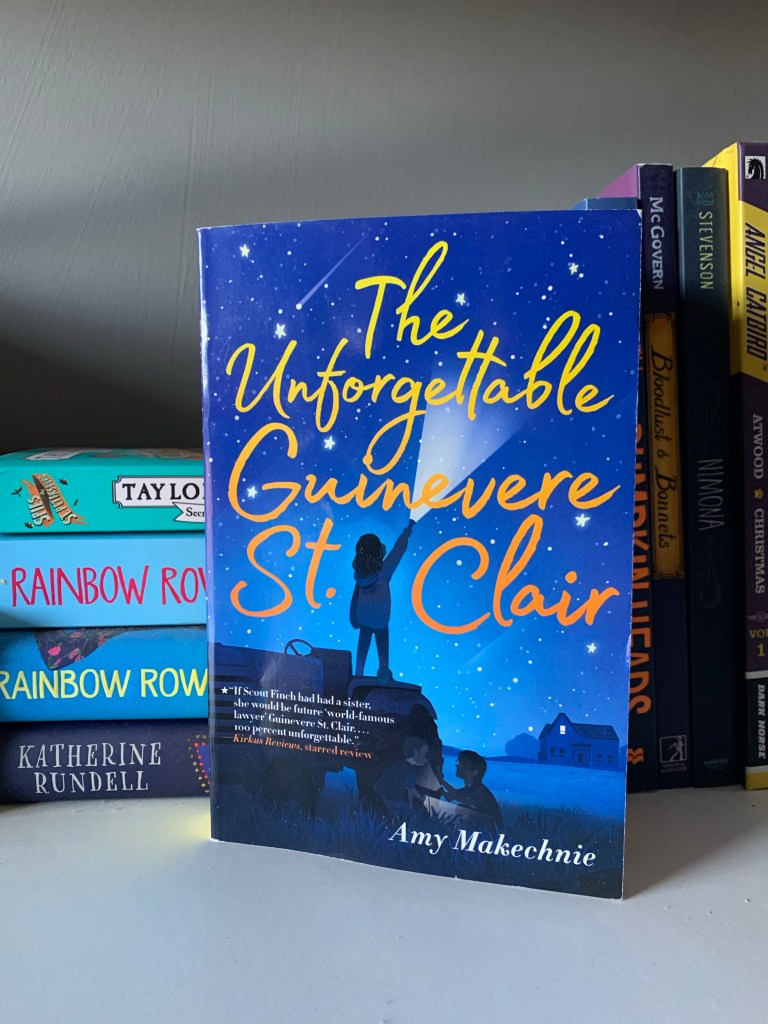
Amy Makechnie’s The Unforgettable Guinevere St Clair is about a ten-year-old girl who moves to Iowa to try and help her mother’s recovery from a brain injury that has left her unable to remember anything past the age of 13. Crow is where her parents grew up and Jed is desperately hoping that coming back will jog Vienna’s memories. Gwyn and her little sister Bitty are used to the bright lights of New York, so small town life comes as a bit of a shock to them, especially their new neighbour Gaysie Cutter. They soon make friends with Gaysie’s son Micah and his friend Jimmy, but they also discover that Gaysie was friends with their parents when they were at school. When Gaysie’s only friend, farmer Wilbur Truesdale, goes missing Gwyn is determined to solve the mystery but she may also find out more than she wants to know about her parents’ past.
Because of Jed’s absence and the age of Gwyn’s grandmother, the children are able to spend a lot of time running around outside without a lot of adult supervision. This gives the story an almost out of time feel – except for the references to current pop culture. The neighbourhood is full of interesting characters for Gwyn to met and things for her to try and work out. Gwyn has decided that she wants to be a lawyer and she is obsessed with finding out people’s stories, but often jumps to the worst possible conclusions (which is understandable given what has happened to her family) but also isn’t actually very good at asking the right questions or showing empathy to people. She wants to solve problems because there is one big problem that can never be solved – Vienna:
Gwyn calls her mum Vienna – because she’s not a mum to her because of her injury. Her dad is obsessed with trying to find a cure for her but as you go through the book you realise that what is initially described as memory loss is actually not amnesia, but massive and irreversible brain damage. Gwyn knows this. Gwyn’s grandmother knows this, everyone in town knows this – even if they’re not saying it – but Jed thinks a miracle is possible, because Vienna has survived this far. This all means that Gwyn is older than her years in someways, but she has her own trauma from what happened to her mum. She’s taken on the role of her sister’s protector, but she can’t see when she is hurting other people’s feelings – most notably when she is throwing herself into what she has decided is a murder investigation- heedless of Micah and Jimmy’s feelings.
Looking through the reviews and blurbs for this, I can see comparisons to To Kill A Mockingbird and I can sort of understand that – small town, weird neighbours, gang of roaming children – but there are a lot of differences too. Lots of things about Gaysie Cutter do remain unexplained, but she is a much more visible character than Boo Radley is, and you can often see glimpses of what is going on and understand her a little bit, even if Gwyn can’t.
It’s a really interesting read – and I’ve just realised that I’ve got this far without even mentioning that Gwyn has a pet cow, or the Big Peril at the end. It even made me get a bit teary eyed. And I’m still thinking about it, a couple of days on from finishing it, which is a recommendation in itself.
Anyway I read this in paperback (as you can see from the photo!) but it’s also available in Kindle and Kobo. I bought my copy online a so I’m not sure how easy it will be to find in stores – but I suspect it will be tricky as I can’t find it at all on Foyles website… But if you do happen across a copy it’s worth it.
Another post from my trip to London the other week. As well as the Elizabeth and Mary exhibition and a wander around the national gallery, we went to see Matilda, the musical based on Roald Dahl’s children’s book of the same name.
So I want to say that this isn’t the first time that I’d seen Matilda – I actually saw it in its original incarnation at the RSC in Stratford a decade ago, but it was the first time I’ve seen it in the West End. I was worried that it wouldn’t live up to my memories of it – especially as I’ve got the CD (yes I know, it’s that long ago) and have sung along to it in the car a lot, but actually it really did. There are a few bits of staging that have definitely changed since that Christmas run, but that’s probably not a surprise given that the stage at Stratford was much more of a thrust stage than the Cambridge theatre is. We bought our tickets on the day (from the theatre) and were sat in the middle of the Dress Circle, which was really good value and a really good view. There is some running around in the aisles in the stalls that you can’t see, but for me it wasn’t worth paying an extra £50+ for.
In terms of the book vs the show, Matilda’s own story is fairly similar, but there’s a secondary plot strand added to tie in (that really works, don’t worry!) and you see less of the telekinises than you get in the book – but given that you have to try and make that work on stage, it’s not a surprise. I’ve always thought that picking Tim Minchen to do the music was inspired – he’s funny and clever and a little bit dark and sly. And like the book it’s funny but funny and suitable for children – there aren’t any jokes here that parents are going to get awkward questions about. And I know it’s a children’s show so you’d think that there wouldn’t be, but actually you’d be surprised!
Anyway, we had a blast, five out of five, would recommend, just maybe don’t go on a Saturday (or in the school holidays) if chatting children during the show are going to annoy you!
As I mentioned yesterday, I changed my reading plans last week and focused on books by black authors and other authors of colour. And so for the second week in a row, this week’s BotW pick is a book for young people.
Tiffany Jewell is an anti-racism educator and this book does exactly what the subtitle suggests – it is a beautifully illustrated (by Aurélia Durand) and brilliantly to the point book that will make children first think about and understand their levels of privilege and then start to look at what they can do to change the status quo and deal with systemic racism. It has activities in every chapter aimed at making readers think and examine their own lives and actions, where ever on the scale of privilege they live. It also helps you work out what you can do to make a difference – how you can use your skills and talents to be anti-racist. Written from the author’s lived experiences – whilst also reflecting the fact that racism manifests in a multitude of insidious ways – it’s absolutely centring the experiences of people who are experiencing racism. This is a great starting point to try to show children what they can do and how to feel less powerless. This would be a great tool for the classroom. It’s also a great tool for adults – to read, digest and think about what you should be doing in your own life. I’m obviously older than the target audience for the book, but I still got a lot from it.
My copy of This Book is Anti-Racist came from NetGalley, but it is on offer at the moment on Kindle for £1.99. You may be able to track down a copy via your local independent book seller, but a lot of books about racism are out of stock at the moment and I think this may be the same, as Amazon don’t have any paperback stock at the moment. Hopefully the publishers are working on getting more copies out there, so that it can be in school libraries and classrooms when we get to the new normal.
This was such an easy choice this week. As soon as I finished The Skylark’s War, after I’d blown my nose and got rid of the tissues, I turned around and went back and read the last 20 pages all over again. Then I messaged my sister and my mother to tell them that they had to read it with a big happy (and soppy) smile all over my face.
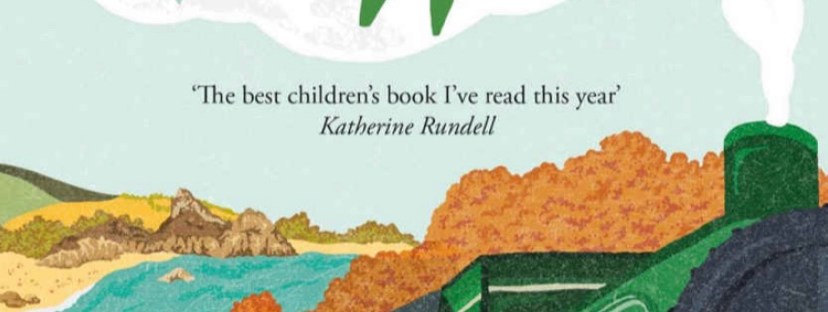
The Skylark’s War tells the story of Clarry, her brother Peter and her cousin Rupert, through their childhood, the Great War and beyond. Clarry’s and Peter’s mother died soon after Clarry’s birth, their father isn’t interested in them and at first at least, Peter blames the new baby for the loss of his mother. The two children are brought up by a succession of housekeepers, with the interference of the do-gooding spinster across the road. The high point of their lives is their annual visit to Cornwall every summer holiday. Their cousin Rupert spends his holidays there – his parents are in India and have basically forgotten about him and he was sent to boarding school at a young age so Peter and Clarry’s dad couldn’t send them to live with their grandparents. During the summers, all the best things in their lives happen and they grow and mature and become a tight gang. Then Peter is sent away to school, Clarry is left alone with her father. And then there is the War and Rupert joins the army. Can their bond survive? Can they all survive?
This is a middle-grade book, and although that synopsis may sound miserable, it is anything but. I mean I did cry my way through a whole pocket pack of tissues, but some of them were happy tears and I just couldn’t put the book down. I had to know what happened. At one point I was sitting sniffling and making a scene of myself in the lounge at a youth hostel, but I was so engrossed in the book that I wasn’t prepared to stop reading for long enough to climb the three flights of stairs to get to my room. The closest I can get to a comparison for this, is if Noel Streatfeild, Nina Bawden and Elizabeth Jane Howard had a book baby. And if that isn’t enough to make you go and read it, then I’m sorry you may be in the wrong place and I’m not sure that we can be friends.
My friends are you looking for a comfort read? Because The Skylarks' War is a comfort read right there even though one line made me cry on the tube this morning. It is wonderful. I know I keep banging on about it but I'm going to finish it and I don't want to.
I’ve had this on the NetGalley list since the autumn but I had forgotten about it until I saw this tweet from Harriet Evans (remember her? I had some ravings/gushing about one of her books here, here and here. And that might also scratch your Elizabeth Jane Howard itch, except that it’s a contemporary story about a house not a 1930s one.) So off I went to look at the blurb, thought it sounded familiar, looked at my NetGalley, tweeted her back and then the die was cast, my fate was sealed etc.
Move it up V. I really think it's your sort of thing.
And now I’m telling you that you need to read it. Maybe as a double bill with The Five Children on the Western Front if you can stand all that Great War and foreboding at once. But if you can, read The Skylark’s War second. Trust me on that. I see from the Goodreads write-ups that there’s a connection to one of Hilary McKay’s other novels, so I’m off to find that and then to buy copies of The Skylark’s War to give to people. As I mentioned my copy came from NetGalley, but you should be able to get hold of a copy really easily: it was Waterstones‘ Children’s Book of the Month in January and it won the Costa Children’s Book Award, so I’m expecting it to be everywhere. And yes, I know, this all means I’m late to the party again. But better late than never. Here are some more links to enable your book-buying habit: Kindle, Kobo, Amazon paperback, Book Depository and Big Green Bookshop.







 Verity Reads Books (lots of them)