A somewhat brief and atypical BotW this week as it was a bit of a strange week in reading – a holiday where I didn’t read as much as usual, and where a fair bit of what I read exasperated me. I would have chosen Vienna Waltz by Teresa Grant, but it’s only a few weeks since I picked Beneath a Silent Moon which is the same series and which I enjoyed more – not least because I’m used to Malcolm and Suzanne being called Charles and Mélanie and it really confused me – for the backstory, see my previous post.
So by default almost, Naked in Death is the BotW. I haven’t read a lot of Nora Roberts – although she writes these as J R Robb (authors writing under different names clearly a theme this week) – and many people on the various romance sites I frequent have raved about her and suggested her. I read her latest romantic suspense last year (The Liar, which I reviewed for Novelicious) and quite enjoyed it, so I thought her long running detective-centric romantic suspense series might be a good choice as I’m not a huge straight contemporary romance reader.
And I quite enjoyed it – it certainly kept me turning the pages – right up until I finished it just as the plane arrived on the stand at Gatwick on the way home. It’s a little too gritty for me and Roarke is a little too close to the controlling manipulative billionaire trope that I hate, but I was intrigued to see what happened next and who was responsible for the crime. Eve gets points for being a strong woman who is good at her job (if you can discount sleeping with a suspect, which you kinda can, mostly, but the paragraph I wrote explaining why spoils the plot, although I’m sure you can work it out) and I quite liked the futuristic world she lives in – contrary to all my expectations when I realised it wasn’t set in the here and now.
But I’m not rushing out to glom on the rest of the series – if a few come my way, then I’m sure I’ll read them, but there’s enough really good stuff on the pile already (and waiting for me in bookshops!) that it can wait. And I won’t be devastated if I don’t read them in order – or really at all. So that’s why I say this is a bit of an unusual book of the week. There was nothing I read that I wanted to rave about, and having written this, I’m not expecting you to rush out to by Naked in Death on the strength of my review. But hey, I’ve been lucky to get this far without having a week like this. If I could have got another book in to rave about I would have done – I tried, but the romance I was hoping was going to fix the problem turned out not to be the solution and I ran out of time. Here’s hoping normal service will be resumed next week…
Hello gentle reader. As you may have noticed, I do quite like a good romance novel. I’m more of a historical romance reader than anything else, but I do sometimes stray into contemporary and to a lesser extent paranormal. I’ve been thinking a lot recently about why some books linger on the to-read pile and it’s led to me contemplating what my favourite and least favourite tropes are in the romance genre. Once you’ve figured out what you like and what you don’t like, it makes it much easier to wade through a genre where there are so many books to chose from. And it also makes it easier to work out what you might like when you’re trying a different type of romance from the ones you usually read.
Lets start with my pet hates…
Accidental Pregnancies/Secret pregnancies
Oof. I think this is my absolute least favourite. If an author that I adore writes one of these, I’ll probably read it, but apart from that I give these a wide birth. I think this is probably all bound up in my own fear of accidental pregnancy, but these do absolutely nothing for me except make me want to scream with rage. Accidental secret pregnancy plots will have me hurling a book across the room if I happen to encounter them.
Secret Children
Following on from the pregnancy problem, I like secret children only slightly better. It has to be really good for me to be able to get past the fact that you’ve stopped the child’s father from being a part of their life for x years. And given that the whole idea of the plot is usually that the heroine will reunite with the father, then the reason’s for the secret tend to be a bit lame/spurious. And as far as contemporary romances go, in the days of the internet and social media it’s easier than ever to keep in touch with people and harder than ever to keep this sort of secret…
Amnesia
Just no. Luckily you don’t find it very often any more (although there is a bit in one of my favourite author’s latest novels, but it’s a late on twist so I just about coped with it) because people have (thankfully) realised that Amnesia is rare, and if you’ve got it, you may well have other stuff going wrong too which is harder to fix. I can’t think of a single romance with amnesia as a main plot point that I’ve read and enjoyed. And I’ve been down lists of amnesia romances on Goodreads and it hasn’t jogged my memory either. I understand there’s a pregnant-with-amnesia sub-genre, which sounds like my idea of hell, although Smart Bitches, Trashy Books have a very witty review of the hilariously titled Pregnesia.
My favourites:
Girls dressed up as boys
Twelfth Night has been my favourite Shakespeare play since we studied it when I was 11 (side note: check out the amazing Globe production of it with Oscar Winner (squee) Mark Rylance as Lady Olivia – clip below!) and I love plots with girls dressed up as boys. From Leonie in These Old Shades, through Harriet in Duchess by Night, Callie in Nine Rules to Break when Romancing a Rake (and that other Sarah MacLean one which not a traditional “breeches” role and is a massive spoiler if you haven’t read the rest of the series) and many more besides, it’s a plot device that will often get me to pick up a new author. It’s usually only found in Historical Romance although if you know of any good contemporary ones, please put them in the comments!
Fake engagements
This is one has to be deployed cleverly, because breaking an engagement would ruin the heroine socially so she’d have to have a good reason to do it, but it’s popular device in more recently written historicals, there’s something I love about couples who enter into these for nerfarious reasons of their own and get more than they bargain for. Because of the above social consequences, it’s not a plot often employed by my beloved Georgette Heyer – I can only think of one fake engagement in her books and that’s False Colours, which almost doesn’t count because Kit is pretending to be his twin brother throughout in a lovely twist. Julia Quinn’s The Duke and I is a great example
Marriages of convenience
Following on from those fake engagements, I do love a marriage of convenience plot, although conversely I think my least favourite Georgette Heyer is A Civil Contract – but she does have some crackers too like April Lady and Friday’s Child (my mum’s favourite). When cleverly executed they can be wonderful fun – Eloisa James’s The Ugly Duchess, Mary Balogh’s At Last Comes Love and Quinn’s To Sir Philip with Love is a fun twist on the idea. To be honest, it’s fairly hard to mess up a marriage of convenience – there are lots of ways a lady can accidentally get compromised – and there’s lots of reasons why people might enter into one (keep lands, escape an evil guardian, get an inheritance etc).
I do read other stuff of course – I like house parties, rake-y heros, beta heros, guardians and wards (but only the sort who don’t do anything about it until the wards are of age), friends to lovers, best friend’s sibling and much much more. To be honest, beyond my pet hates above there’s not much I won’t give at least one try (except the Tragic Lives aisle of the bookshop). All recommendations for things that might tick any of my boxes are gratefully received – in the comments below please!
I know – two posts in two days. I’m spoiling you. But I couldn’t let Valentines Day go past without mentioning some of my favourite romantic books.
Pride and Prejudice by Jane Austen
I don’t care about all the posts about how you wouldn’t actually want to be with Mr Darcy in real life because I love this book. I started reading my mum’s copy of the book as soon as I’d finished watching the first part of the 1995 BBC adaptation of it and I adored it. I was in the tail-end of primary school and just flat-out loved Lizzy. My TV tie-in copy is much loved and I read it a lot. Read it and fall in love with Lizzy as much as you do with Darcy. And he grows as a person people. Everyone’s allowed to make a mistake and compared to some of the stuff romance novel heros have in their past, being a bit stuck up and arrogant is not the biggest problem ever!
These Old Shades by Georgette Heyer
And a prime example of how Darcy could be so much worse is the Duke of Avon. Justin’s nickname is Satanas. You’re told he’s lost a fortune at the gaming tables and then won back someone elses – someone who then killed themselves. He kidnapped a woman to try to force her to marry him. But I defy you not to be rooting for him as he turns Leon the page into Leonie the lady and restores her to her place in eighteenth century French High Society. And the way he achieves it isn’t exactly all hearts and flowers (although it is totally deserved). One of my favourite romance tropes is I’m not good enough for him/her and this is just the perfect example of that. And then when you’re done falling in love with Big Bad Justin, read Devil’s Cub and meet his son Dominic – mad, bad and dangerous to know and watch prim and proper Mary win his heart. He doesn’t think he’s good enough either. Swoon.
Stately Pursuits by Katie Fforde
Still my favourite Fforde novel (see my love letter to Fforde here), and you may start to detect a theme in my heros here. Connor is tall, dark, brooding and moody. Hetty’s mum’s sent her to look after Great Uncle Samuel’s stately home. Hetty wants to save it, Connor thinks selling it is the best solution. Cue fireworks of two different types. If you like your heros a little bit more beta, try Fforde’s Flora’s Lot and Charles the auctioneer. He’s engaged and thinks Flora is pushy. She thinks he’s uptight and change resistant. Another of my favourite tropes – I hate you, I hate you, I can’t stop thinking about your hair as Sarah McLean of Smart Bitches would say.
Busman’s Honeymoon by Dorothy L Sayers
I’ve said it before and I’ll say it again. This is the most romantic detective story ever. After 3 books of angst and tension, Peter and Harriet are finally married. But a body turns up at their honeymoon dream house and unless they can figure out who did it Harriet is worried that Peter will be haunted by it forever. You’ll appreciate it most if you’ve read the other three books first, but once you have you’ll come back to it again and again. I’ve listened to it once this week on audiobook already. If you need more convincing I wrote a whole post about the wonders of Peter in general and Peter and Harriet in particular.
And Finally…
And if this still isn’t quite enough romance for you, try Eloisa James Duchess by Night featuring another of my favourite tropes – girls dressed as boys (see also the aforementioned These Old Shades) or Sarah MacLean’s Nine Rules to Break when Romancing a Rake (I would suggest Never Judge a Lady by Her Cover but that’s the end of a series and a big spoiler for the earlier books) which is another great trope (heroine needs to learn about love, asks rakish man to teach her) or a bit of Julia Quinn. Try not to get hooked. American-import romance can be an expensive habit.
This week’s BotW is Kristan Higgins’ latest romance Anything For You – which in a stroke of serendipity is out today! For those of you who are all Christmas’d out, this would make a great break from the festivities. It has a winery, some star-crossed lovers and a whole lot of fun.
Anything For You tells the story of Connor and Jessica. They’ve been hooking up in secret for years and now Connor wants to take it public – and make it official. But Jessica thinks things are fine as they are – and she has her brother to look after, her brother who really doesn’t like Connor. So with Connor down on one knee and telling her it’s all or nothing, how sure is Jessica that marriage isn’t for her?
This is such a good read. Jessica and Connor have such a tangled backstory – which is explained really well in a series of flashback-type sequences in the aftermath of the proposal. They are both really complicated, well thought out characters. Connor has quite a privileged background (I mean he’s not a billionaire or a billionaire’s son, but there’s some money there) but a difficult relationship with his parents. Jessica has dragged herself up from a trailerpark whilst bringing up her little brother in the process – she’s got trust issues, abandonment issues and a bit of an inferiority complex. Watching them work out their problems is a really engrossing read.
And they are proper problems that need a proper resolution. I’ve read a lot of romances where the obstacles keeping the hero and heroine apart aren’t really obstacles – or are easily resolved. But these two have something real and tangible to work out. And the resolution is really well worked out – it doesn’t involve one of them suddenly doing an abrupt character change or an about face. They work out their problems and grow and mature to a solution.
And if that sounds too serious – don’t worry! There’s plenty of humour here too – Connor has a fabulously funny relationship with his twin sister Colleen (aka Dog Face) and the two of them have some great sparky exchanges. And Con and Jess have their moments too. Add to that a very stabbable events planner and some meddling friends and the angsty bits are well balanced out.
This was my first Kristan Higgins – but I’ve already found another one in the Kindle backlog pile so that may well have jumped its way closer to the top. My copy came via NetGalley, but you can get yourself a copy from Amazon or Amazon.com – although it doesn’t seem to be available on Kindle in the UK or the US at the moment.
Back into proper historical romance territory with this week’s BotW. I read a couple of good books last week – but you’ve already heard enough about my love of Janet Evanovich and Lauren Willig and Kerrigan Byrne’s The Highwayman bucked the trend of not-so-good historicals that I’ve had recently.
Farah and Dougan are best friends at the orphanage in the 1850s. They handfast – but then A Bad Thing happens and they are parted. Jump forward 20ish years and Farah is working as a clerk at Scotland Yard when Ruthless Villain Dorien Blackmore is brought in for questioning. She’s promptly kidnapped so he can keep her safe from Forces Which Threaten Her. But will he capture her heart?
The Highwayman (which doesn’t actually have a lot of actual highwaying in the actual narrative, so don’t go expecting the Masqueraders in Victorian times people) hits a whole lot of my catnip including – without giving too much away – tortured hero! Smart heroine! Marriage of convenience*! It also has a side order of some of my peeves – comedy Scottish accents, kilts, lairds, handfasting – but it is good enough and different enough that I didn’t care. It wasn’t perfect – even if you don’t have my dislike of the Highlander trope in general there were some language choices that didn’t work – but it rattled along quickly and there was so much happening that you didn’t notice too much. I had a few things pegged fairly early on, but it Didn’t Matter.
As I said at the top, I’ve had a run of not great historical romances recently and this was a breath of fresh air – the Victorian setting made a change (and meant that we didn’t get too far into my least favourite bits about Scottish heros/stories) and Farah is a smart sensible woman who lives up to the billing. Yes its quite dark. Yes the hero is a Bad Boy who has done stuff that Can’t Be Fixed, but it is not at all miserable. As you can probably tell from all the Capital Letters its a bit melodramatic – in a good way. I really enjoyed The Highwayman and will be looking out for the next in the Victorian Rebels series.
Get your copy from Amazon or on Kindle but don’t expect to find it in the supermarket – its not that sort of romance!
*It’s in the blurb on Goodreads I’m allowed to mention it
Oh dear. It’s two days from Christmas and I am no where near the bottom of my Christmas-themed book list – and I promised you a post about Christmas novels. This is what comes of refusing to read Christmas-themed stuff until November. Will I never learn? On the brightside, I did actually manage to post about Christmas Short Stories back at the end of November. So that’s a positive.
So what have I read since then that’s festive?*
Well I caught up on Jenny Colgan’s Christmas book from last year – Christmas at Rosie Hopkins’ Sweet Shop – which was fabulous. I’ve only just managed to restrain myself from going out and buying this year’s dose of Rosie – The Christmas Surprise – by reminding myself a) I’m behind on the Christmas reading and b) I like actual copies of Jenny Colgan’s books – and it’s in hardback and thus Won’t Match.
I also enjoyed Katie Fforde’s Christmas offering – A Christmas Feast – which has a couple of novellas in it that I’ve read before (released at previous Christmases) but also a nice new novella and some other short stories. The fact that some of the stories have been available as ebooks before may explain the bargain Kindle price (£1.19 at time of writing) and there’s definitely enough new stuff in it to pay that even if you’ve read a couple of the novellas before. Christmassy but not cloying.
On the novella front, I’ve read and quite enjoyed Fiona Gibson’s How the In-Laws Wrecked Christmas (although I wanted more resolution – it just seemed to stop to me), Lyn Crain’s A Viennese Christmas (very straight up romance, not a lot of anything beyond the romance) and Manda Collins’ Once Upon A Christmas Kiss (a bit melodramatic and with a couple of abrupt character about faces but still readable) – and that’s about as far as I’ve got.
There are several Christmas books still waiting on the Kindle – so you may have to check my Goodreads reviews to see what I think of them – because I appreciate that there’s not a huge market for Christmas stories once the big day is over…
*Because this is so last minute, all my links are to kindle ebooks – so that you can actually get hold of any that take your fancy and get them in time!
Note the colour gradation that my matchy-matchy problem forces me into
I discovered Katie Fforde in my final year at university – when I was stressed, overworked and severely in need of relaxation. At the time I’d been dealing with the stress by watching a lot of DVDs (I had an unlimited LoveFilm membership and boy was I using it) because as a History and French student I was doing a lot of reading for my courses and reading didn’t seem like much of a treat! I was also working on a very limited budget – and I was trying not to buy books. I picked up my first Katie Fforde (Paradise Fields I think) at York Central Library – on a trip to borrow DVDs – and I was hooked. I knew from the start that these would be books that I would re-read over and over and my budget went out the window as I started buying up her back catalogue. As it turns out Paradise Fields is possibly my least favourite of her books now I’ve read the lot – and I think it is the only one that I don’t own – and I did buy myself a copy over the internet but it was the wrong size* and so I got rid of it.
There is a bit of a formula to them – and you’re not exactly going to have trouble working out who the heroine is going to end up with (or at least you’re not once you’ve read a few of them) but they’re brilliantly relaxing reading, which will leave you with a smile on your face and a warm and fuzzy feeling inside.
Stately Pursuits by Katie Fforde
If I had to pick a favourite, it would be Stately Pursuits. It has my favourite type of heroine – Hetty’s fairly close to the age I was when I first read the book (nearly a decade ago – crikey!) and I like my male leads to come from the grumpy on the outside but with a soft centre mould. Connor’s dilapidated stately home – which Hetty is sent to house sit adds to the books charm for me – I love books with houses as a character, that’s why Trisha Ashley’s A Winter’s Tale has been my favourite of hers for so long (although I think I like her “new” one Every Woman for Herselfnearly as much).
Like Hetty, many of Fforde’s heroines have (or get thrown into) interesting jobs – in another of my favourites, Flora in Flora’s Lot inherits a share in a struggling auction house and fights to save it (whilst falling in love), but there’s also wedding planners, artists, cooks on canal boat restaurants and interior designers. Another of my favourite books is Thyme Out – where Perdita, the salad gardener, ends up supplying the restaurant owned by her ex-husband and then working with him rather closer on a TV series.
For me Fforde’s books are great examples of the cozy romance genre – they’re not raunchy or rude and they won’t make you blush on the train – they are entertaining and romantic and do exactly what it says on the tin – what more can you ask for?!
You can find Katie Fforde’s back catalogue in any good bookshop – like Foyles – and her new books are usually stocked by the supermarkets in their multibuy promotions and they sometimes have some of the older ones too.
* I’m planning a post about my OCD tendencies when it comes to book jackets and arranging my shelves. But trust me when I say that I really don’t like it when books by the same author aren’t the same size and cover design!
Between the 1920s and 1970s, Georgette Heyer wrote nearly three dozen novels set Regency or Georgian times, along with a string of thrillers. I love me some Golden Age detective action, but this article is about her historical romances which, in my opinion, are sublime and nearly perfect examples of their type.
Hardback, paperback, different styles – my shelf has editions from the 1940s through til the 2000s
My mum had a shelf of Heyers on the landing the whole way through my childhood, but it was only when I was about 16 that I first picked one up (either False Colours or Cotillion, I can’t remember which) and that one led to another, which led to all of the ones she had and then to buying the ones that she didn’t. When my parents moved house a couple of years ago, mum passed them on to me as she “didn’t have space for them” any more, on the understanding that she could borrow them back if she wanted and that I wouldn’t get rid of them. Since then though, rather than borrowing them from me, she’s started re-buying them!
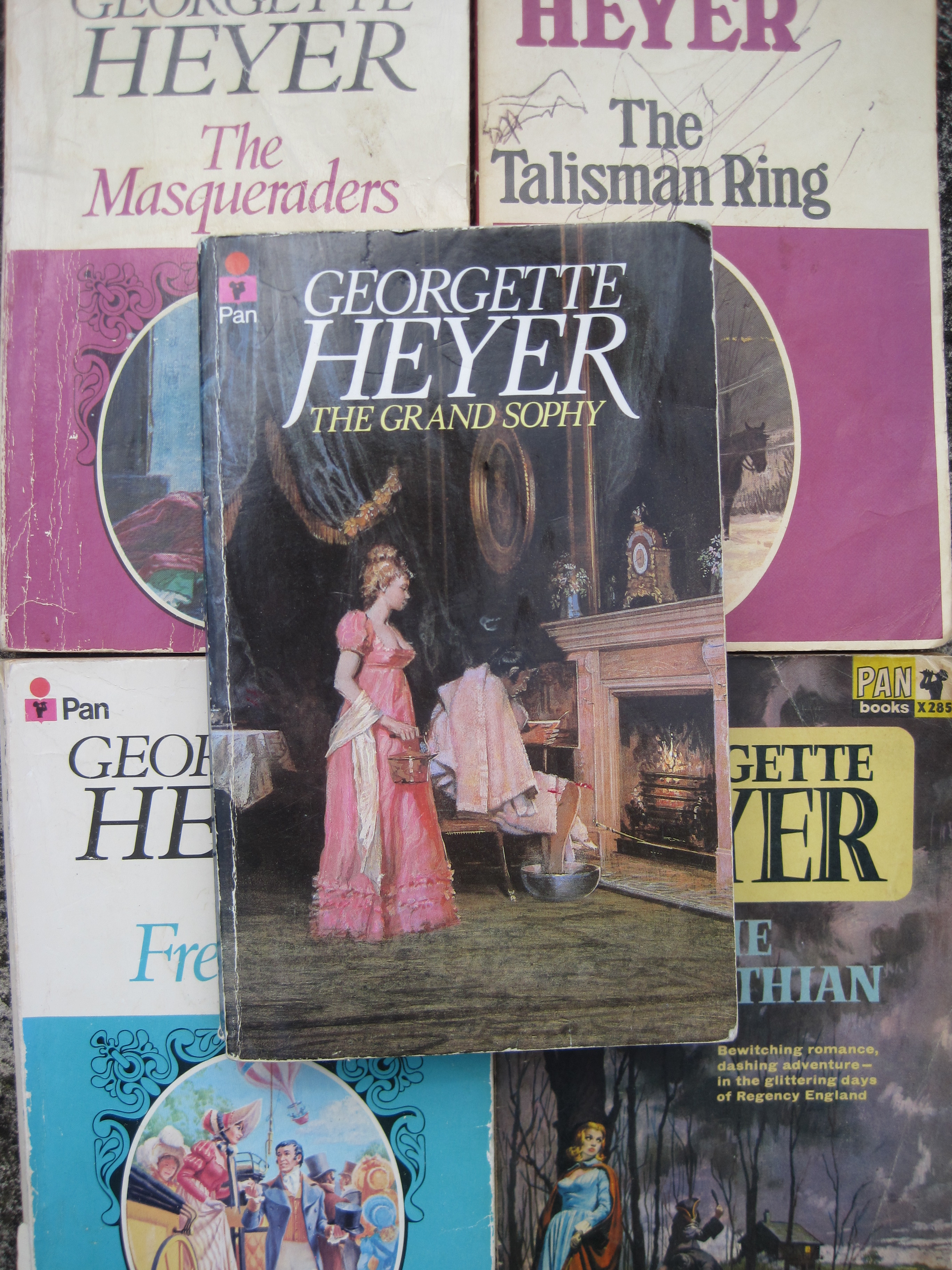
I have a lot of favourites, but if I was forced and could only have one, it would be The Grand Sophy. Sophy is feisty, independent, well-travelled and used to running her own life – and everyone else’s. She arrives back in England to live with her aunt and her cousins after her diplomat father is posted to South America. She finds them in the midst of a family crisis – with one daughter in love with an unsuitable poet and the eldest son engaged to a disagreeable bluestocking. Sophy proceeds to try to organise the household along more harmonious lines and arrange matches for her cousins and, in the end, herself.
My copy of The Grand Sophy – in what I think is a late 1980s edition
What I love about Heyer’s female characters are that they’re not weak and wishy-washy pushovers, but they also don’t feel like modern women who have been supplanted to the eighteenth or nineteenth century. Her women aren’t simpering misses sitting around waiting for life to happen to them or for a man to make their life complete, but they’re not doing anything that feels jarringly out of period either. I have a weakness for American-written British-set historical romances (you know, the ones with the buxom heroines bursting out of their corsets on the covers) which lead a shamefaced existence* on the uppermost shelf of my tallest spare bedroom bookcase – and that’s a problem I find with some (but by no means all) of their heroines.
One of the feistiest and most independent of Heyer’s heroines is Léonie in These Old Shades – who we first meet as Léon the page when he is bought “body and soul” by Justin, Duke of Avon – known as Satanas because of his lack of morals. Heyer books always have a lot plot and not a lot of yearning looks or heaving bosoms and Shades is a great example of this. At the start of the book Justin is a thoroughly disreputable character who buys Léon not to free him from a life of abuse and mistreatment, but because he sees a method of being revenged on one of his enemies. Léonie is in love with Avon almost from the start, but you’re not sure until the very end, after the plot has taken you from France to England and back to France again, whether Avon’s motives have changed at all. Most of Heyer’s books are standalones, but Shades is unusual in that some of the characters have appeared before, albeit with different names and in a less developed form, in The Black Moth – and Justin, Léonie and Rupert all appear again in Devil’s Cub (which I also love) where Justin and Léonie’s son Dominic – who has all of his father’s faults and his mother’s temper but does at least have a conscience – runs off with a virtuous young lady who is trying to protect her sister’s honour.
My copies of Moth, Shades and Devil’s Cub show some of the range of different editions in my collection!
In Regency Buck (another with a sort-of sequel – An Infamous Army of which more later) another strong minded heroine comes up against a domineering alpha-male and, dear reader, you may start to see a pattern in the sort of heroes that I like. Preferably tall, dark and handsome, he needs to be bossy, clever and with a bit of a dark side or at the least a temper – like Buck‘s Julian St John Audley, the titular Sylvester or best of all Damerel in Venetia. But they also need to be up against a smart woman who is prepared to stand up for herself and what she wants. I don’t want to see any woman being forced into a marriage by a man who holds all the power. The Heyers that come off my shelf the least are ones like Cotillion (Freddy’s too thick), Friday’s Child (Hero the heroine is too wet), Cousin Kate (Kate’s too stupid to see the trouble coming) and A Civil Contract (Adam needs a good slap).
My copy of Devil’s Cub has a note from in the front written by my mum
Those are the exceptions though and just looking along the shelf is like seeing group of old friends – they live in the sitting room so I have them to hand if I need them! If you’ve never read any Georgette Heyer, may I heartily recommend you have a look now – particularly if you are a fan of authors like Eloisa James or Julia Quinn. They don’t have the sex that modern historicals do – in fact there’s barely any kissing, but they’re still breathtakingly romantic in places and have tight well-structured plots – and a wealth of meticulously researched historical detail (An Infamous Army was required reading for trainee army officers because its descriptions of the Battle of Waterloo are so accurate – it also features Julian and Judith from Regency Buck and a cameo from a much older Dominic and Mary from Devil’s Cub) that I can only imagine the current crop of authors have drawn on. It also says a lot that more than ninety years since her first book was published and forty years (this year in fact) since Georgette Heyer died, her Regency/Georgian romances are still in print.
A selection of my favourites in a charming garden setting!
I like them so much I even have a couple of them on my kindle and as audiobooks in case I need a fix when I’m away from home. And, while I was taking the photos for this article I discovered I’ve got a couple of duplicates of my own – I think I bought the pretty Pan paperbacks of The Talisman Ring and The Masqueraders when I was living in Essex – in the days when mum had most of the Heyers…