Exhibitions, not a book

Not a Book: Seurat and the Sea

Happy Mothering Sunday everyone, and I have been doing some more high culture to report back on today, with one of the first of the big London art exhibitions of the year and one which is very much in my area of interest.
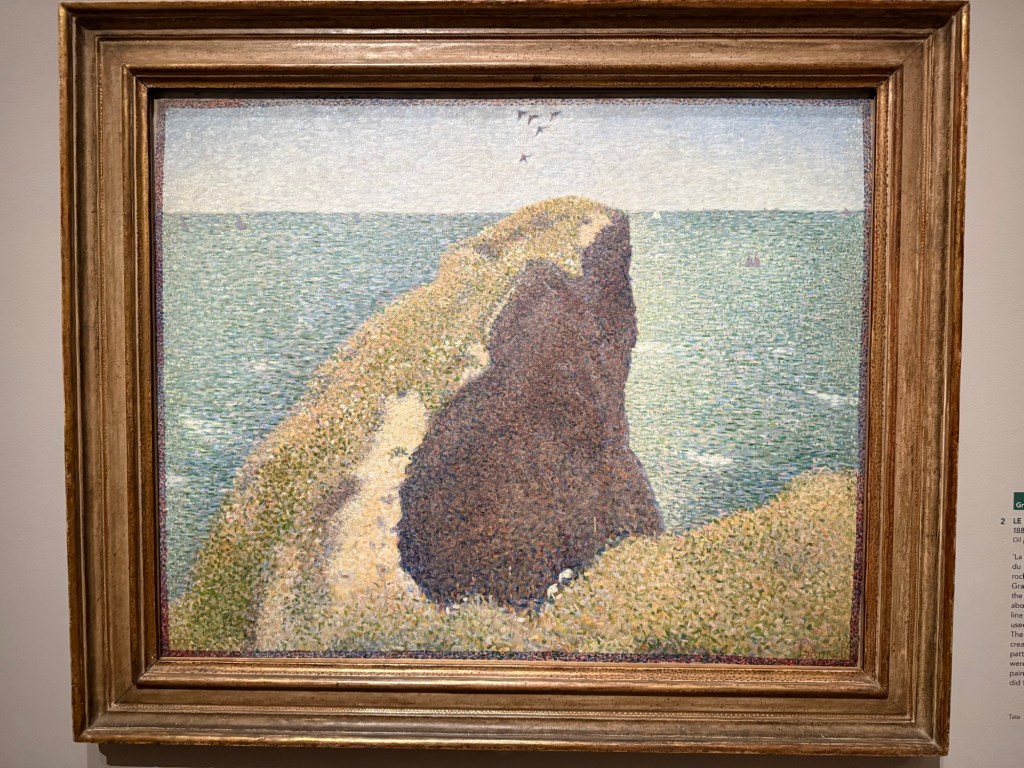
Georges Seurat’s most famous paintings are Sunday Afternoon on the Island of La Grande Jatte and Bathers at Asnieres. I’ve never seen the first which is in Chicago, but the second lives at the National Gallery and I will go and look at it every time I visit. In Washington back in 2018, I went to the National Gallery of Art where they have a selection of his works and wandered around that. So it’s no surprise that I would be very excited to go and see the first dedicated exhibition of his seascapes which is on at the Courtauld at the moment.
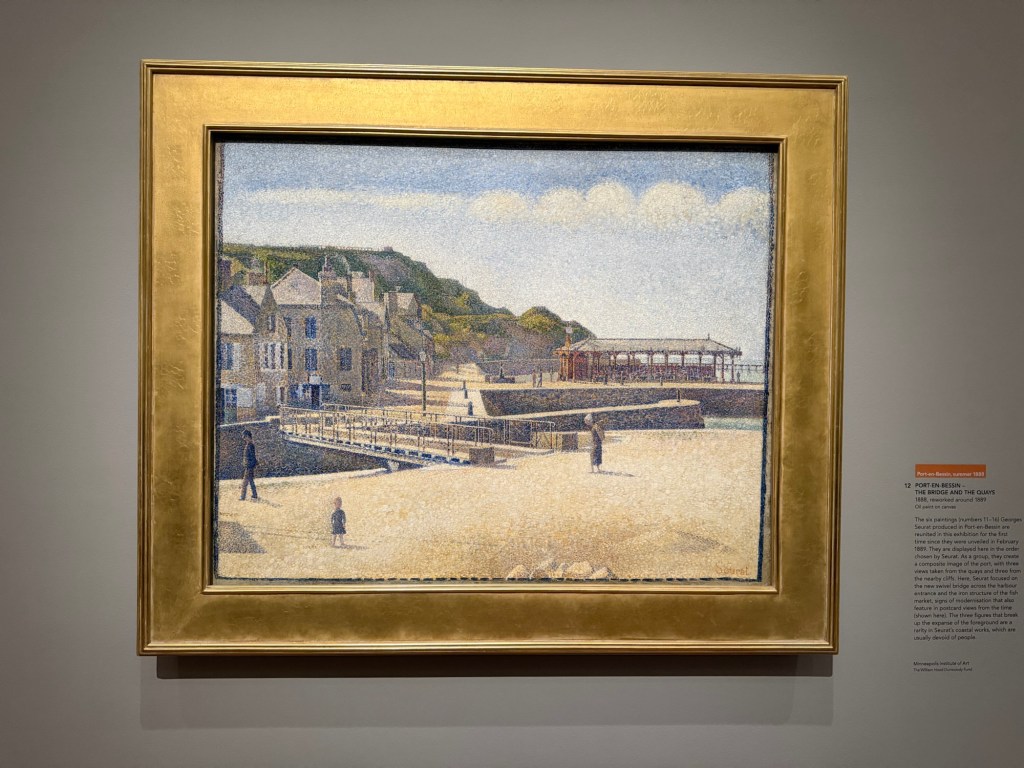
The Courtauld says this “major, focused display is the first devoted to Seurat in the UK in almost 30 years” which I can believe – because I don’t remember another one, and I have had my eye open for one since I first saw Sunday in the Park with George in the summer of 2006. This exhibition has 26 paintings, oil sketches and drawings that Seurat made during a series of summers he spent on the northern French coast between 1885 and 1890 before his early death at the age of 31 in 1891.

I find it really hard to write about art but there is something about the light and movement in Seurat’s works that always gets to me – and these seascapes are really something. They are arranged chronologically so that you can see the his technique and style developing of the the years, as well as seeing some of the studies alongside the major works that they were preparatory for. They have a sense of stillness and calm, despite the fact that they are seascapes. I spent some time standing on the far side of the gallery staring at them from a distance when they look almost like photographs and the effect he was aiming for with the pure colour is at it’s most effective. But up close the detail is incredible too.

The Courtauld also has other Seurats, including studies for la Grande Jatte and others in its regular collection along with other works by the impressionists, so if you’re interested in this period in art, this is well worth the entry fee. This was one of those occasions where I bought myself the exhibition poster and am now spending a stupid amount of money on the frame for it. And I’ve added to my postcard collection too, only to discover that I’ve got a mix of landscape and portrait postcards so I still don’t have enough to fill my big postcard display frame! Anway, if you want to go and see this, do your planning now because there are already some dates that are sold out. It’s already been extended so instead of ending in April it now ends in May and they have added late night opening on Fridays to cope with the demand.

I leave you with some Sunday in the Park with George, from the Sondheim Prom to mark his 80th birthday back in 2010. I’m bracing myself for the bunfight that will be ticket sales for next summer’s revival with Jonathan Bailey and Ariana Grande. Pray for me – and my wallet!
Exhibitions, not a book

Not a Book: Cecil Beaton’s Fashionable World

Happy Sunday everyone, I had a really good time out at a gallery on Friday and given that the exhibition is only on until early January, I thought i ought to write about it sooner rather than later.

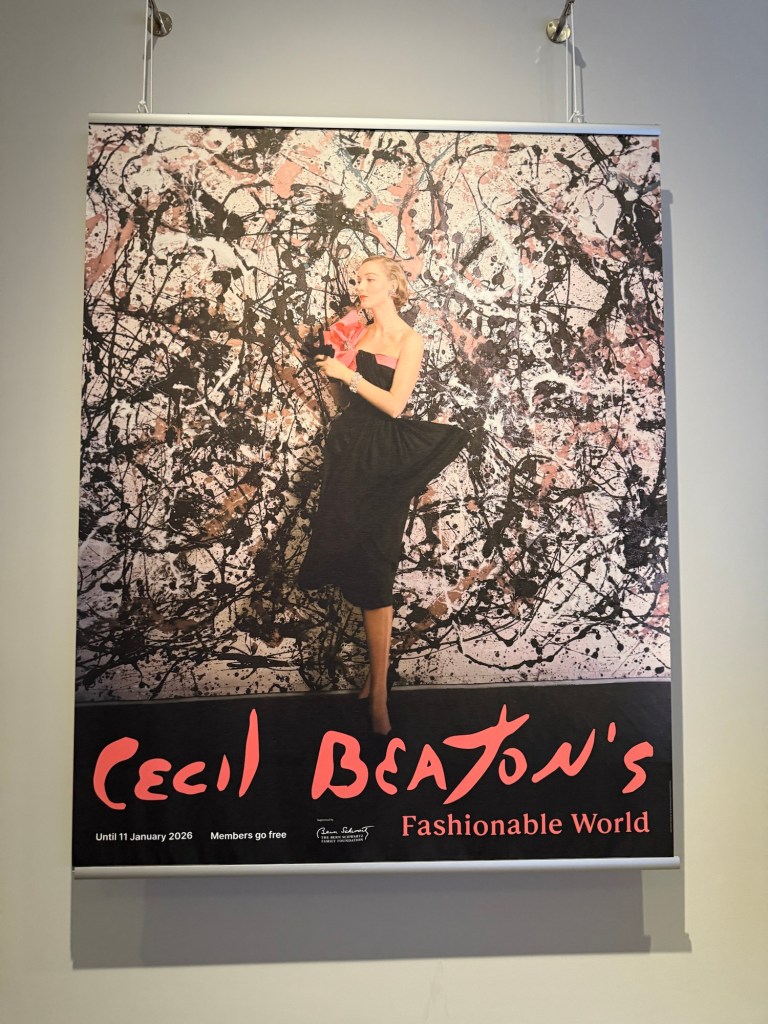
Cecil Beaton’s Fashionable World at the National Portrait Gallery is an examination of the photographer’s work in Fashion and Portrait photography. It takes you through from his early days and Bright Young Things of the 1920s to the My Fair Lady era in the 1960s. Along side the photographs there are also things like his first camera, which he used all the way through til after he first started at Vogue, and one of the dresses he designed for Julie Andrews to wear as Eliza Doolittle in the West End production of My Fair Lady in the late 19050s.

I didn’t get to see the last Cecil Beaton exhibition at the NPG – because it opened just a few days before Covid shut the world down in 2020 and never reopened. I have the exhibition poster from that on the wall of my house and the exhibition book as well, and that one focused on his work in the 1920s and 1930s with the Bright Young Things. This does have some of that, but is much broader in its scope. Yes the famous Stephen Tennant picture is here, but so also are the royal portraits and Hollywood royalty – like Marlon Brando, Katherine Hepburn and a young Yul Brynner with hair!

I really enjoyed myself – it’s in the same space that The Culture Shift exhibition was in earlier in the year which is big enough that you feel that there is plenty to see and that everything has space to breathe but not so big that you get overwhelmed by it all and start to lose focus.

Cecil Beaton’s Fashionable World is on at the National Portrait Gallery until January 11, and I would book your ticket in advance, especially if you’re planning on going at a weekend.

Exhibitions, not a book

Not a Book: Culture Shift

We had a lovely day out in London yesterday – with a nice meal and a show but also an unplanned trip to the National Portrait Gallery where we went to their exhibition The Face Magazine: Culture Shift. And I’ve rushed this to the top of the Sunday post list because it’s only got two weeks to go before it closes.

So if you haven’t come across The Face before, it is a culture, fashion and style magazine that was originally from 1980 to 2004 and was revived and relaunched in 2019. I only remember the 1990s onwards era – and even then it’s somewhat hazily because I was a mainstream pop girl, and The Face was very much cooler than I was. But its influence on contemporary culture was huge.

In the 1980s it was the first publication that really covered the Blitz Kids and the club culture that became the New Romantic movement. It wrote about the clubs, the people at the clubs and the fashion that they wore, and then it photographed the bands that came out of it. In the early years the photographers were mainly young and scrappy, often self-taught and just doing what they wanted to without referring to the history or grammar of photography. And so their photos looked different – and they changed what was out there. And then in the 90s they were all about the indie and Britpop groups and they are basically responsible for the career of Kate Moss – she was the face of The Face – as well as launching the careers of tonnes of models and photographers.

This has got a whole load of amazing images along with their backstories and shows why and how the magazine was a disruptor and how it influenced the photography and graphic design of today. If you weren’t around or there it’s hard sometimes to appreciate how different what they were doing was -and if there is a weakness of the exhibition it’s that there are no equivalent images from other magazines to compare The Face’s stuff to because what they were doing then can seem so mainstream for what we see today. But it really wasn’t.

If you get a chance to go and see it before it closes, it is pricey (but what exhibitions aren’t though) but for me it was worth it.