I know, I know, I know. This is a day late. I have excuses – relating to post nightshift haze and then a few days away and only remembering I hadn’t written this post at 11pm after a couple of cocktails. And as drunk blogging doesn’t end well, I thought it could wait til the cool light of day and rational thought, especially as this week’s pick is Important to me.
So this week’s BotW is Wonder Women: 25 Innovators, Inventors and Trailblazers who changed history. Written by Sam Maggs, this is a series of potted biographies of women who you may not have heard of, but who have played an important role in various areas of Science, Technology, Engineering, Espionage and Adventure – aka areas that tend to be seen as traditionally masculine. There are 25 featured women – but at least the same again get bite-sized mentions too. I’m a history graduate (admittedly specialising in British and European history) and there were a lot of names here that I had never come across before – and many fascinating stories.
I’m definitely not the target market for this – which is written (I think) very much with tweens/early teens in mind – and some of the language started to annoy me a little, but that’s because it’s written in a vernacular that is not really mine, although I do think that the choice of language will appeal to the intended audience. It’s got lovely illustrations for the 25 women, which is a nice touch. My copy was an e-galley for my kindle e-reader so I don’t think I got the full effect, but from what I’ve seen the actual book itself looks attractive and appealing.
This would make a good book for an upper-primary school/middle school age girl and would also be a great addition to school libraries for that sort of age of child. I’ve said there that it would be a good book for a girl – because I think young girls need reminding that they can have adventures too, and be brave and daring and that careers in things like science and tech aren’t just for boys. But boys need reminding that too – and that there have been women through history doing important things, often against the odds and against societal expectations. I saw this video last week, and it may have been the nightshifts, but it got me all emotional. And it’s an important message for children to get – girls can be anything, do anything – nothing is a man’s job – or a woman’s job.
Anyway, lecture over. As I said, my copy was an e-galley via NetGalley, but this is out now and you can get it from Amazon, Waterstones and Foyles as well as on Kindle and Kobo – although I think it would look best in the hardback actual book.
Gosh this was so hard this week. My favourite book I read last week was one I read to review for Novelicious (which is returning to the internets in full force very shortly) and my rules dictate that I can’t make that my book of the week here as well. My second favourite book of last week was the second Corinna Chapman book – and my rules dictate that I can’t pick that because I picked that series last week. So after that it’s not so much Book of the Week as Book I Quite Liked of the Week. And that’s not really in the spirit of the thing. I was prepared to cheat if I managed to finish one of the books I had on the go on Monday morning, but I didn’t so I couldn’t justify that either.
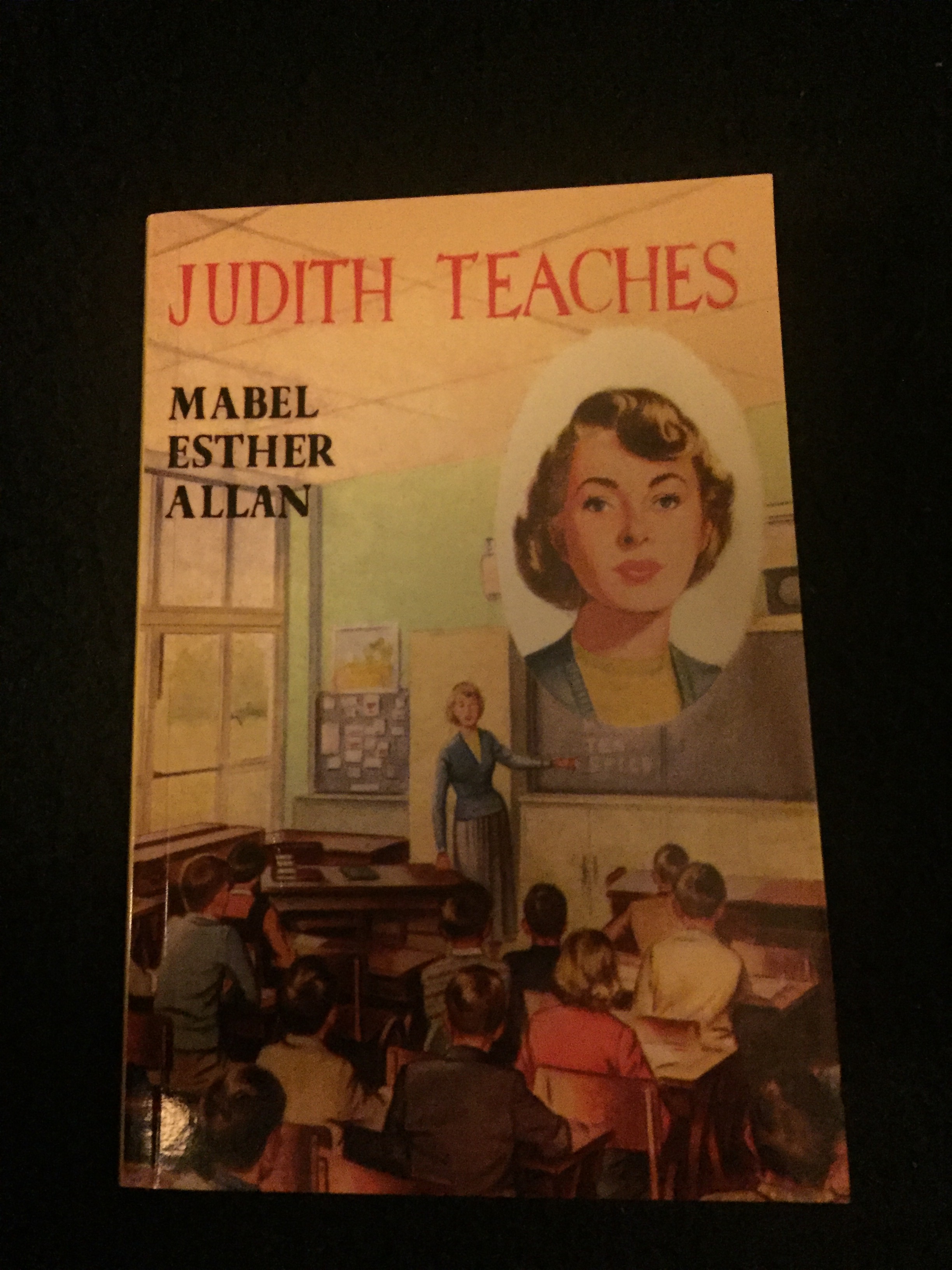
So what I’ve decided to do is write about Judith Teaches by Mabel Esther Allen – which I read last week and which interests me on a few levels. Judith Teaches was part of a series of career books for girls published by Bodley Head in the 50s. Various different authors wrote the books which each feature a different career suitable for young ladies to do before they got married (and had to give up working to look after their husbands). Other titles in the series cover jobs like floristry, farming and modelling as well as some becoming a doctor or being a veterinary student.
My newly reissued paperback copy of Judith Teaches. Check out the retro!
Judith Teaches covers the first year of the teaching of Judith and her friend Bronwen who get jobs at a secondary modern school straight out of training college. They have a friend who is already teaching at the same school who they share a flat with, and although the book mostly focuses on Judith you hear about the other girls lives as well. The three are clearly Nice Well Brought Up Grammar School/Boarding School girls who have a bit of a culture shock with the pupils at their new school (dirty! desperate to leave school to go work in the factory! not interested in reading! can’t spell!) and some of these sections feel very of their time. But it does cover the potential ups and downs of teaching in a way that would have given the school girls that it was aimed at a realistic look at what they might be letting themselves in for – not all the children will be clever, not all the other teachers will be friendly, it will be stressful and tiring and you won’t be able to please everyone – in a way that you don’t get in boarding school books (which as regular readers will know Mabel Esther Allen also wrote along with my beloved Drina books).
I don’t think I knowingly read a career book as a child – unless Shirley Flight, Air Hostess counts – as the only ones I ever remember seeing were about nursing and that only interested me (as a weekend job, while being a teacher during the week) for a few days when I was about 6, so I’m not sure how representative this is of the genre, but Judith Teaches gave me several interested hours of reading – and a few wry smiles. It also made me realise how far the world has come for women in 50 years. After all, no one’s going to expect me to give up my job if I get married and I don’t think anyone would think I’m over the hill yet. There’s still a long way to go – but I like to hope that my sort-of-nieces who are at primary school today won’t need a book to tell them that they could be a doctor if they wanted to.
Anyway, Judith Teaches has just been republished by Girls Gone By if you’re geeky like me and want to have a peruse for yourself.
This week’s Book of the Week is Mabel Esther Allen’s Chiltern School. Regular readers will already be aware of my love of the classic school story and this one last week was a real treat for my sleepy post-nightshift brain.
Chiltern School tells the story of Rose Lesslyn – who has lived with her grandparents since her mother died and her father moved to work abroad to get away from his pain (as people frequently seemed to do in books in this era). Her father decides that she needs to go to school – much to her grandmother’s dismay – and she’s dispatched from her home on the Isle of Wight to a rather progressive (for the 1950s anyway) school in the middle of the Chiltern hills. There she struggles to fit in but eventually finds her feet, makes friends and (re)discovers a hidden talent.
Chiltern School was written in the 1950s – and sold to a publisher, but never published until Allen published it privately in the 1990s. And she was only able to do that because of the success of a reissue of another of her series – the Drina books in the 1990s. The Drina series (the subject of one of my very early posts on the blog) were written under one of her pen names – Jean Estoril. I had no idea about this until I read the forward of this book – I’d bought it because I’d really enjoyed another of her (many) other books The View Beyond My Father (about a young blind girl escaping from her domineering father in the 1910s) back in primary school days. I was thrilled to discover that my love of the Drina series in the early 90s had meant that Allen had money to do this in her old age – and that someone who’s books I’d liked so much had written so much more than I thought!
And Rose does have similarities to my beloved Drina (that series started 7 years later). Both live with their grandparents – with a stern grandmother and a kindlier grandfather, although both of Drina’s parents are dead as opposed to just one of Rose’s (there are a lot of dead parents in children’s books of this era). And trying not to give too much of the plot away here, Drina doesn’t know about her background at the start of the series but later choses to keep it secret – while Rose knows but doesn’t tell.
Both also feature the Chilterns – Drina’s ballet school has a boarding department there, where she stays in Drina Dances in Exile (the green book as it always is in my head because of it’s cover) and where she returns to several times in later books to visit friends. Now since reading Drina, I have acquired a boyfriend who comes from that part of the world – so I got an extra level of enjoyment from Chiltern School’s mentions of places that his family live or have lived and where we have been. And the area is a big feature in the book – it’s beautifully described – you can practically feel the wind rushing through your hair as Rose and her friends cycle around.
It’s not perfect – it is of it’s time and is not as diverse as you would (hope to) find a children’s book written now would be. But Allen’s writing style is charming and every readable – this is a fun romp that will make you wish you could have gone to boarding school (in the 1950s) with Rose and all her friends. That is if you couldn’t be a ballerina and be Drina…
My edition was published by Girls Gone By – who as I’m sure I’ve said before – specialise in republishing classic children’s stories that are now out of print. They do the same for my beloved Chalet School and for authors like Lorna Hill, Malcolm Saville and many more. Check out their website and see if they’ve done any of your childhood favourites.
I went straight on from this to Allen’s Ballet Family books (bought in the same spending spree back at the start of the year) which appear to have been published under Allen’s name and then reissued under the Estoril pseudonym in the 90s to capitalise on the success of Drina. I don’t know how I missed them at the time – but they are a cross between Drina and Lorna Hill’s Jane goes to the Wells – with a ballet school that’s not The Royal Ballet and a family of 4 ballet students – who’s mother is still a ballerina. And I really want to go back and reread the Drina series too.
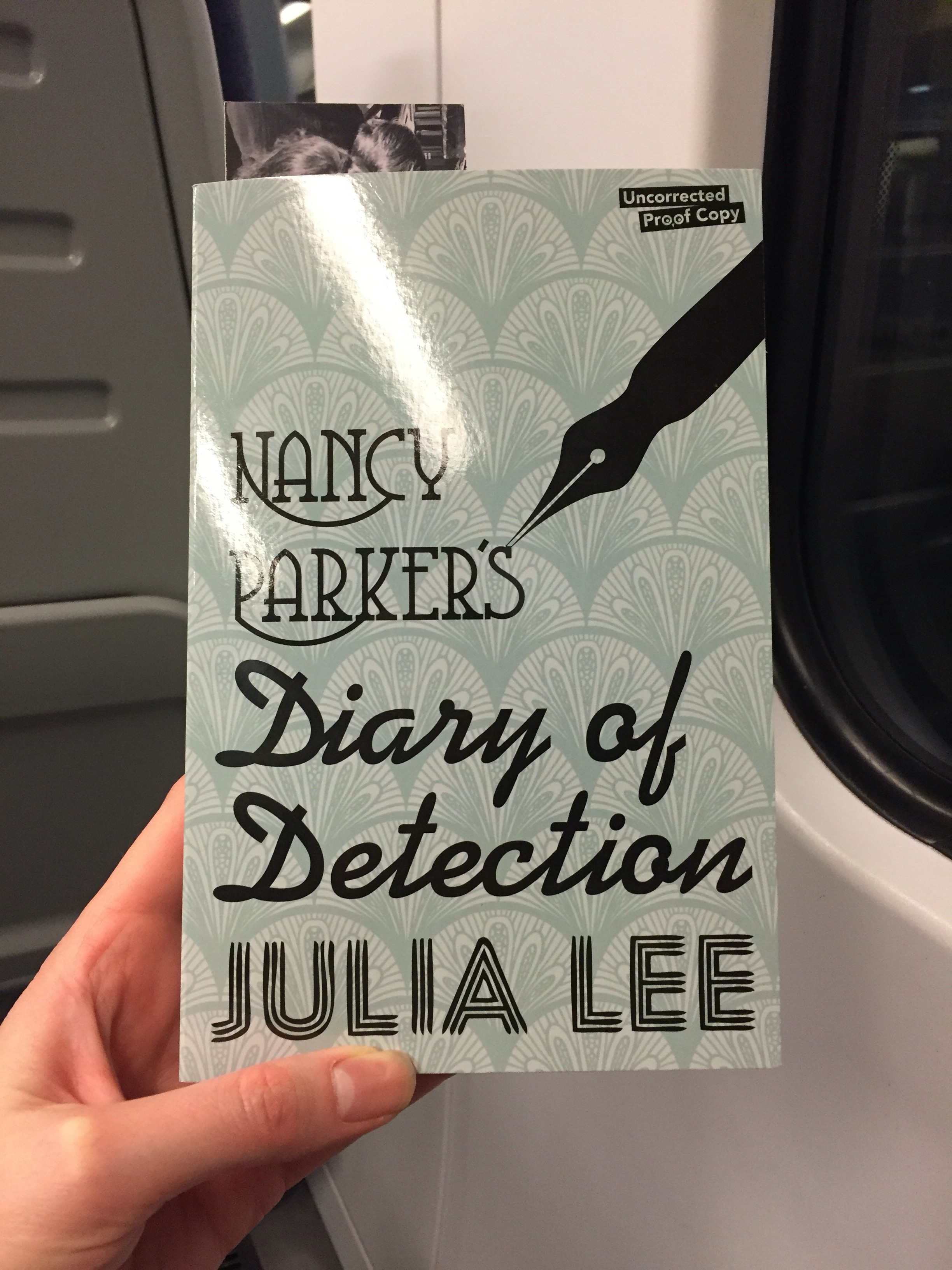
Oh I do love a good children’s detective yarn – and I had two to pick from when I was selecting my BotW this week. I went with Julia Lee’s latest – because it’s out on Thursday and doesn’t feature any murder – so I think I can give it to my 7-year-old niece who has the right reading age, but who can’t cope with too much peril!
Perfect reading for the train to work ahead of a nightshift!
Nancy Parker is 14 and has just left school. She gets her first job – as a housemaid to the rather glamorous Mrs Bryce. It’s not her dream job (who dreams of cleaning at 14!), but its more exciting than she expects as soon the whole household is living in a rented house at the seaside. There are parties, talk of movie-making, a reputed air-ace but also a cook who seems to be hiding a secret, a string of burglaries and chores – lots of chores. Nancy teams up with two other children from the neighbourhood to try and work out what is going on.
The book made up of a combination of extracts from Nancy’s journal (given to her as a leaving gift by her school teacher) and a third person narrative – which covers what the other children are up to. It’s fun, engaging and fast-paced. As someone who loved all of Enid Blyton’s mystery series (but particularly the Five Findouters) this really worked for me and filled that gap. And unlike those Blyton stories, this books shows the range of experiences in the 1920s – Nancy would only have appeared in one of those as the maid providing the picnics for the other children. And there’s also nice nods to the other realities of the 1920s like shortages of men for women to marry and women having to give up their jobs to returning soldiers.
As an adult, I figured out what Mrs Bryce was up to quite early on – but that’s because I’ve read a lot of the grown-up versions of this sort of story, but I think for a young reader it would be a fun, thrilling and non-threatening mystery. I love Robin Steven’s Wells and Wong series and also enjoyed the second book in Katherine Woodfine’s Clockwork Sparrowbook last week (the other BotW contender) but they are definitely a level up from this in the scares and peril – which isn’t a bad thing, but it does mean that you need to be bit more mature to be able to cope with them. I’m desperate to give my niece Murder Most Unladylike – but murder is quite a big deal for a 7-year old – at 10 I was terrified by some of the Miss Marples*. But Nancy Parker’s adventure feels like a new equivalent of a Secret Seven or a Famous Five – which is A Very Good Thing.
I was lucky enough to get my hands on an advance proof – but you can get your copy from Amazon, Kindle, Waterstones or Foyles. I don’t know if it’ll be in the supermarkets – but it feels like it might as the Katherine Woodfine was. Happy Reading!
After Books for Guys and Books for Girls, I give you Books for Kids! I buy books for all my nieces and young cousins every year. I think boys and girls should be encouraged to read books with male and female protagonists, so hopefully there’s something for everyone, but obviously these are going to be influenced by what I’ve read and what the girls have read and told me they liked. I don’t have kids, so if some of my suggestions seem really obvious to those of you reading who are parents, I’m sorry.
Under Fives
An oldie but a goodie to start for the upper end of this age group – Janet and Alan Ahlberg‘s The Jolly Christmas Postman. They need to be past the ripping things apart stage and be able to cope with the little letters without losing them. Mog is everywhere this Christmas, and it’s totally deserved – Judith Kerr writes wonderful children’s books. My favourites are obvious ones like The Tiger Who Came to Tea and all the Mog books, but also The Great Granny Gang. Jon Klassen‘s books have gone down well with the little people I buy for – I’m still getting fish drawings based on This Is Not My Hat. I also like Chris Naughton‘s books like Oh No! George – but Little Sis-the-teacher reckons she prefers her picture books with more detail so you can get the kids to describe them. And finally, if you haven’t already seen them, Oliver Jeffers‘ books are gorgeous – I love Lost and Found.
Five to Eight year olds
The Nieces are in love with Jenny Colgan‘s Polly and the Puffin – we got a postcard with a puffin on it from their latest holiday and a note saying it was because of the book. If you want to give something educational, but also absolutely beautiful and engrossing, go and find a copy of Aleksandra Mizielinska andDaniel Mizielinski‘s Maps in your local bookshop. I think this is gorgeous and it teaches stuff subtly as well, a bit like Richard Scarry did for younger kids. Their Welcome to Mamoko is equally beautiful. I’m also debating buying My Sewing Machine book for the nieces – as they have a Grandma who is big into sewing and patchwork – but I’m not sure it’s fair to let her in for the extra work!
Eight to Twelve year olds
School Ship Tobermory by Alexander McCall Smith went down well with Eldest Niece (just under this age bracket, but a keen reader) – who wouldn’t love a story about a boarding school that’s on a tall ship? I read it and thought it was fun and clever and modern. In Waterstones last week I saw some lovely new editions of Noel Streatfeild‘s Shoe Books. I haven’t read them all, but Ballet Shoes is amazing – although I was a little annoyed there wasn’t a similarly pretty version of White Boots (which I still have on my shelf upstairs) which is sometimes called Skating Shoes to make it fit the series. If you want to give some classics, my local branch of The Works had a variety of Enid Blyton Boxsets – including Famous Five, Secret Seven and The Faraway Tree – although I can’t find all of them on the website.
Finally a photo I hear you cry! Is this the most picture challenge gift post of the set? Just you wait…
Also mentioned here before are Robin Stevens‘ Wells and Wong mysteries – I can’t wait for Eldest Niece to hit the right age (I think murders are a bit scary for her yet), Murder is Unladylike is the first one, but First Class Murder is the latest and is all you’d hope for from a book that is boarding school story meets Murder on the Orient Express. For the top end of this age bracket, I’d also suggest Simon Mayo‘s Itch (which I’ve read) and its sequels Itch Rocks and Itchcraft (which I haven’t) which are sciencey thriller chase stories.
Teen/Young Adult
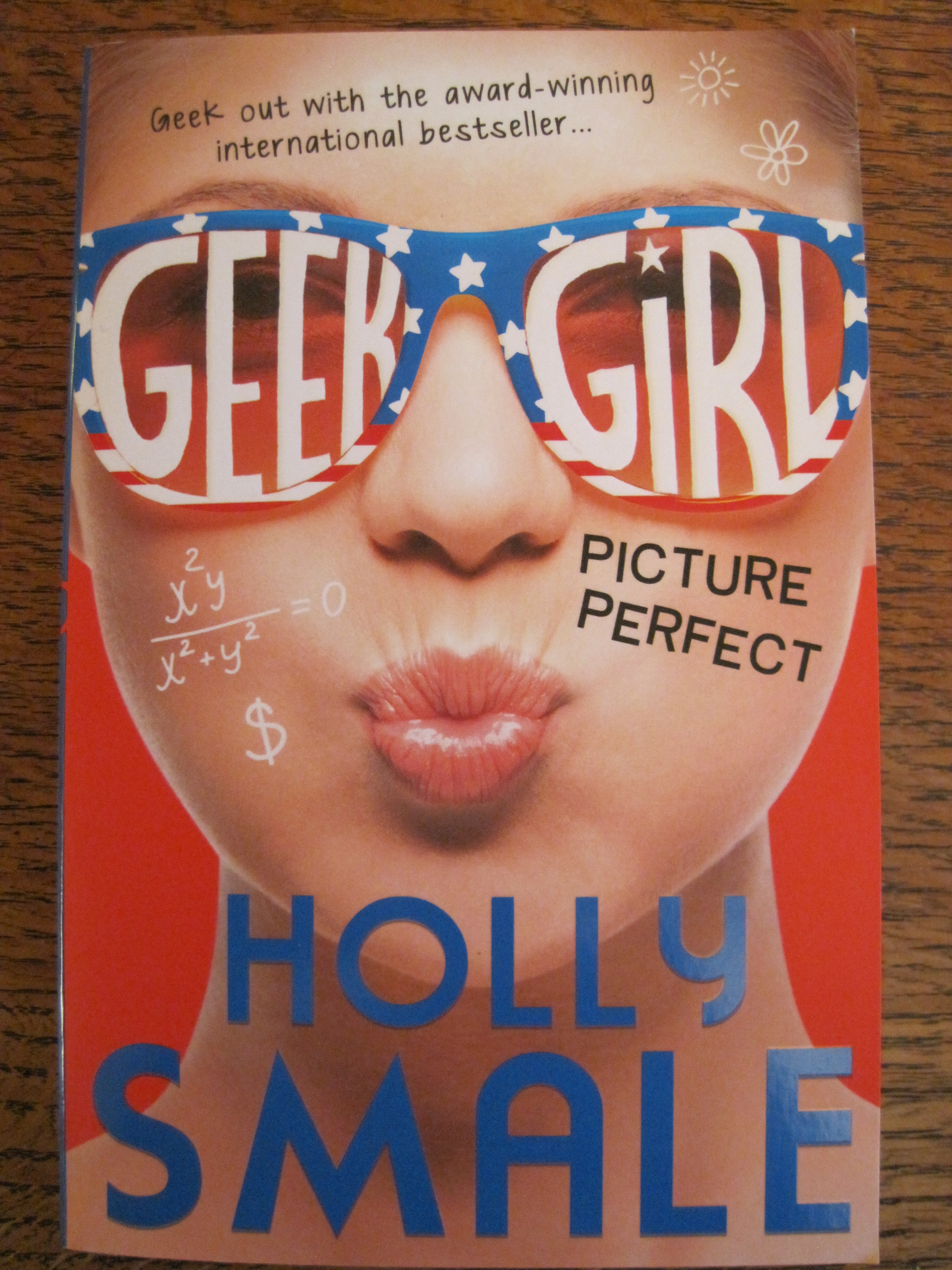
No surprise that I’m going to recommend Gail Carriger‘s Finishing School series. Her books are one of my obsessions – I’m currently working my way through her audiobooks on my walks too and from work. Etiquette and Espionage is the first one, and would be a great gift for someone who has read St Clares/Malory Towers or similar when they were younger. I really enjoyed the Geek Girl series earlier this year, which would make a great choice for a girl who is into her clothes and fashion, but which isn’t afraid to show the less glamourous side of modelling as well as the difficulties of not fitting in at school.
This is the third Geek Girl book – I read the others on Kindle, but at least I have this one to photograph!
I read Jenny Valentine‘s Fire Colour One back in the summer and it would make a good choice for someone who’s read The Fault in Our Stars (they’ll almost certainly already have TFIOS, but I’ve put the link in anyway), but doesn’t quite want to cry as much again. One which will make you cry (especially if you’ve read other Pratchetts) is the final Tiffany Aching book The Shepherd’s Crown. I spoke about it at length earlier this year, but I really think that this book is the culmination of a brilliant series. If you’ve got someone who’s read Harry Potter and/or The Hobbit and is looking for the next move, start them on The Wee Free Men and you may be the originator of a Discworld love affair. If you’re buying for someone who’s not as much of a reader, may I suggest the first Lumberjanes book. I loved this graphic novel, and even The Boy pronounced it “quite good, but it ended just as it got interesting”, which presumably bodes well for Part Two.
And thank goodness for Lumberjanes. Just you wait until tomorrow though. That’s even worse!
Finally, if in doubt, there’s always a book token. But lots of your old favourites from when you were that age may still be in print, but out of fashion, so the kids may not have them. my mum’s getting My Naughty Little Sister for one of the little girls she buys for this year. I bought Eldest Niece The Worst Witch for her birthday in the summer (and I’ve heard a passage from The Worst Witch being used in a school entry reading comprehension test!) and I think she’s since asked for more of them. Meg and Mog, Hairy McLairy, The Enormous Crocodile and Peace at Last are all still out there too.
Miss Parts 1 and two? Here’s Books for Him and Books for Her. Coming next, the final part: What books do I want for Christmas?
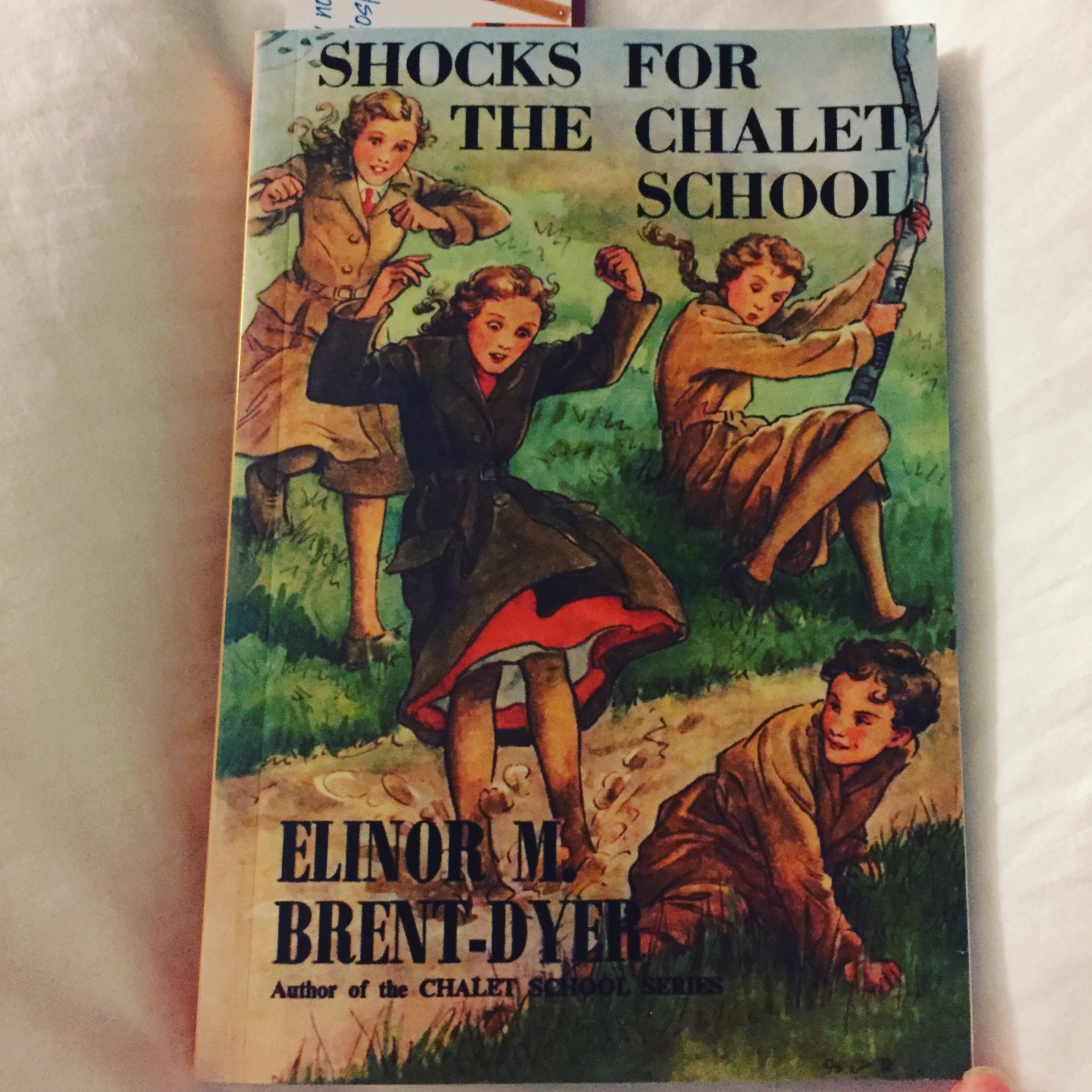
An unusual choice for BotW this week – Shocks for the Chalet School was one of my post-Paris purchases from Girls Gone By and it turned out to be that rarest of things – a Chalet School book that I hadn’t read. I know. Who knew. And this also gives me hope that there may be more!
Shocks for the Chalet School is the book where Emerence Hope bursts onto the scene. Now I think that the reason why I thought that I had read this is partly because her early antics are talked about so much in the later books, and partly because it takes place at the same time as Chalet School in the Oberland.
For those of you who are not Chalet afficionados (and I appreciate that early/mid 20th century boarding stories may not be your speciality) a quick recap on where we stand at this point in the series: It’s after the war and the school is on St Briavels Island after the problem with the drains at Plas Howell. The new term means a whole new team of prefects – as the finishing branch is just starting in Switzerland and many of the Sixth formers have left to go there. Mary-Lou is still a Middle-schooler, Jo and her family are in Canada with Madge and her family and the book opens with news of the arrival of Jo’s Second Twins and a letter from former teacher Miss Stewart (now married) apologising for having unwittingly unleashed Emerence on the school.
With me so far? Really all you need to know is that a (very) naughty new girl is arriving at an established boarding school, where an inexperienced team of prefects will have to try and deal with her. Who knew it was that simple to explain!
I’ve mentioned my abiding love of the Chalet School before on this blog, and reading one for the first time reminds me how much. Yes, they are dated – and in the Girls Gone By reprints you get the original unabridged text complete with smoking teachers and problematic racial sterotypes. They are of their time. The plots are some times repetitive; Elinor M Brent-Dyer has favourites and doesn’t know how to make lists (or do continuity in some cases); there’s an unbelievably high number of dead parents and “kill or cure” operations; there are huge families, religious messages and you would never try and bring children up like this today. But with an appropriately sceptical eye and a tongue in cheek where necessary, they are joyful. No one gets bullied, very few problems are completely unsolvable, no one is homesick (for long at least), Joey (the series’ main heroine) can sing people out of comas and if you’re a good girl, you’ll get to marry a doctor and live happily ever after, popping out babies in a Chalet near the school!
Basically a new (to me) Chalet School book was exactly what I needed to bring me out of my World Events-based slump. And I got an unabridged copy of Rivals for the Chalet School a couple of days later too so got to read the missing bits in that as well.
If you’re not already a boarding school fan, then these probably aren’t for you – so may I instead recommend Cathy Bramley’s Wickham Hall serialisation – the final part of which came out last week.
This week’s BotW is RJ Palacio’s Wonder. It was hands down my favourite book of last week’s reading – I was enjoying it so much I nearly took it to London when I went down for work at the weekend – even though it was a hardback library copy! And the first thing I did when I got home on Sunday afternoon was to curl up on the sofa and finish it.
Wonder is the story of Auggie – born with a terrible facial abnormality and starting school for the first time after years of home schooling. With multiple narrators, you see the world from his point of view and from those of the people around him as he tries to fit in and make friends and be “normal”.
If I could have read this in one sitting, I would have done (don’t you just hate it when real life gets in the way of reading?!), it’s that kind of book. It really is one of those novels where you fall in love with the characters and the world and don’t want to leave it behind. And you can insert my usual comment about the state of my to-read pile meaning I don’t get to good stuff soon enough – because this has been on my to-read list since it was mentioned in an Emerald Street mailing soon after it came out.
I need to get my own copy – firstly because my library copy didn’t have “The Julian Chapter” in the end of it and secondly because I want to lend it to my sister and my mum. And I want to read it again. It’s that sort of book. And don’t be put off by the fact that it’s a children’s/YA book if you don’t usually read that sort of thing. It’s really worth it.
I’m back in the children’s section with this week’s book of the week – embracing my long time (20-year plus) love of boarding school stories with Arsenic for Tea by Robin Stevens – the second book in her Wells and Wong series.
I mentioned the first book – Murder Most Unladylike – back in September and have been looking forward to reading the next one ever since. In Arsenic for Tea, there’s a murder at Daisy’s house, where Hazel is staying during the holidays. Once again the Detective Society tries to work out who did it – from a cast of suspects including most of Daisy’s family.
When I started reading boarding school books – back in the early 1990s – the world that the girls at St Clares lived in wasn’t that different to the one that I was in. They called maths arithmetic and the trains they travelled on were steam ones, but I could recognise their school life and identify it with mine. Since then, with computers, mobile phones, tablets and the like, school has changed a lot. But Robin Stevens has found a way to write boarding school stories (yes this is set in the holidays, but it still counts) that still work for modern children. By setting it in the 1930s, she can avoid having to include technology and things that may date very quickly, but she’s also included things that writers at the time didn’t talk about – but that children today can relate to and using Hazel as the principal narrator is a masterstroke.
Hazel is from Hong Kong – and this lends her narration a sense of detachment that works well. She doesn’t fully understand this world either – so it makes sense for her to explain things that modern children might not quite understand but that would seem jarring if they were explained by Daisy who “belongs”. Hazel also faces prejudice – and these are subtly dealt with, showing how unfair it is – in a way you never got in “old school” boarding school books, mostly because the cast was either all white – or because the author didn’t think that it was unfair (a sad commentary on a genre of books I love).
Daisy’s parents also have issues – their relationship is clearly… troubled and that forms part of the plot – which again you don’t have in books like Mallory Towers or my beloved Chalet School (where one doesn’t mention d.i.v.o.r.c.e or have any relationships that aren’t perfect. Although there’s a high percentage of children missing one parent through death from TB or similar!). This makes the book relatable – as well as making the plot make sense and hang together
I said in my mini review of book one that it’s like Mallory Towers crossed with Agatha Christie – and I stand by that. There’s enough here for NotChildren like me to enjoy as well as the target audience. In fact, it’s a bit like a good animated movie – there are bits that adults will love – nods to golden age detective fiction, etc – but that kids would pass straight over without realising that they were missing anything. And Daisy and Hazel’s antics aren’t too outrageous – everything seems perfectly plausible for them to have been able to do, with enough peril to make it interesting, but not so much superhuman deduction that they don’t seem real. In fact, part of the fun as a (supposedly) grown-up is the reading between the lines of what Hazel and Daisy don’t understand.
Arsenic for Tea is out on Thursday – you can pre-order the kindle copy here if you’re a grown-up, but I suggest if you’re buying for the 8 – 12 year old in your life and want use of your e-reader/tablet device in the near future, you buy the paperback – here it is on Amazon, Waterstones, Foyles or on my page at My Independent Bookshop – which gives money to one of my local indies.
Welcome to my (roughly) quarterly round-up of what Young Adult and Children’s fiction I’ve been reading recently.
We start this time with Gail Carriger’s Etiquette and Espionage*, which is the first book in her Finishing School series. Published 18 months ago – the third book is due out next month – it’s a steampunk school story which ticked quite a few of my boxes (Nineteenth century setting, school story, assertive female lead) and stayed on the right side of what I can get into when it comes to vampires and supernaturals. I loved the premise – a finishing school which teaches its students espionage alongside social graces. The cast of characters was interesting, the plot was pacy and you get the feeling there are lots more things still to be revealed in the rest of the series. I think it would suit an early teen who was a Worst Witch fan and who likes Harry Potter – but it works for those of us who are Young Adult at heart with a thing for school stories as well.
In the last round-up I mentioned that Fools’ Gold by Philippa Gregory was on the to-read pile. This is the third book Gregory’s YA series The Order of Darkness, which is set in the fifteenth century. I suspect in coming to a middle book in this series I’ve probably spoilt the plots of the previous two – but hey, I wasn’t going to get books one and two just to read them in order because I happened to have bought book three. That would be insane. But this is an illustration (again) of why I prefer to read series in order. Anyhow, enough digression. Fools’ Gold is set in Venice where our intrepid heros Luca and Isolde are trying to track down the source of an influx of English gold that has hit the Venetian market, whilst also pursuing their own quests for various things. It was fine. Just fine. It fell slightly the wrong side of my supernatural/paranormal limits – it’s more White Queen than Other Boleyn Girl – which may suit others but not me. It filled an afternoon, but I won’t be hunting out the rest of the series.
In the last post I also mentioned that I was behind the curve with Rainbow Rowell’s work – and I have (finally) read Eleanor and Park. For those who’ve missed it, set in the 1980s Eleanor is the new girl in town with a troubled and chaotic home life; whilst Park is the boy in the headphones and black t-shirt at the back of the bus, busy trying to make himself invisible. As the two get to know each other – through mix-tapes and cartoons they fall in love. But it’s not as simple as that of course. Although I was worried for a while it was going to end up with me in tears on the train, it was all ok in the end (in that I wasn’t a weeping mess on the train) and I really enjoyed it. I’m saddened (but not surprised) that this has been a bit controversial in areas of the US (swearing! sexuality!) but luckily that doesn’t seem to have dented the book’s performance. One for a mid-teenager I think – around the start of GCSE time.
Out next week is Oh Yeah Audrey* by Tucker Shaw – which is the story of 16 year-old Audrey Hepburn super fan Gemma and her meet-up with fellow fans who she met through her tumblr page dedicated to the Breakfast at Tiffany’s star. I can’t say that I loved it, but it was perfectly fine whilst it lasted – although it did have a few issues, like a late plot development which I didn’t think was adequately resolved. It’s set over the course of one day – so naturally there’s not a whole lot of scope for character development, but it does have a nice take on some of the best – and worst – bits of the social media revolution.
And a massively advance heads-up about Unspeakable* by Abbie Rushton – which isn’t actually out until February – which is bonkers. I’m sure I’ll mention it closer to the time to remind you, but it’s really worth putting a note in your diary to look out for it because it’s really good. It deals with difficult issues, it’s powerful, it’s emotional and it’s gripping. Unspeakable is the story of Megan. She doesn’t speak. She wants to – but the voices in her head won’t let her. Then Jasmine joins her school and suddenly talkative Jasmine is unlocking things inside Megan – could she be the answer? But what will happen if she rediscovers her voice?
So there you have it – the best bits of my latest Young Adult reading. A quick mention should also go to the first Wells and Wong book* – which I reviewed in the Back To School post and is also well worth a look if you have someone to buy for who has read all of the Worst Witch, St Clares, Mallory Towers sort of books. Book Two is due out early next year. As usual – any more recommendations for what I should be reading in the YA world always welcome – pop them in the comments.
And thanks as always to NetGalley who provided me with my copies of the books which have asterisks (*) next to their titles in return for an honest review (as if I’d ever do anything otherwise). All the others come from the pile of purchases!
Just a quick post about some of the Children’s and YA fiction that I’ve read recently. I may be a grown-up, but I’ve never grown out of children’s books and teen fiction. I love buying picture books for the little people in the extended family – and I still collect several series of books that I used to read when I was at primary school. So it follows that if I hear about some good books in the Young Adult genre I’ll pick them up!
The Fault In Our Stars by John Green – I was very late to the party on this one, only getting around to reading the book a couple of weeks before the film came out. I found it really readable and suprisingly upbeat for a book about cancer – right until the final act, which left me a weepy snotty mess at nearly 3am after I stayed up to get to the end and find out what happened.
Death Cloud (Young Sherlock Holmes) by Andrew Lane – This was an impulse request on Net Galley because I’ve always had a soft spot for children’s versions of adult characters. And actually it was really readable – enough of a thriller to satisfy the reader and with Sherlock doing a lot of the leg work, but not so much that it seemed unrealistic for what a young boy could have accomplished. Definitely a good set up for a series – and I’ll be bearing these in mind when I’m picking books out for my godson next time.
Are You There God, It’s Me, Margaret by Judy Blume – which was put up as a Net Galley download after a vote on favourite books by Blume. And re-reading this 20 years after I first encountered it, I really think it still works. I worry that some of the books that I loved as a child won’t attract children today because the world they portray is so different to the one that they live in – no mobile phones, no computers let alone the internet. And then I re-read a book like this and realise that good story telling is universal and timeless. it might take me a lot less time to read it these days, but I still enjoyed it – and if you have a girl in your life about 9 or 10 years old who hasn’t read this – why not?
Red by Alison Cherry – A rare book that I gave up on (I really hate not finishing books) but I just couldn’t work up any enthusiasm for this one once I started reading it, which was a shame as I’d liked the look of the blurb. Set in a redhead sanctuary, it’s the story of the town’s queen bee – who is hiding the fact that her red hair isn’t natural. I grew up on classic school stories and Sweet Valley High, Babysitters club etc none of which are completely focused on looks and external appearances and mostly focus on the underdog rather than the Prom Queen which may explain why this didn’t draw my attention.
Waiting on the shelf to be read at the moment are Flambards – which was on a list of classic children’s books and which I hadn’t read – Philippa Gregory’s Fool’s Gold which I picked up in a shopping spree in The Works and How To Love by Katie Cotugno – which was part of the same competition prize as Red and which I’ve been putting off reading as I didn’t enjoy Red! I really need to read some Rainbow Rowell and I want to look at some more John Green. Any other recommendations for Children’s/YA novels that I should try, please put in the comments – I think I’ve done the most of the obvious (Harry Potter, Hunger Games) but I’m always looking out for stuff I’ve missed.




 Verity Reads Books (lots of them)