
How long has this post taken me to write? A long time. Did I start it in summer 2025 when I saw that there was a sequel to The Socialite Spy coming? Yes. Has this see-sawed wildly in the writing between abdication books and Edward VIII books? Also yes. Am I posting it now because yesterday was the 90th anniversary of Edward VIII’s accession? Yes. Was that the thing that finally gave me the push to post it? Yes again. Anyway, here we are.
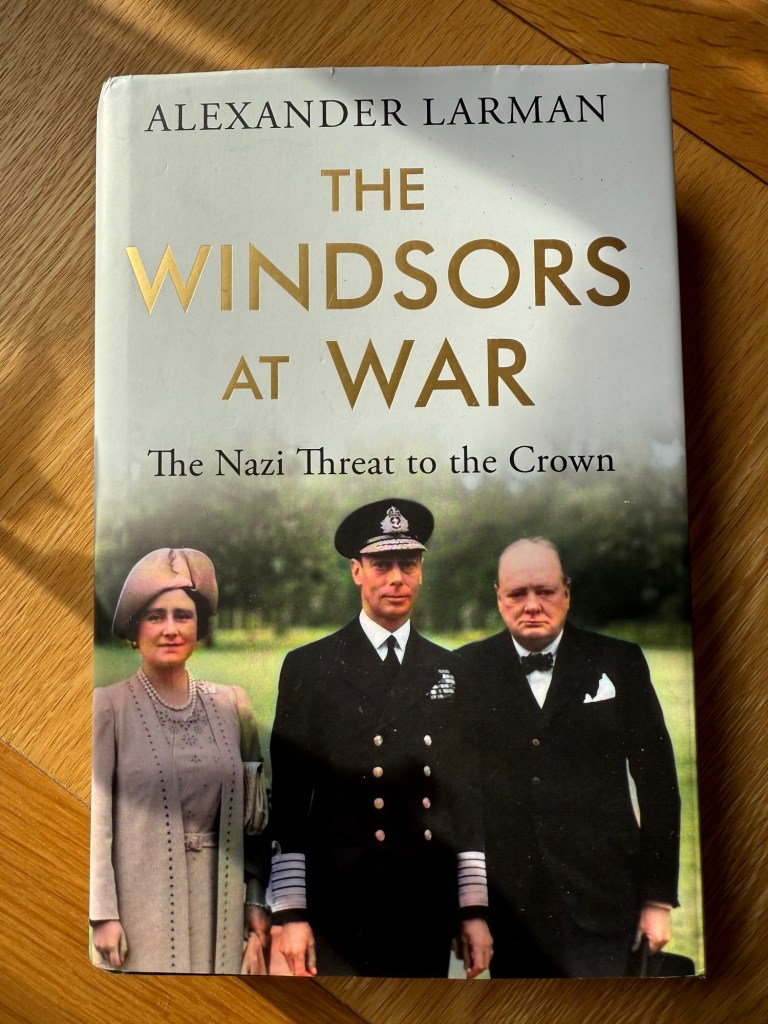
Andrew Larman’s The Windsor’s At War is actually his second book in a trilogy about the Windsors. The first, The Crown in Crisis, followed the events leading up to the Abdication, and this follows the relations between the now-Duke of Windsor and his brother the new King from 1937 and through to the end of the Second World War. The final book in the trilogy is The Power and the Glory and examines what happened after the Duke of Windsor’s wartime activities emerged and finishes with Elizabeth II’s coronation. I’ve only read this one of the three, and I’m not sure this told me anything I didn’t already know – and the writing can be a bit dry at times. But if you’re after an in-depth look at the situation this – and the others in the trilogy – might be a good option for you. I’ll be keeping an eye out for them, at a sensible price of course!
I’m following that with Abdication by Brian Inglis, which was actually written in 1966 for the 30th anniversary of the abdication, by an author who remembered it happening when he was a school boy and who had access to lots of the people involved because they were still alive. And it’s definitely got a different sort of sensibility to the more modern books, but those eyewitness reports are worth it if you’re really interested in the minutae of what went on and already know a bit about the characters. Which I am, and I do. It’s especially good on the political context of the time and who the different non-royal characters were. But probably one for the completists.
Next up is Anna Pasternak’s The American Duchess, which is a 2019 biography of Wallis Simpson originally called Untitled, but renamed for the paperback publication. Pasternak says she’s trying to understand the woman behind the headlines, and as is often the case with Wallis biographies says it’s “her story as it’s never been told before”. Having read that, I would say that the way that it is different is that it is giving Wallis a very easy ride – putting the best possible interpretation on her behaviour and ascribing the worst interpretation to everyone else’s actions. It was published before Lownie’s Traitor King, which led to a re-evaluation of the Nazi sympathies of the couple, but even bearing in mind what was known before that Pasternak glosses over the pre-war visit to Hitler and the events surrounding it. It gives a lot of weight to Diana Mosley’s views on the Duchess – without giving the context of Mosley herself – married to the head of the British Fascists, who was friends with Hitler and wrote an incredibly partisan and gushing biography of her friend. The Anne Sebba is better on pre-war Wallis, the Lownie better on post war.
Talking of Diana Mosley, I have also read her book about The Duchess of Windsor and I cannot recommend it. My goodreads review from back in 2016 reads: “I was expecting this book to be partisan, but it was much, much more biased than I had expected… Worth reading only as a lesson to retain your critical faculties when you read any non-fiction book to remind yourself what the author’s objectives may be.” I need say no more.
Moving on… The Kings Loot by Richard Wallace is a look at the astonishing jewel collection that Edward bought for Wallis and the origins and provenance thereof. Like the Brian Inglis, it’s probably only one for the truly interested because the writing style is hard going. But there is some really interesting stuff in there about Edward VIII’s potential raiding of the royal jewellery hoard which had been gathered from colonising the world and marrying into various European royal families.
There are still a couple of books I’m yet to read – the Phillip Ziegler Edward biography and the Michael Bloch Wallis biography as well any of the Andrew Morton about Wallis. I’ve tried some of the Alan Lascelles diaries and never managed to get through them, but I may yet give them another go. I have the Larman that precedes Windsors at War on the Kindle as well. And of course it’s a source of endless fascination to historians, particularly in the current climate, so I’m sure there will be more in the pipeline…
Happy Humpday

 Verity Reads Books (lots of them)
1 thought on “Recommendsday: Edward VIII related non-fiction”